
Healthcare runs on tech now, but a third of its support workforce can't keep up. Here's how to screen for the digital and administrative skills that actually matter before someone touches a patient record.
- Healthcare's fastest-growing roles are administrative. Administrative healthcare job postings rose 15% year over year, but many applicants lack the foundational digital skills these roles now demand.
- You're not hiring for Epic knowledge. You're hiring for "can this person use a computer." Transferable digital literacy matters more than EHR-specific experience. Test for the baseline so training focuses on your workflows, not on how to save a file.
- A short assessment early in the process can cut your candidate funnel in half — in a good way. When you're getting hundreds of applications per opening, objective skills data beats resume-scanning every time.
Say you're a patient access representative at a busy hospital. A patient walks up to the registration desk, stressed, in pain, and probably running late. You need to verify their insurance, pull up their chart, schedule a follow-up, and enter their information into the EHR. All while maintaining eye contact, showing empathy, and managing the three other patients waiting behind them.
Now imagine you can't figure out how to copy and paste.
This is far beyond a hypothetical problem. Research shows that roughly one-third of U.S. health and social care workers lack key digital skills, with about 12% having essentially no digital skills at all. As healthcare increasingly runs on electronic health records, telehealth platforms, and data-driven care models, that gap is getting harder to ignore, especially for the non-clinical support roles that keep hospitals and clinics actually functioning.
The roles everyone forgets about
When people talk about healthcare workforce shortages, they usually mean nurses and doctors. Fair enough. The Association of American Medical Colleges projects a physician deficit of up to 86,000 by 2036, and the nursing shortage has been headline news for years.
But there's a parallel crisis happening in the roles that don't make the news, including the schedulers, patient access specialists, medical coders, billing staff, call center agents, and administrative assistants who handle the operational backbone of every healthcare organization. Robert Half's 2026 analysis found that employers posted nearly 60,000 administrative healthcare jobs in 2025, up 15% from the prior year. Intake specialist postings alone surged 80%.
The Bureau of Labor Statistics projects medical assistant employment alone will grow 12% through 2034 (much faster than average) with roughly 112,300 openings per year.
These are high-volume, high-turnover roles. And they've changed dramatically in the last decade.
Ashley Earnest, eSkill's Assessment Expert who works closely with healthcare customers, put it simply: "Tech proficiency has become critical. Healthcare today, as everything else, is incredibly tech-driven. When they're hiring for these high-volume roles, patient access reps, call center agents, schedulers, registration staff, it's incredibly important that they understand how to navigate the tech stack."
Remember: many of those openings exist because people keep leaving, and many of them leave because they weren't equipped for the role in the first place.
"Tech proficiency has become critical. Healthcare today, as everything else, is incredibly tech-driven. When they're hiring for these high-volume roles, patient access reps, call center agents, schedulers, registration staff, it's incredibly important that they understand how to navigate the tech stack."
Ashley Earnest, eSkill Assessment Expert
Clinical vs. non-clinical: different roles, different skills, same urgency
One important distinction that often gets lost is that hospitals aren't typically relying heavily on pre-hire assessments to evaluate surgeons or ICU nurses. Clinical hiring has its own credentialing and licensure pipeline.
Where skills assessments do their hardest work in healthcare is on the non-clinical side, where degree requirements are loosening, applicant volumes are enormous, and the gap between "has a resume" and "can do the job" is widest.
“It's patient access reps, call center agents, schedulers, registration staff, medical office assistants,” Ashley explained. “Food service workers, janitorial staff. It spans a broad range."
Many of these roles don't require a college degree, which is both a feature and a challenge. It opens the talent pool wider, but it also means you can't rely on credentials as a proxy for capability.
And the capability bar is rising. Healthcare organizations are closing the digital skills gap as a top workforce priority in 2026, according to UCF's healthcare trend analysis. Despite this, a survey of 1,800 healthcare workers found that only 14% report having "advanced" digital skills. Even for support roles that seem straightforward, like answering phones or scheduling appointments, the actual work now involves navigating CRMs, managing multi-channel communications, entering patient data in real time, and toggling between applications under pressure.
What you should actually be testing for
We have some good news. You don't need to build an assessment that tests for your specific EHR system (although we do have a test for that) when you’re running pre-employment evaluations for healthcare workers.
"There are so many different systems out there,” Ashley said. “What we're looking for is foundational knowledge that can translate to being able to navigate a computer. Basic computer literacy. Do they understand how to use a browser? Save a file? Name a file?"
From there, the testing gets more role-specific. For healthcare organizations using eSkill, a well-balanced assessment might include:
Digital literacy fundamentals. Can the candidate navigate a desktop environment, manage files, and work across multiple applications? This is the baseline, and a surprising number of applicants can't clear it.
Microsoft 365 simulations. Ashley noted that these are some of eSkill's most popular healthcare assessment components, "because they're simulations. It's a simulated environment. You either know it or you don't." For scheduler roles, that means Outlook calendar navigation. For administrative roles, Excel proficiency. For anyone touching documentation, Word.
Multi-tasking simulations. This is where it gets interesting. "These reps need to be able to be doing multiple things at once, answering a chat, working on an email, answering multiple chats," Ashley said. "Our multi-tasking simulations are incredibly popular" among healthcare customers for exactly this reason. The person at the patient access desk isn't doing one thing at a time. They never are.
Cognitive and aptitude questions. Problem-solving, attention to detail, numerical reasoning, active listening. Especially for patient-facing roles. As Ashley put it, "Due to the nature of healthcare alone, it's not always a happy environment. It's emotionally charged. It's imperative that they have the ability to problem-solve, reason with the patient, and process information."
Typing and data entry accuracy. Foundational, and non-negotiable. If someone is entering patient data all day, accuracy becomes a compliance issue, and healthcare documentation is incredibly specific. This can result in turnover, so skills testing can be essential. One client, for example, reduced turnover by 10% for documentation-heavy roles by implementing eSkill’s skills and behavioral testing.
Specific technical skills. There are some roles that will require more advanced digital skills beyond basic literacy. Medical billing, for example, can be complex, so you’ll want to make sure you can hire someone with the right experience and skills needed for the role.
The point isn't to test for everything, because it could weed out strong candidates who either drop out or who have digital literacy but just don’t know your specific tool. Instead, you want to test for the things that predict whether someone can perform on day one and stick around long enough to justify the training investment.
Why "we'll just train them" isn't enough
Every healthcare recruiter has heard this objection: "We train all our new hires anyway, so why bother testing?"
It's a reasonable question with an uncomfortable answer. Training assumes a baseline. If a new hire can't navigate a web browser or type accurately, no amount of EHR training is going to get them up to speed before they're drowning and before the rest of the team is drowning trying to cover for them.
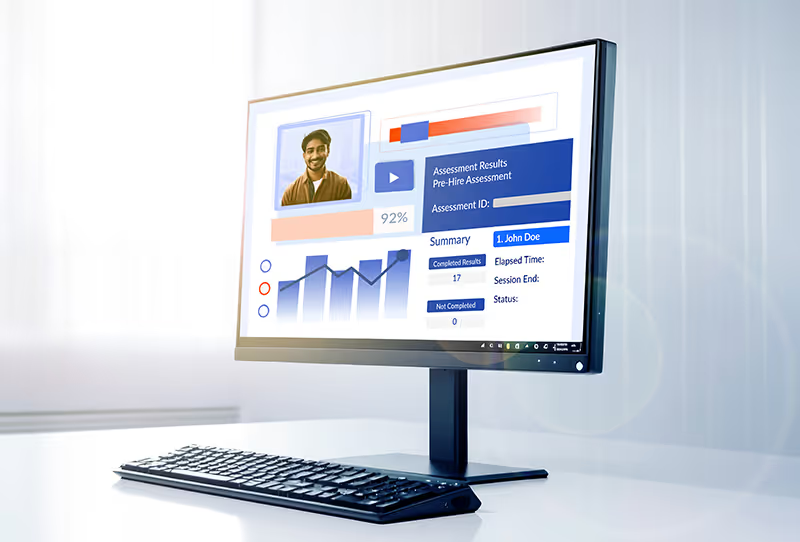
Ashley described how her healthcare customers think about assessment data in high-volume hiring. She shared that assessments early in the process let recruiters filter the candidate funnel quickly based on objective scores, rather than spending hours reviewing resumes that may or may not reflect real capability. Some customers use scores as a knockout; others use them as one data point among several. Either way, it's an additional, objective signal in a process that desperately needs one.
"It's a strong, well-rounded assessment that covers the ideal profile of someone who will perform well from day one," Ashley said, "and ideally be retained for a longer period of time."
That "retained" part matters. When McKinsey projects a global healthcare worker shortfall of 10 million by 2030 and the AHA warns of 3.2 million unfilled U.S. healthcare jobs, every hire that doesn't work out costs you double. The sunk cost of onboarding them, and the opportunity cost of not onboarding someone who would have stayed.
The bottom line
Healthcare support hiring is a volume game with quality-of-hire consequences. The roles are expanding, the applicants are plentiful, the digital skills gap is real, and the cost of getting it wrong compounds fast.
The organizations that are hiring well in this environment aren't the ones relying on resumes and gut feelings. They're the ones adding an objective checkpoint that verifies whether candidates can actually do the digital and administrative work the role demands.
A 15-minute assessment won't tell you everything about a candidate. But it'll tell you whether they can use a computer, manage competing tasks, and enter data without introducing errors into your patient records. That's a pretty good start.
See how eSkill helps healthcare organizations build smarter, faster hiring processes →
Talk to sales to learn more about how the eSkill platform can help you hire.