
Bad hires don't announce themselves. They arrive with strong resumes, say the right things in interviews, and then drain your team from the inside out.
- A bad hire costs far more than the recruiting spend. The U.S. Department of Labor pegs the direct cost at 30% of first-year salary. SHRM estimates total replacement costs at 50% to 200% of annual pay. But there’s also the likelihood of lost productivity, manager time, and team morale, too.
- The hiring environment is making bad hires more likely, not less. AI-polished applications are flooding pipelines with indistinguishable candidates, time-to-fill keeps climbing, and recruiters are under more pressure than ever to hire fast.
- Prevention isn't about adding more steps — it's about adding the right ones. Teams can benefit from structured interviews, behavioral questions that probe real experience, alignment on what the role actually requires, and skills assessments that verify ability before the offer goes out.
There's a Reddit post that's been making the rounds in recruiting circles. The title says it all: "Our first bad hire cost us $180K and nearly killed our company." The comments section is full of founders, recruiters, and HR professionals sharing their own versions of the same story that it’s practically its own genre at this point.
That's because bad hires are shockingly common. Research suggests that 74% of employers admit to having made the wrong hiring decision. Three out of four. And most of them figured it out too late.
The number everyone cites (and why it's low)
According to the U.S. Department of Labor, a bad hire costs roughly 30% of the employee's first-year earnings. On a $60,000 salary, that's $18,000. On an $80,000 salary, $24,000.
But that 30% figure captures mostly direct costs, such as recruiting fees, job board spend, background checks, onboarding, and training that's now been tossed out the window. It doesn't account for the more expensive, harder-to-quantify damage that happens while the bad hire is still sitting at the desk.
SHRM estimates that the total cost of replacing an employee ranges from 50% to 200% of annual salary, with senior and executive roles clustering toward the high end. CareerBuilder data puts the average financial loss per bad hire at $17,000 for entry-to-mid-level roles, but at $240,000 for specialized or executive positions. Talk about a doozy.
And then there's the Toggl Hire 2025 Report, which surveyed over 100 HR professionals and found that while direct costs typically fall between $5,000 and $10,000, the indirect costs balloon to $30,000–$150,000 per bad hire once you factor in wasted training, delayed projects, and the ripple effects on the team.
This is already expensive enough to make us a little queasy. Which brings us to the part that doesn't show up on any invoice.
The costs nobody puts in the spreadsheet
The financial numbers are bad. The human costs are worse.
Ariana Kolaitis, Founder of Koala HR, walked us through what actually happens when a bad hire sticks around for a few months: "That person hasn't worked out for three, four, five months, and you had to let them go. The work then goes back to the team. The overcapacity is stretched thin, and the morale continues to fall."
That tracks with the data. One study found managers spend an average of 17% of their time — nearly one full day per week — supervising poorly performing employees. That's time pulled directly from strategic work, coaching your high-performing people, or doing literally anything that moves the business forward. Another survey put that number even higher, at 26%, which is more than 10 hours a week.
And the manager isn't the only one absorbing the impact. When a new hire can't carry their weight, the rest of the team notices immediately. Deadlines slip, rework piles up, and your experienced team starts picking up the slack on top of their own work. The people who are performing start asking themselves why they're covering for someone who's collecting the same paycheck.
"If you're hiring somebody where there's a skills gap — if you have strong performers that are needing to pick up the slack — it really impacts morale," Ariana explained. “It’s not just the bad hire that gets frustrated, and that can become a retention risk.”
She also shared that the situation also isn’t really fair to the poor-fit employee. Their engagement likely isn't great, and they are not learning or growing. They’d be better off looking for a better-fit role sooner rather than later.
"If you're hiring somebody where there's a skills gap — if you have strong performers that are needing to pick up the slack — it really impacts morale. It’s not just the bad hire that gets frustrated, and that can become a retention risk.”
Ariana Kolaitis
Why hiring has gotten harder, not easier
If bad hires were easy to prevent, 74% of employers wouldn't be admitting to making them. The problem is that the hiring environment in 2026 is actively working against good decision-making.
AI-polished applications have flooded hiring pipelines. Resumes look better than ever and tell you less than ever. Ariana described seeing the same polished language repeated across dozens of applications, noting that some of them all looked practically identical.
But it doesn’t stop at resumes. Candidates are using AI to generate interview responses in real time. Some are subcontracting entire interviews to third parties, and this can be a particularly high risk when interviewing remote candidates.
Meanwhile, hiring processes have gotten longer. Some data shows it can be an average of 62-68 days depending on industry, but some hard-to-fill roles may take longer. Meanwhile, the pressure to fill roles quickly has only increased.
Ariana pointed out that the people's time involved in hiring is itself a major cost: "All of the time and effort that goes into hiring — people's time internally, hiring managers, recruiters, anyone that touches the recruitment process — the hourly rate gets really expensive. Thousands of dollars on people's time during the hiring process, and that could be taking away from revenue-generating activity."
So recruiters are spending more time and money on a process that's producing weaker signals due to a number of factors, including AI. It’s not a great combination, and could increase both the costs and the risk of a bad hire all in one go.
What actually prevents a bad hire
The good news is that most bad hires don't happen because of bad luck. They happen because of a broken (or missing) process, and processes can be fixed.
Start with alignment
Before you write a job posting, before you screen a single resume, everyone involved in the hire needs to agree on what "good" looks like for this specific role:
- What problem is this person here to solve?
- What are the must-haves versus the nice-to-haves?
- What are the deal breakers?
Without that shared definition, you're evaluating candidates against different, unstated criteria, and that's how you end up with a technically strong hire who's a terrible fit, or a culture fit who can't do the work.
"For me, it starts at the very beginning — having a brief that everyone aligns on,” Ariana explained. “We need the business case: why do we need to hire this role in the first place?"
It sounds basic, but it’s a step that many hiring processes skip.
Ask better questions and follow up
Structured interviews dramatically outperform unstructured ones as predictors of job performance. That means asking every candidate the same core questions, in the same order, with a consistent scoring rubric.
The key is pushing past the polished surface. Behavioral questions that demand specific examples — not hypotheticals — are far harder to fake.
As Ariana put it: "Give me an example of a time you had to implement X — what went well and what went wrong. What would you do differently next time?"
Ask for vulnerability, and ask follow-ups. AI can generate a plausible first answer, but it's much worse at generating a real story about a real project that went sideways, and then fielding three follow-up questions about it.
Verify skills before you hire
Resumes are unreliable, and unfortunately, interviews can now be gamed. Even references can be scripted. None of these tell you with any confidence whether a candidate can actually perform the work you're hiring them to do.
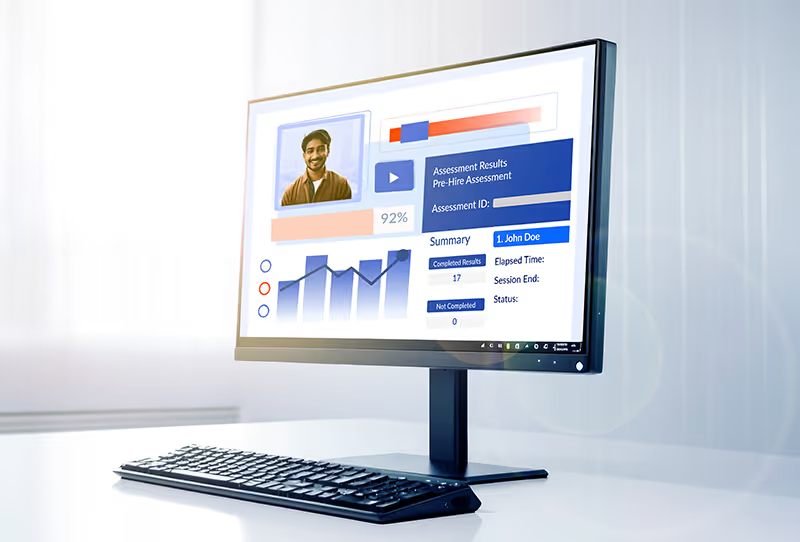
A pre-employment skills assessment closes that gap with objective, role-specific data before the offer letter goes out and the clock starts ticking.
Unlike an interview answer that can be coached or AI-generated, a well-designed assessment measures real aptitude for technical knowledge, cognitive ability, job-specific competencies, and the practical skills that determine whether someone can do the work on day one or will spend months faking it.
eSkill's assessment library covers 600+ subjects and can be customized to match the exact requirements of the role, from hard skills like Excel proficiency or mechanical aptitude to cognitive abilities like problem-solving and attention to detail. You can pair skills data with a strong interview and clear alignment on the role, and you've closed the loop on the three most common sources of bad hires: inflated resumes, impressive-but-hollow interviews, and misalignment on what the role actually demands.
Assess the whole package
Skills matter, but they're not the only thing that determines whether a hire works out. Someone who's technically excellent but miserable in your work environment is a bad hire waiting to happen, and so is someone who thrives in collaboration but gets placed in an isolated, heads-down role.
Ariana made this point well: "We're assessing the whole package — how does someone like to work? If someone prefers working in a team with a lot of collaboration, they won't work well in an isolated role. We're assessing that we're setting someone up for success."
That's where behavioral assessments come in. You can measure work style, temperament, and job fit alongside hard skills to give you a fuller picture of whether this person will actually thrive in this role, on this team, at this company.
The math is simple
Every bad hire that slips through costs your company money, time, management attention, and team morale. Some of those costs are recoverable. Some aren't, and you can't un-burn the goodwill of a strong performer who spent three months covering for someone who wasn't pulling their weight.
The investment in getting it right upfront comes down to a layered hiring approach that may include structured interviews, clear role alignment, and skills verification depending on the role. And the good news is that this investment is a fraction of the cost of getting it wrong.
Talk to sales to learn more about how the eSkill platform can help you hire.