


Remote interviewing used to mean greater flexibility and expanded candidate pools. Now it means navigating deepfakes, AI teleprompters, and candidates who may not even be real people. Here's how to actually evaluate remote candidates in 2026.
- Remote interview signals have become more challenging to interpret. AI tools let candidates generate polished answers in real time, proxy interview services are booming, and Gartner predicts that by 2028, one in four candidate profiles worldwide will be fake. The traditional video interview is no longer a reliable predictor of on-the-job performance.
- One-way interviews help with volume, but they're not a silver bullet. Asynchronous video screens can improve structure and fairness, but they're also susceptible to AI gaming (and many candidates drop out when they encounter them). They work best as one layer in a multi-step process.
- The best defense is a layered evaluation. Behavioral questions that demand specifics, live follow-ups that probe depth, and skills assessments that verify whether someone can actually do the job — not just talk about it.
You know that meme where someone's clearly reading something off-screen during a Zoom call, eyes darting left-right-left like they're watching a very fast tennis match?

Too many recruiting teams have experienced this when holding job interviews for remote candidates now.
Remote interviews were supposed to be the future of hiring. They were faster, cheaper, more inclusive, and accessible to candidates who can't take a half-day off to sit in your lobby.
But between AI-polished resumes that all read the same, real-time cheating tools, proxy interviewers, and deepfake-enabled fraud, the signals recruiters rely on during remote interviews have gotten dramatically worse. This can increase the risk of a bad hire, which is downright expensive and exhausting for your team.
Here’s how to conduct interviews to successfully find top remote candidates, with expert insights from a fractional recruiter who has tackled these challenges directly.
The signal-to-noise ratio has collapsed
In 2023, the biggest concern with remote interviews was maybe a shaky Wi-Fi connection or a candidate Googling an answer while pretending to think. Quaint, right?
By 2025, CNBC was reporting that fake job seekers were flooding remote hiring pipelines using AI-generated profiles and deepfake technology. The CEO of BrightHire told CNBC the number of fraudulent candidates had "ramped up massively." Then, Gartner surveyed 3,000 job candidates and found 6% admitted to outright interview fraud — posing as someone else, or having someone else pose as them. That's the number who admitted it.
And that's before you get to the more mundane (but equally corrosive) problem: candidates using ChatGPT, real-time AI assistants, and screen-side cheat sheets to generate answers during live interviews. According to Computerworld, 72.4% of recruiting leaders said they're now conducting in-person interviews specifically to combat fraud. Google, Cisco, and McKinsey have all re-instituted in-person interview rounds.
But not every company has that luxury. If you're hiring for remote roles — and many companies are — you need a way to evaluate candidates without the built-in safeguards of a handshake and a conference room.
What you're actually up against
Let's catalog the threats, from old-school to dystopian:
Proxy interviewing. Someone else shows up for the interview. The real candidate appears on day one. This has been happening for years, but remote work made it trivially easy. No lobby check-in means no photo ID at the front desk.
Real-time AI assistance. Candidates run ChatGPT or specialized "interview helper" tools on a second screen (or, increasingly, on the same screen with transparent overlays). Their answers are suspiciously articulate. Their pauses are just long enough to read a response. One recruiter told Business Insider that candidates "frequently looked off to the side" and "copied and pasted full blocks of code instead of typing step-by-step." Subtle.
AI-polished everything. Even before the interview, candidates use AI to produce resumes, cover letters, and assessment responses that are indistinguishable from one another. Ariana Kolaitis, Founder of Koala HR, explained how obvious this can be: "A lot of the time, the resumes and responses to application questions look very similar, sometimes even across dozens of applicants. It becomes uncanny and easy to spot."
The cumulative effect? The traditional interview — even the remote version — has become a worse predictor of job performance than it already was. And it wasn't great to begin with.
"A lot of the time, the resumes and responses to application questions look very similar, sometimes even across dozens of applicants. It becomes uncanny and easy to spot."
One-way interviews: helpful tool or candidate repellent?
One-way (asynchronous) video interviews have surged in popularity as recruiters try to screen higher volumes of candidates without scheduling dozens of live calls. Candidates record video responses to preset questions on their own time, and recruiters review them later.
There’s a clear upside. These interviews are structured, they scale well, and can reduce scheduling bottlenecks. They also give every candidate the same questions, which can improve fairness compared to unstructured live interviews where the conversation wanders.
The downside, though, is clear. Many candidates don’t enjoy them, and that dislike can turn to disdain when AI is used in the process. Research from Greenhouse found that 38% of candidates withdrew from a hiring process specifically because it included an AI interview, which is a live and responsive interaction between a candidate and an AI tool. They feel impersonal, and they don't let candidates ask questions, read the room, or build rapport. For competitive roles, that can mean losing strong candidates who have better options.
And now, there’s another issue at play. One-way interviews are also susceptible to AI gaming from the applicant’s side. A candidate can take as long as they want to craft a response with the help of ChatGPT. Without live follow-up, there's no way to probe whether the answer reflects real knowledge or a well-prompted chatbot.
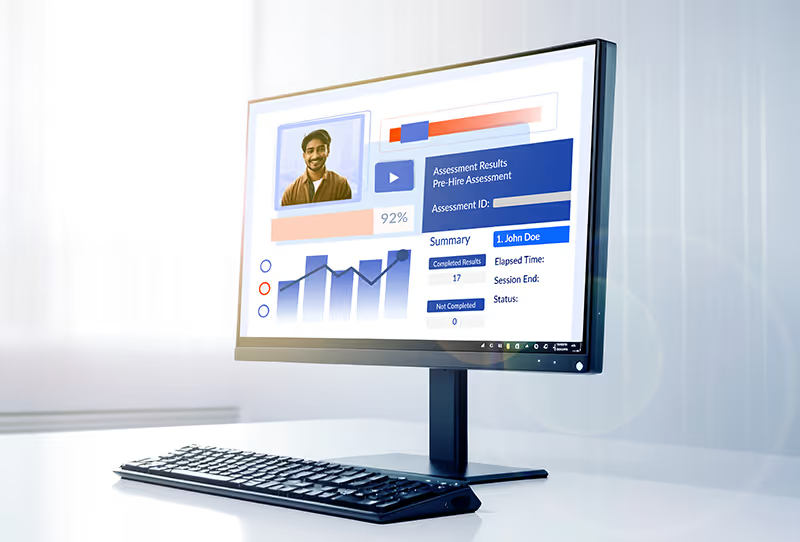
As a result, one-way interviews work best as one layer in a multi-step process. They can still be used to reduce bottlenecks and filter out poor-fit candidates, but they shouldn’t be your entire interview process. eSkill's one-way interview feature is designed with this in mind, giving you a screening tool that complements, rather than replaces, deeper evaluation.
The eSkill platform even has built-in anti-chat capabilities, including test timers to reduce the opportunity to “find” the right answer by way of Claude and AI-powered proctoring features that can lock down a candidate’s browser and flag suspicious behavior.
Talk to sales to learn more about how the eSkill platform can help you hire.
How to actually evaluate remote candidates
So, remote interviews may not tell the whole story, one-way interviews have limits, and the AI arms race isn't slowing down. What do you actually do?
Ask behavioral questions that demand specifics
Ariana's go-to strategy is to push past the polished surface: "Tell me about your experience with X. Give me an example of a time you had to implement Y — what went well and what went wrong." The key is asking for vulnerability. "How they work in that kind of a situation tells you a lot. Open questions, not closed yes-or-no. You can dig deeper."
AI can generate a plausible STAR-method response. It's much worse at generating a specific, messy, human story about a project that went sideways, and then fielding follow-up questions about it.
Watch for the signs
You can easily see eyes tracking text on another screen, or track unnaturally long pauses followed by unnervingly fluent answers. And when it comes to application questions or written assessments throughout the interview process, you’ll likely notice answers that sound like they were written by the same very helpful, very articulate robot.
"ChatGPT has become somewhat obvious with the certain tone that it uses," Ariana noted. "It becomes really obvious when you're reviewing hundreds of applications, and you have applicant after applicant sending nearly the same generated responses."
"ChatGPT has become somewhat obvious with the certain tone that it uses. It becomes really obvious when you're reviewing hundreds of applications, and you have applicant after applicant sending nearly the same generated responses."
Probe depth, not breadth
Instead of covering ten topics superficially, pick two or three and go deep:
- Ask candidates to walk you through their decision-making on a specific project.
- Ask what they'd do differently.
- Ask them to explain a concept to you as if you were new to it. Real expertise holds up under follow-up questions.
AI-assisted answers tend to collapse one or two layers down. Getting applicants to ask why they made specific decisions ensures they understand the technical concepts behind the answer, which is invaluable.
Assess the whole package
Technical skills are a critical part of finding the right remote candidate, but it's just one layer of the screening process – top talent will have more than the right skills.
"It's not just skills we're looking for. We're assessing the whole package. How does someone like to work,” Ariana explained. “If someone prefers working in a team with a lot of collaboration, they likely won't work well in an isolated role where it's more independent. We're also assessing that we're setting someone up for success."
Remote interviews should evaluate work style and communication fit to ensure that even the most technically-sound applicants will be a good fit. Since they’ll be working remotely, for example, it’s essential to make sure they have the right self-discipline to do so.
Verify technical skills independently
Plenty of people can talk a good game, but may lack the skills you actually need in practice.
This is where pre-employment skills assessments earn their keep. A well-designed skills test doesn't care whether a candidate has a second screen open, because it measures whether they actually know the material.
Unlike an interview answer that can be coached or generated, a timed, proctored assessment with anti-cheat tools provides objective data on what a candidate can actually do. Pair that with a behavioral assessment, a one-way interview, and a live interview, and you have a variety of independent signals instead of one easily-gamed one.
That said, you’ll want to match the rigor of the process to the stakes of the role, because not every role will require each stage of this process, and going overboard can result in candidates dropping out. Select the layers that make sense, and filter as you go.
The process isn't broken. It just needs more layers.
Remote interviewing isn't going away, and unfortunately, neither is AI-assisted candidate fraud. The recruiters who will hire well in this environment aren't the ones clinging to a single interview as the sole evaluation method. They're the ones building processes with enough layers that no single point of failure can sink the hire.
That means the right approach is a layered one, designed to understand both the technical skills and the cultural fit of every candidate. It can include:
- Structured interviews with follow-up depth
- One-way video for efficient screening
- Skills assessments to verify what candidates claim they know.
Remember: The interview tells you who a candidate appears to be. A skills assessment tells you what they can actually do. You need both.