

Why candidates abandon job applications, what causes drop-off throughout the hiring process, and how to keep candidates engaged without lowering your hiring standards.
- Candidate drop-off is a major hidden hiring problem. Many applicants abandon applications before submitting, often because the process feels too long, repetitive, clunky, or not worth the effort.
- The biggest friction points are bad application UX, poor communication, too many hoops, and growing discomfort with AI-driven hiring.
- Employers can reduce drop-off without lowering standards by making the process clearer and more candidate-friendly. That means mobile-friendly applications, time estimates, fewer redundant steps, better communication, transparent AI usage, and role-relevant assessments that provide hiring signals without wasting candidates’ time.
If you’ve applied to a job in the last two decades or so, you understand the frustration of having to re-type everything on your resume into an ATS that just can’t seem to parse any document — PDF, .docx, .txt, come on — correctly.
On top of that particular frustration, there are usually other requirements — like cover letters, free-response questions, screening questions, references — that extend the time to complete an application. Invite a candidate to an interview with an AI bot or send them an hour-long test before they’ve even personally heard from anyone in HR, and you may have created the perfect storm for an unhealthy candidate drop-off rate.
According to LiveCareer’s 2025 Job Search Frustration Survey, more than half (57%) of applicants quit a job application before clicking submit. By another estimate (a 2022 SHRM article citing a report from programmatic job advertising platform Appcast), the percentage of candidates that never complete job applications after hitting “Apply” may be as high as 92%. Conversely, in Employ’s 2025 Job Seeker Nation Report, 43% of respondents said that “an easy application process” had the greatest impact on their impression of a company during the interview process.
Even though the process of applying through an ATS may have become less frustrating on the whole as newer platforms have gained ground, overall candidate frustration with the hiring process has gone up as times-to-fill have gotten longer, communication with candidates poorer, and AI tools like interviewing agents more popular.
Talented candidates may decide these applications just aren’t worth their time. In fact, the majority of Americans think the application process should take less than 30 minutes, according to a 2025 study from Employ, Inc. Additionally, about half (49%) of job seekers say most application processes are “too long and complicated,” according to Indeed’s 2024 Workforce Insights Report. A third (33%) said they’d abandon overly complex application processes.
The employment market is also increasingly competitive. According to a report from ATS platform Bamboo HR, the number of US applicants per role on their platform has doubled since 2021, from 46 applications per open role in 2021 to 95 in 2025, though the number of job postings has stayed largely flat. Bamboo HR also found that the hiring rate has fallen over that time period — from from 4.5% to 2.8%.
This is backed up by additional data from ATS platform Ashby. On their platform, applications have tripled: throughout 2025, each open role received more than 300 applications on average, increasing from roughly 100 in early 2021.
Part of that increase comes from LLMs making it easy to mass-apply to many positions, but it also comes from an increase in layoffs flooding the hiring pool with capable candidates, a slowdown in hiring in many fields, and the proliferation of ghost jobs bloating job boards. More candidates are sending out more applications in a market that’s hiring fewer people, not more — even if job boards look stable.
Some candidates are applying for hundreds of roles within the same week, increasingly with a spray-and-pray approach. If your hiring process is too lengthy and complex, they may simply abandon one job opening in favor of another.
But then again, if you make it too easy to apply — take LinkedIn’s “Easy Apply” button — you could get inundated with low-quality applications that are impossible to wade through. Make that double for 2026, since AI-tailored applications are that much easier to produce en masse.
So, how do you split the difference — design an application workflow that encourages talented candidates to click “submit” and stick with it through the entire hiring process, but isn’t so easy that it becomes impossible to find talented candidates in the mess of applications?
It’s a big question, so let’s start with an important definition.
What are candidate drop-off rates?
Broadly speaking, candidate drop-off rates measure how many candidates leave the hiring process before reaching the next phase in the process. This can happen at any point, from the moment someone clicks into an application to right before the final hiring decision.
The most useful way to measure candidate drop-off is by looking at specific stages in your process.
For example, application drop-off measures how many candidates start an application but never submit it. These may include qualified applicants who decide the process is too long, too repetitive, or simply not worth their time, especially for roles where candidates have other options.
Drop-off can also happen after an application is submitted, during the screening stage, before an interview, after an interview, or while candidates are waiting for a final decision. Long delays, unclear communication, or redundancies in the application process can all cause people to disengage before the hiring process is complete.
Looking at candidate drop-off for each of these steps in turn can help you determine where your hiring process could use some tuning-up.
ATS friction
41% of job seekers think that fewer than a quarter of the applications they fill through an ATS make it to a real person.
Additionally, according to a report from job board Monster, nearly half of those surveyed (45%) said ATS systems made them more likely to apply to jobs more broadly, with 21% believing that “many resumes are screened out automatically.” An additional 22% said they use Quick Apply options to save time, and 14% said they focus on keywords rather than job fit in their applications.
Bad ATS experiences encourage applicants to cast a wider net, or make use of rapid-fire (if buggy) AI-application bots, browser extensions, LLM chatbots, and autofill tools that apply for jobs on their behalf.
That may help candidates submit more applications, but it does not necessarily help employers identify better candidates. Mostly, it just adds more volume to an already crowded funnel.
While a frustrating ATS experience can cause high drop-off rates that drive cost-per-application and cost-per-hire up and additionally increase time-to-fill, designing an initial application process that invites a flood of resumes doesn’t exactly make the process any easier (or cheaper) either.
Splitting the difference — designing an application process that is transparent and allows exceptional candidates to stand out, that at the same time is not overly complex — starts with improving candidate communication, and designing hoops that are effective for singling out competent candidates (not just an extra useless step in the process). At the same time, these hoops need to be reasonable to the candidate — many talented applicants may drop out if they’re faced with an AI interview or a seemingly irrelevant assessment.
Too many hoops, too much waiting
Another primary cause of candidate drop-out is a long hiring process, beyond the application phase. In Talent Board’s 2016 Candidate Experience Research Report, 47 percent of candidates were left waiting two or more months for a response after submitting an application.
SHRM reports that the average time-to-fill is 42 days. However, HR thought leader Dr. Sullivan suggest making hiring decisions within 10 days to avoid losing candidates — especially the very best ones, who may receive offers from competitors. Taking too long to schedule or complete interviews, or waiting too long between hiring steps, can cause candidates to look elsewhere.
However, this may become a bigger friction point as the time-to-hire lengthens across hiring as a whole. According to a report from Robert Half in HR Dive, the hiring process has become both more time-consuming and more costly. Almost all (93%) of hiring managers surveyed said the process took longer in 2025 than just two years ago. This is due to the volume of applications, plus the time needed to evaluate applications, check references, conduct background checks and schedule and conduct interviews.
That also translates to more hoops and time-to-hire on the candidate side. In Monster’s 2024 Work Watch Report, 36% of respondents said they had dropped out of the hiring process post-application because they had been asked to jump through hoops, such as completing unpaid assignments or go through multiple rounds of interviews.
But even despite time-to-hire lengthening overall, there is a confounding problem that can lead to increased candidate drop-off: poor communication.
Poor (or nonexistent) communication
In the 2024 Monster Work Watch Report, the top reason candidates cited for withdrawing their applications was poor communication from employers — with almost half (47%) of respondents citing it as their top frustration. Similarly, the top frustration in the 2025 Job Search Frustration Survey from LiveCareer was not hearing back from employers, at 35%.
Candidates who don’t hear from your company in a timely manner are likely to lose interest.
HR director Ken Meyer put it best in this SHRM article: “I don't like it when hiring managers say to recruiters, ‘Keep the candidate warm’ [i.e., prolong the hiring process by staying in touch but not making an offer or refusal]. We're dealing with real people and can't treat people like we’re heating up a burrito. While we do not want to hurry employment decisions, we want to act quickly.”
Candidates aren’t burritos. Treat them like people — and let them in on what’s going on in-between hiring stages. That goes double for communication during the interview. (The interview, in fact, may be the most important part of the hiring process to candidates, according to a Gallup poll: 44% of workers surveyed said the interviews they had with the people who hired them had the most influence on their decision to accept the job offer.)
And of course, even if you reject a candidate, it’s important to show appreciation for the time they’ve invested in participating in your hiring process. Just look at all the beans this woman received:
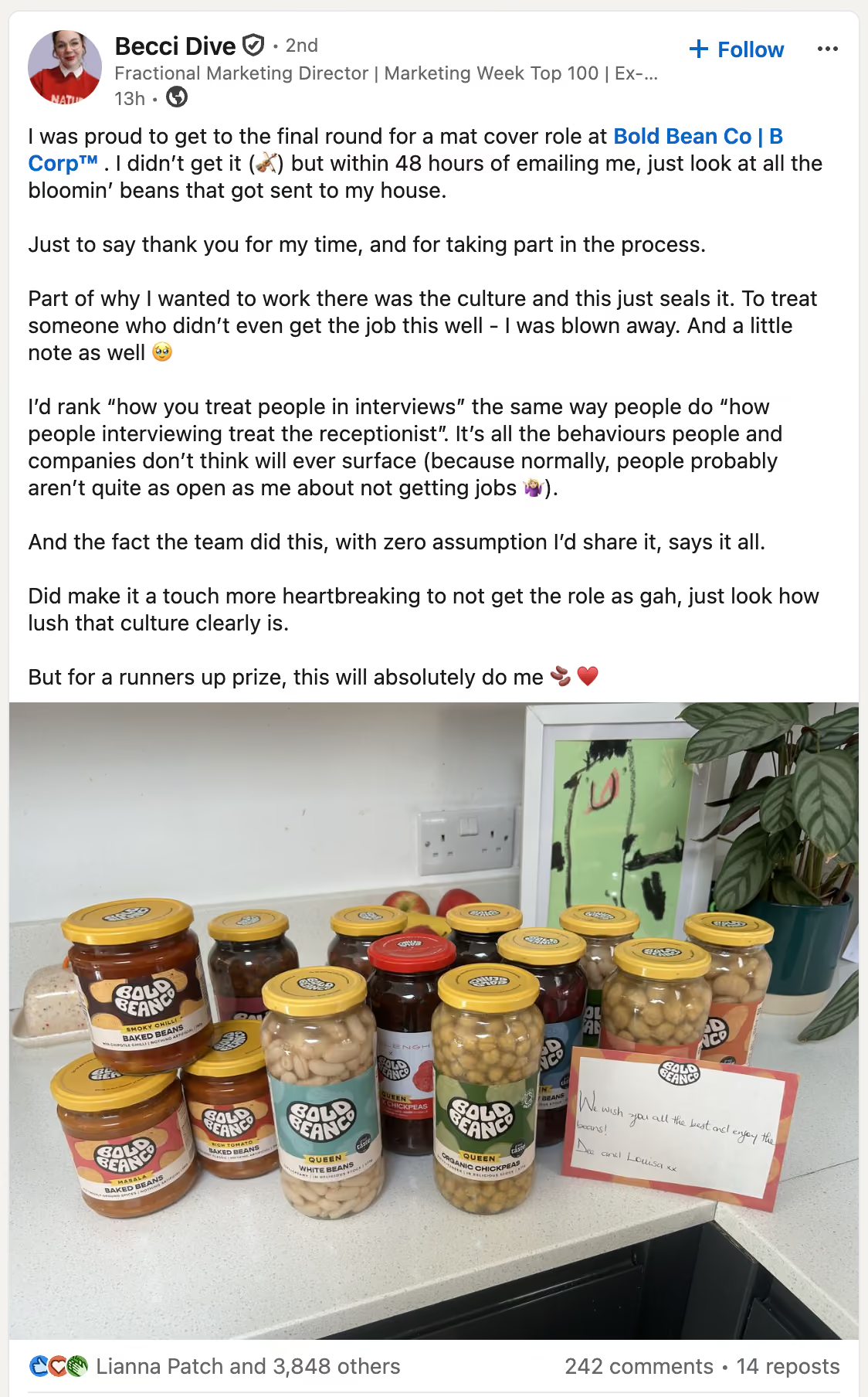
Look at that engagement rate. Do you want to be Bold Bean Co.? Or do you want to be one of those companies who sends an impersonal, form email to a candidate, even after making them jump through hoops and go through several interviews? Or worse, one of the companies that ghosts candidates entirely?
In the age of AI
AI is already instrumental to many recruiting processes. In fact, it’s the top HR function where companies are using AI, according to 2025 research from SHRM.
But what if recruiters don’t tell candidates anything about it?
Common misstep. Candidates want to know if AI is involved.
Transparency in hiring includes how companies use AI in the hiring process. In some states, it is (or will be) legally mandated. Research from ServiceNow found that “90% of job seekers said they want companies to be upfront about how AI is used in recruiting and hiring.”
According to data from Gartner reported in HR Dive, more candidates (26%) last year said they’d drop out of an application process if it included AI, up from 21% two years prior.
It also depends on where AI is used: Job seekers are uncomfortable about companies using AI to screen resumes and make decisions about applicants. However, they don’t mind companies using AI to schedule interviews and reach out to potential candidates as much. They’re also particularly uncomfortable — and likely to drop out — when AI is used in the interview.
According to a recent article from The Guardian, candidates in the UK find AI interviews “awkward and humiliating.” According to data from ATS platform Greenhouse, over half of job seekers have done an AI interview — and additionally found that 38% of candidates had withdrawn from a hiring process because it included an AI interview.
If you’re in search of talented candidates and want to streamline your process, consider that many may drop off the hiring process if they encounter these types of bots.
Talk to sales to learn more about how the eSkill platform can help you hire.

See you at the party?
Just as applicants are experimenting with new (and old-school) ways to get the attention of employers in a flooded market, hiring managers, too, are trying new ways to find talented applicants — including by expanding their outbound recruiting efforts. According to a report from Glassdoor, the percentage of recruiter-sourced candidates increased from 8.6% in 2023 to 14.8% in 2025, a 72% uptick overall.
According to a survey from Zety, a resume templates service, reported in HR Dive, on recruiting outside of traditional funnels, 59% of those surveyed said they felt very comfortable finding candidates outside of work, and a little over half (53%) said they’d already done so. They sourced candidates at restaurants, grocery stores, parties, and airports — and on other online mediums including social media outside of LinkedIn. Recruiters tend to notice strong communication and interpersonal skills in these contexts, and surprisingly, 84% of those surveyed said they found solid candidates this way, compared to formal channels.
Despite all that, online applications still reign in terms of applicant volume and hiring outcomes, according to Glassdoor data. Even in the age of AI, online applications led to twice as many interviews and 1.5 times as many job offers compared to all other sources combined.
How testing can help
One article from Fortune makes the bold proclamation that members of Generation Alpha, i.e. those born roughly between the years 2010 and 2024, may never have to write resumes at all — instead, they may simply be taking batteries of personality and skill assessments. While that may be a bit of a stretch, many employers do like personality and skills testing as proxies for job ability — but that’s only relevant if the tests are actual predictors of job performance (and seem relevant to candidates too, by the way).
That may mean skipping broad personality assessments and hour-long generalized tests and instead opting for short assessments on job-specific knowledge and skillsets. Tailored testing can give applicants a concrete way to demonstrate what they know, and help employers identify qualified candidates more efficiently.
But assessments only work if they fit into a thoughtful hiring process. If they are too long, poorly timed, or paired with impersonal steps like AI interviews too early in the process, they can contribute to candidate drop-off instead of helping talented candidates stand out.
eSkill’s assessment experts recommend keeping tests under 20 minutes to encourage completion rates — and customizing the assessment to meet the needs of the position, which often includes mixing and matching questions from two or three subject types.
Balance, in everything
Of course, the “right” amount of friction in the hiring process depends on what you’re hiring for.
If you’re hiring for a high-volume role with modest pay, limited benefits, seasonal demand, or urgent staffing needs, a lighter-weight process may make more sense, as some candidate drop-off is expected. Candidates may not be willing to complete a long application or wait weeks for a response — especially if they can find similar work elsewhere.
In these cases, the goal should be not to remove standards entirely, but to focus on the few requirements that actually predict whether someone can do the job at hand: reliability, basic skills, availability, work ethic, and the ability to follow directions.
For more selective roles, the equation changes. If you’re hiring for a specialized position with a smaller talent pool, candidate drop-off matters much more. A long process may be necessary, but it also needs to feel purposeful. Candidates are more likely to tolerate assessments, interviews, work samples, or multi-step evaluations when they understand why each step exists, how long it will take, and when they can expect to hear back.
In other words, the more selective the role, the more communication matters. You can ask more of candidates, but you have to give more in return: clear timelines, regular updates, context for each step, and indicators that a real person is paying attention. Otherwise, strong candidates may assume the process reflects the company culture and move on.
A good rule of thumb: match the process to the stakes of the hire. High-volume hiring should be fast, focused, and easy to complete. Selective hiring can be more rigorous, but it should also be transparent and highly communicative. In both cases, the goal is the same: reduce unnecessary friction without lowering hiring standards.
It might start with your ATS — but it doesn’t end there.
And don’t forget to send the beans to your burritos (translation: thoughtful emails to your candidates).
Oh, and maybe add some salsa (translation: skills testing in your hiring process).