

As industrial work goes digital, the line between blue and white collar work is blurring fast. “Gray collar” is solidifying as the term to describe the hybrid skillsets and responsibilities expected within these roles.
- Gray collar work has been forming for decades. Blue and white collar roles were once clearly divided. But by the early 2000s, mechanics and factory workers were expected to have digital skillsets as well — setting in motion today’s blend of hands-on and digital labor.
- Modern manufacturing is a software-driven, skills-hybrid industry. Clean, automated factories now rely on cobots, sensors, digital twins, AI, and data systems, meaning workers constantly switch between physical tasks and digital tools. That makes most traditional blue-collar roles effectively gray collar.
- Hiring is shifting from degrees to skills testing. With millions of manufacturing jobs to fill and more Gen Z and white-collar workers moving into the trades, employers increasingly need to assess both technical fundamentals (like blueprint reading and mechanical reasoning) and digital fluency to hire successfully for these new gray collar roles.
Collars have a long, messy history of colors and career associations. Once, it was simple: blue or white. Now it’s a whole spectrum — green, gold, gray, purple, red, and on and on.
Each additional shade has its own origin story and contested definition. But we’re here to track the history of just one: gray.
Let’s shuffle into the Wayback Machine. Come on in, there’s room. Watch your step.
We’re going to 2006, the year of the Nintendo Wii (among other things).
Ready for launch?
We land on August 10th. The Pittsburgh Post-Gazette has just published an article about the growing rainbow of collar colors.
Green collar work, the writer explains, belongs to environmentally focused fields. Gold collar workers sit at the top of the pay scale — doctors, lawyers, investment bankers. And pink collar jobs are roles traditionally held by women.
But the least defined term, she notes, is gray collar.
It could mean workers past retirement age. Or underemployed white-collar professionals. The article doesn’t yet describe what the term would come to represent: the fusion of blue- and white-collar work, and the blend of physical labor and digital skill that now defines modern manufacturing.
Not explicitly, anyway.
Then, a few paragraphs later, this line appears:
“For example, even a traditional blue collar worker such as a mechanic now has to have computer and electronic skills to do the job.”
And there it is. It’s early evidence of the trend that has come to define industrial work today. And though the term “gray collar,” as we refer to it, has only begun to enter the broader lexicon, the wheels have long been set in motion.
So what is gray collar work?
Back in the mid-1900s, the divide between blue and white collar work was pretty concrete. Office work stayed in the office. Hands-on industrial work mostly remained hands-on.
The term white collar came first. Popularized by Upton Sinclair, that well-known muckraking journalist from the 1900s, the term was used to describe office and clerical workers who wore white dress shirts. By the 1920s, the term appeared widely as office work expanded and could assert itself against a convenient foil: industrial work.
The contrasting term blue collar arose in the 1920s, named after the durable blue denim and chambray shirts workers wore. By the 1940s, the term blue collar, with help from white collar to serve as its antithesis, became essentially standardized. The two terms served as opposites for a long time, and the contrasting definitions continue to reign even as the line between them blurs.
Looking from the other end, there’s still no widespread consensus on what a “gray collar” role is. This article from 2009 refers to gray collar jobs as maintenance and custodial roles. (Yes, we’re still in the Wayback Machine. Hope you’re not dizzy.)
And a recent report from Ernst & Young defines four collar colors — your typical white and blue, but also green collar, which they say represents “the new category of digital AI agents” (sorry, wind turbine engineers) and gray collar workers, which are “physical AI agents” that work alongside blue collar employees in warehouses and factories.
So depending on who you ask, gray collar might mean:
custodians,
older workers delaying retirement,
underemployed office staff,
or even robots.
But here’s one more emerging definition, and it’s the one we like best: roles that combine both traditional blue collar factory work and white collar digital work — which is becoming increasingly common as industrial sectors integrate more sophisticated tech.
Wikipedia agrees with us. They define gray collar as a “category [that] requires more intellectual labor than would be required of a blue-collar profession and more physical labor than would be required of a white-collar profession.”
But we want to take it a step further. We argue that all blue collar roles are now gray collar. As digital skills become more and more tablestakes, blue collar roles all involve some level of tech know-how.
Manufacturing goes digital
Manufacturing today looks nothing like the dim, greasy factory floors people still picture from the past.
Factories are “smart” now — high-tech environments where technical literacy is just as essential as mechanical skill. Modern plants are clean, highly automated, and increasingly software-driven, with cobots, sensors, digital twins, edge AI tools, federated learning applications, and connected machines handling much of the heavy lifting while humans oversee it all from the comfort of cabs and tablet interfaces.
The manufacturing industry, in fact, makes up the lions’ share of all private-sector R&D spending in the US, at 52%.
And as a result, the skills needed within manufacturing and the industrial sector are changing, too. One 2024 report from Deloitte and the Manufacturing Institute puts it a little more eloquently, saying the “evolving landscape of skill requirements and the rearchitecting of roles” will likely be required in the “journey toward the smart factory and Industry 4.0.” The report also references the World Economic Forum’s 2023 Future of Jobs report, which found that 40% of existing skill requirements in advanced manufacturing would evolve in the following five years.
They also reference a study where half of respondents said it was “important” or “very important” for employees to have a high level of digital proficiency. And the report found that the most sought-after skills in manufacturing were in software simulation, enterprise information management, and cloud computing.
The report goes on to state that with the increased adoption of digital tools, soft skills like adaptability, problem solving, and critical thinking have also come to the fore. As an example, the report points to the need to evaluate outputs from AI tools, like generative AI, and the need “to process data mined from interconnected machines.”
But of course, as the report goes on to state, “digital and soft skills alone are generally not enough — for employees to successfully apply these skills, it tends to be important to have a strong foundation in the fundamentals of manufacturing.”
And that’s where the hybrid need for blue (the old skillset) and white collar (the new skillset) know-how comes from.
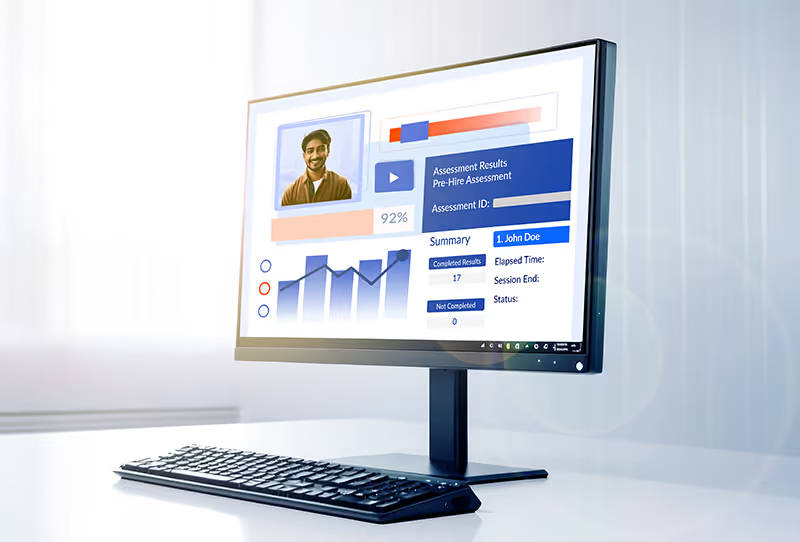
Talk to sales to learn more about how the eSkill platform can help you hire.
The growth of blue and gray collar roles
Over 30% of the fastest-growing jobs in the US are blue-collar roles, with over 1.7 million new job positions projected by 2032, according to the Bureau of Labor Statistics (and this guy in Forbes). Reflecting that, some estimates put the total at 3.8 million net new employees needed for manufacturing between 2024 and 2033. However, over half of these positions could remain unfilled, unless the skills gap is solved.
Yet even growing salaries for blue collar roles and the prospect of job stability aren’t attracting skilled applicants — likely because the people with the right training simply don’t exist.
And as the industry continues to progress toward Industry 4.0, manufacturers will continue to struggle to fill roles across all skill levels, not just more skilled ones. Unless, of course, they can hire, train, and retain the increasing numbers of Gen Z and dissatisfied white collar workers who are looking to industrial roles for fulfillment.
Gen Z ditches the 4-year degree
Recent college grads are struggling to find jobs. As worldwide rates of unemployment for young workers reach new highs and entry-level roles begin to disappear (allegedly due to AI), many young Gen Zers are looking to pursue the skilled trades rather than white collar roles.
According to a report from Resume Builder, “42% of Gen Zers are currently working in or pursuing a blue-collar or skilled trade job, including 37% of those with a bachelor’s degree.” Their top motivations include “avoiding student debt and reducing the risk of being replaced by AI.”
As manufacturing and other industrial fields seek to appeal to new workers through on-the-job training, apprenticeship programs, and promises of development, it’s looking like a fine choice for younger, digitally-savvy generations.
White collar goes blue collar
It’s not just Gen Z that are looking to pursue industrial roles rather than white collar opportunities. Regardless of collar color, employees want job security and financial security. As AI threatens traditional office work, many want to pursue the always-in-demand, clean, smart factory roles.
According to a report from FlexJobs, 62% of white collar workers say they would switch to the skilled trades for more job stability and pay.
Testing for gray collar roles
It’s clear blue collar roles are changing. The skills demanded in these roles are evolving. And though some white-collar professionals and Gen Z grads are looking to enter the blue collar workforce, there’s still a notable skills gap for manufacturing — and other industrial industries — to contend with.
As we’ve mentioned, digital skills are a primary need among new hires for manufacturers. Working with cobots on the assembly line. Setting standards for production. Even billing someone on an iPad, for small-business HVAC technicians or plumbers.
But traditional blue collar skills, and on top of that, social skills, are also necessary for this type of work. Employers still need to verify fundamentals like blueprint reading, mechanical reasoning, measurement, and safety awareness.
Changing skill requirements have prompted some companies to employ a “skills-based” approach that focuses on employees’ abilities and competencies — instead of their job titles or formal qualifications, better aligning workers with work that fits their skills and capabilities.
Now, let’s go to the future. In the, um, WayForward Machine (the name is a work in progress).
Factories are intelligent systems built around sensors, AI, and real-time data, where production lines adapt automatically to demand and changes in the supply chain. Instead of relying on manual oversight and reactive fixes, plants operate through dashboards and digital twins that simulate outcomes before changes are made.
These “gray-collar” jobs are the norm, replacing the old divide between blue- and white-collar work. A machinist might also be a robotics technician; a maintenance worker might also analyze performance metrics.
Hiring is shifting away from degrees and toward proven skills. The result is an industry that is less about repetitive labor and more about technical problem-solving — high-tech work in a hands-on environment.
In the future, industrial employers will expect both digital and traditional hands-on skills. And that’s what gray collar is about.