

Proxy interviewers, fake test takers, and applicants using AI tools to write resumes, cheat on assessments, and excel in interviews are taking over job applications. Here’s what hiring teams can do.
- Fraud in hiring is escalating from old-school proxy test-taking and interviewing to high tech scams. Recent cases include a $1M Texas teacher certification ring, agencies offering professional proxy interview services, and FBI warnings about deepfakes and lip-syncing in remote interviews.
- AI tools and remote work have amplified risks. Candidates using AI to fake skills or deepfakes to impersonate others and large-scale operations (like North Korean cyber operatives) that infiltrate the job market raise both hiring quality and security concerns.
- Companies are responding by reverting to in-person practices. Firms like Google and McKinsey are reintroducing in-person interviews as a safeguard against AI-assisted and proxy-driven cheating.
- Using anti-cheat tech and AI proctors can combat some of these bad actors. Employers can fight tech with tech, introducing solutions like AI proctoring and digital tools like browser lockdown to prevent proxy and AI test taking.
Five teachers and school administrators made headlines in Texas last year for running a $1 million scam ring in which proctors, bribed into agreement, allowed test taker impersonators to complete exams on behalf of applicants, certifying hundreds of unqualified teachers in the process.
The scheme dated back to 2020, and at least 400 fraudulent tests were taken in the course of the four years before it was discovered. The head of operations? A basketball coach at a public school in Houston.
Hard to believe? It’s not the only case of proxy test taking or job application scams lately.
On top of fake Texas teacher certifications, we have the case of a woman showing off her acai smoothie bowl on TikTok leading to her arrest for running a laptop farm on behalf of North Korean cyber operatives posing as remote workers (yes, really), deepfake-using interview scammers, and companies like Google moving back to in-person interviewing to prevent AI-assisted test taking and interviewing fraud, among other headline-worthy hiring problems.
Will it ever end?
The short answer: probably not.
One study from 2020 found that 78% of job seekers “admit they did or would consider misrepresenting themselves on their application” — i.e., lie to get hired.
And with the faltering job market and increasingly advanced AI tools added to the pot, your run-of-the-mill proxy interviewing and test-taking schemes (where applicants hire someone else to interview or take a hiring test for them) now seem rather old-school.
AI tools, increased virtual interviewing, deepfakes, and established scheme organizations are just adding more fuel to a long-burning fire.
Before we get into solutions, let’s review the top ways applicants (and bad actors) cheat on assessments and interviews, from the most basic ways (hello, ChatGPT) to the most advanced.
Proxy interviewing
Proxy interviews, also called bait-and-switch interviewing, is when one person shows up for the interview, and then a different person appears on-the-job.
As companies increasingly conduct job interviews digitally and hire remote workers, it’s become much easier for interviewees to involve a proxy in the process.
Applicants do so in order to gain access to jobs they are underqualified or unqualified for — landing jobs they would otherwise be rejected from. It’s a practice that’s particularly widespread in IT departments and other non-creative, non-managerial fields.
Allowing a bait-and-switcher to slip through the interview process, as you might imagine, could also be a security risk (on top of being a financial risk) — allowing hires to gain insider knowledge for the purpose of cyber attacks or espionage.
Take this one proxy interview case featured in a Buzzfeed article recounting a Reddit thread in r/AskHR: an HR manager interviewed a candidate, yet the person who showed up several weeks later on-the-job was not the one they hired.
Commenters responded and brought up lip-syncing as another strategy interviewees have used — mouthing the words spoken by someone off-camera. One HR rep said they now take screenshots during video interviews to confirm the candidate interviewed is the same person who shows up after they’re hired.
The practice is so widespread that some individuals offer services where they arrange proxy interviews and stand in for applicants.
And as the remote job market expands, so does proxy interviewing.
Deepfakes
Speaking of the remote job market, the risk of deepfake-using candidates infiltrating the hiring process is especially risky with video interviews, where candidates can not only have someone else pose as them, but also digitally shrinkwrap their own face onto that individual — or shrinkwrap someone else’s face onto theirs, in the case of cyber operatives attempting to conceal their identity.
The US FBI even issued a warning in 2022 of an increase in candidates using deepfakes during live video interviews.
LLM help (AI-assisted interviews)
These days, it’s not even necessary to have someone else pose as you for the interview, when an LLM like ChatGPT can just answer the interview questions for you.
A study from Capterra found that about 40% of candidates are writing or editing their resumes using AI. Over a quarter are also using AI to generate interview answers.
A candidate could secretly feed interview questions into another tab in the midst of a Zoom meeting, for example.
It’s such a problem that companies like Google has moved back to in-person interviews — not only to prevent candidates from cheating on interviews, but on hiring tests, too.
Proxy test taking
On the other side of the hiring-scam coin is proxy test-taking. We mentioned the cheating ring in Texas — where proctors were bribed to allow test-taker impersonators to replace applicants in the testing room.
So clearly, physical proxy test-taking exists. Yet virtual exams, though they have many upsides (being able to test from anywhere, allowing more candidates to test, less costly) may make it easier to cheat — using outside tools, other people, and more — especially when employers don’t have anti-cheat tools or proctoring set up.
In Japan, proxy test-taking has become a widespread issue, particularly for the Japanese Language Proficiency Test (JLPT). This exam is a critical requirement for foreign workers who want to extend their stay or secure employment in the country. Because of the high stakes involved, organized networks and individuals often step in to impersonate test takers, undermining the credibility of the process. Reports have noted the scale of this practice and the challenges it poses to both immigration and employment systems.
Virtual proxy test-takers
Some job applicants bypass the hiring process by arranging for another person to take their pre-employment exam in their place, or by quietly enlisting help from a friend or even a coordinated group.
In many cases, this is done remotely, where test-takers can share screens, send answers in real time, or hand over login credentials entirely. Without strict monitoring systems — such as proctoring software, identity verification checks, or time-sensitive question banks — virtual exams are especially vulnerable, making proxy test-taking not only possible but relatively easy to pull off.
Using AI to cheat on hiring exams
One headline-grabbing case was that of Columbia University student Chungin “Roy” Lee, who created an application specifically designed to cheat on LeetCode tests, exposing just how sophisticated cheating tools can become.
Yet most applicants don’t need advanced systems or programming knowledge to game the process. With many online assessments, simply opening another browser tab to Google answers — or quietly running prompts through AI tools like ChatGPT — can be enough to slip past the system. This highlights a broader issue: unless hiring platforms are carefully monitored and safeguarded, even the most basic internet shortcuts can undermine the integrity of skills assessments.
Fake job seekers
As highlighted in the now-infamous açaí bowl TikTok case — where a woman casually documented her life while secretly running a laptop farm for North Korean operatives — there has been a noticeable surge in “fake” job applicants. According to Gartner, by 2028 one in four job candidates may be inauthentic, whether through synthetic video, identity theft, or orchestrated proxy schemes.
Consider the case of Ivan X — an applicant to Pindrop. Hiring managers noticed unusual inconsistencies that revealed the attempt was part of a coordinated attack.
This is not an isolated incident. North Korean cybercriminals have been documented posing as remote candidates, particularly targeting Web3 and cryptocurrency startups. These scams make sense strategically: salaries paid in crypto are harder to trace, and while the resumes may look flawless, the candidates often lack any real experience. They typically remain on payroll just long enough to funnel funds back to the regime before being discovered and dismissed. In some cases, such operations go beyond simple financial gain and veer into potential espionage.
And it’s not just foreign operatives — even domestic candidates in the US have been caught fabricating credentials, using AI avatars in interviews, or hiring others to perform their tasks — essentially seeking paychecks without doing the actual work.
The threat has become so broad that hiring teams now face risks from both international cyber operatives and everyday job scammers alike.
A return to in-person interviews?
In the US, a report from Blind from this year estimated that 20% of employees use AI during job interviews.
As a result, companies like Google are returning to including at least one in-person interview in the job process in order to combat the rise of AI test-taking and more. Cisco and McKinsey, too, are returning to including in-person interviews in the hiring process.
These actions reflect a broader trend: according to a Gartner report, about 73% of recruiting leaders say they are currently conducting interviews in-person to combat fraud, such as a hire pretending to be someone else or having someone else impersonate them.
Talk to sales to learn more about how the eSkill platform can help you hire.
The bot vs. bot battle
In what some are terming the AI job apocalypse, companies are getting rid of entry-level jobs and instead replacing simpler tasks, i.e. ones typically completed by entry-level workers, with AI tools.
And while companies go “AI first,” candidates, in a struggle to find jobs, are using AI tools to make their resumes better and excel in interviews and on tests.
And while at least 20% of candidates may be using AI to help during job interviews, recruiters themselves are using AI agent interviewers to hire.
In what seems like a recursive cycle, increasing competition among job applicants has led to an increased use of AI, which has led companies to also use AI tools to wade through resumes and screen better.
While some companies are returning to in-person interviews and tests like Google, there are other ways to tackle the problem, too.
AI-proctoring and anti-cheat tools with eSkill
Some good news in the bot-vs-bot battle: you can’t bribe an AI proctor.
Advancing tech may be opening up new use cases for cheating applicants — but eSkill is on it. We’re at the forefront of addressing proxy test taking and AI cheating on digital hiring assessments.
We have a robust set of digital tools to prevent the most common types of test cheating — like tab switching, copy-paste, and with our proctoring tools, using additional screens or outside help.
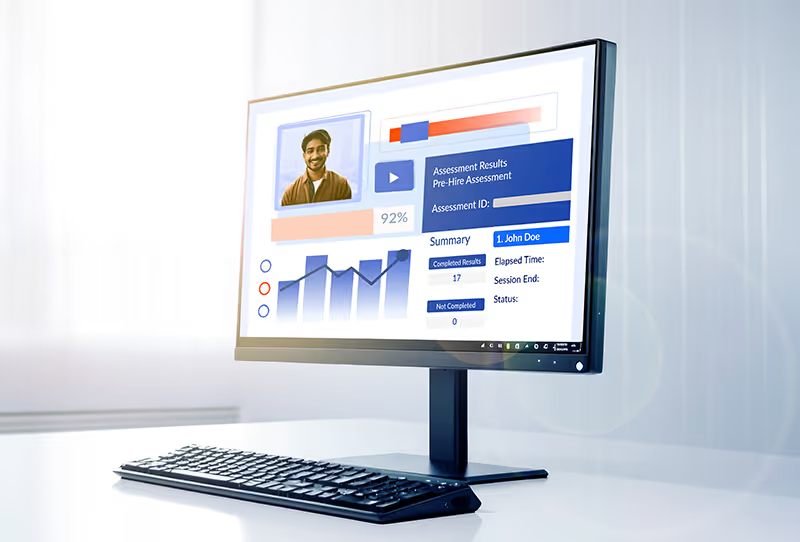
During hiring tests, clients that use eSkill AI proctoring can closely monitor candidates to detect and deter any suspicious behavior. That way, you can easily flag instances of cheating to understand which candidates are ethical, and which are…resourceful.
You can also verify candidate identity with photo ID checks before the hiring test begins, and throughout the test itself. This confirms that the individual taking the test is the intended participant.
Need more rigorous anti-cheat tools?
We also offer AI-proctoring, recording candidate assessments, flagging activity, and generating a suspicion score for each candidate so you can review footage after the assessment.
You can also document employment test data and keep it on file in case you ever need to review it or respond to a legal challenge.
Altogether, eSkill’s tools allow you to evaluate all candidates under the same conditions and hire the best-qualified candidates with accurate proctoring.
It might be cliche to say, but yes, the hiring world is changing. And so are we, keeping pace with both recruiters’ needs and candidates’, too — for fair and equitable hiring.