

As hiring plateaus and applications piled up in 2025, recruiters turned to AI and skills-based strategies to keep things moving. Here’s where we expect those trends to go in 2026.
- Hiring in 2026 will remain sluggish, but stable. Forecasts suggest a near-standstill similar to 2025, with fewer layoffs than last year but little overall growth, as employers stay cautious amid economic uncertainty and persistent skills shortages.
- Recruiting is getting slower, more complex, and more automated. Application volumes are surging, time-to-hire is stretching, and recruiters are increasingly turning to AI to screen candidates, find “hidden gem” talent, and manage the growing workload.
- Skills (not resumes or job titles) are becoming the new currency. A widening skills mismatch, growing interest in blue-collar and trade roles (especially among Gen Z), and the rise of AI-driven hiring tools are accelerating the shift toward skills-based hiring and alternative ways of evaluating candidates.
Happy New Year! Are we still allowed to say that in mid-January?
Regardless, it’s out with the old and in with the new. At least, that’s what we’re hoping for, as far as hiring is concerned.
The data, however, is painting a different, more dreary story — and it is that the pace of hiring in 2026 is likely to match the pace set in 2025, i.e. pretty much a standstill. That’s from forecasts and analysis gathered together in Indeed Hiring Lab’s 2026 US Jobs Hiring & Trends Report.
Inc. magazine, referring to the report, calls the predictions “decidedly uninspiring.”
But while the overall volume of hiring may not be changing much, under the stagnant surface, there’s a number of important HR trends simmering. Recruiters should take note.
AI — especially agentic systems — is often blamed for the recent rise in layoffs and the slowdown in job openings. But that narrative isn’t entirely accurate. What is true is that generative AI adoption is accelerating quickly, and with it comes growing pressure on recruiters (and other white-collar workers, including new hires) to use these tools — and skillfully, at that.
At the same time, employers are grappling with a broad skills mismatch between the roles they’re trying to fill and the capabilities of available workers.
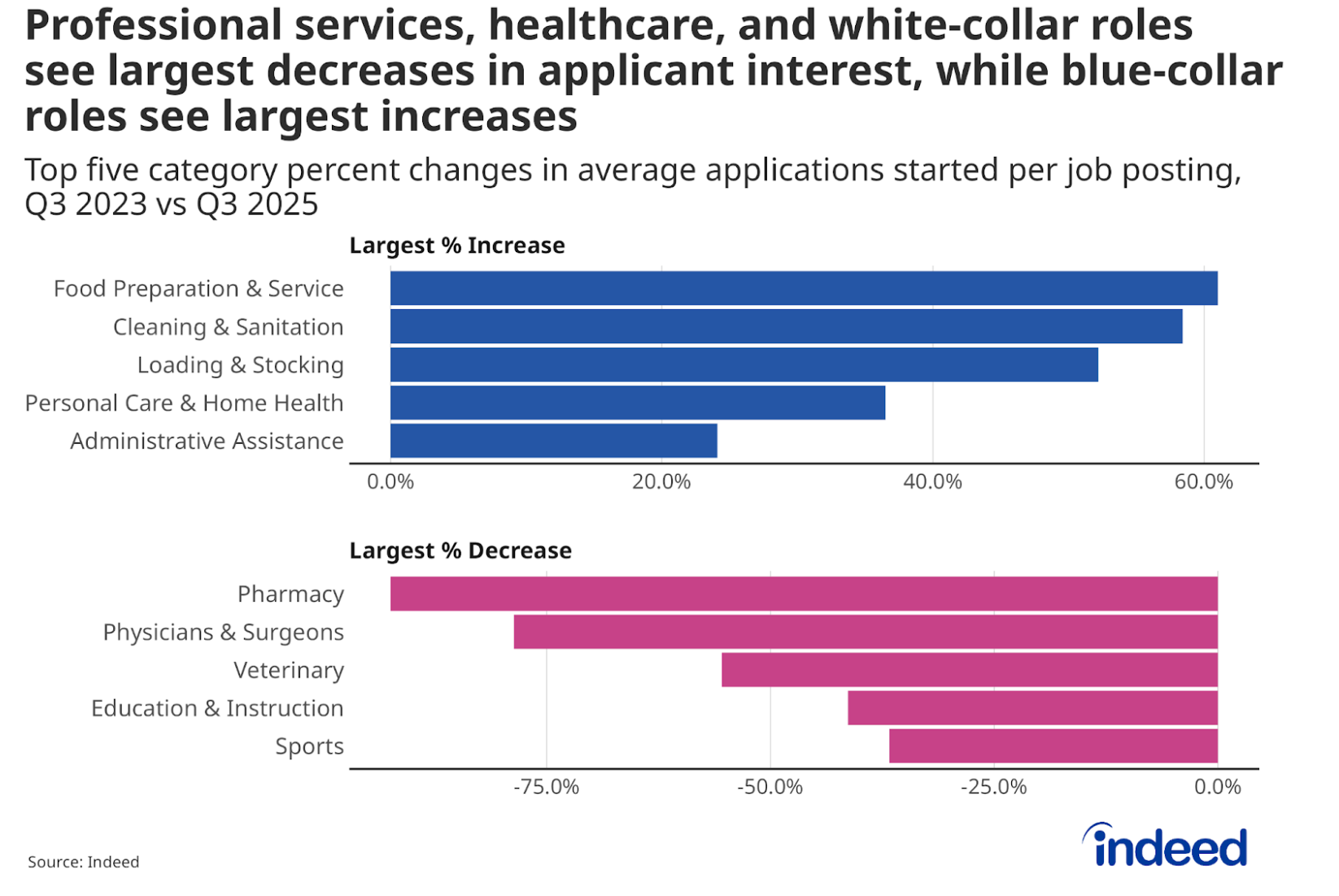
We’re also seeing a shift in where candidates are applying: away from white-collar roles and toward blue-collar work, alongside a growing sentiment among younger workers that skilled trades offer a more attractive and stable path.
Finally, we expect the traditional resume to continue losing ground, as hiring moves further toward skills-based decision-making.
Let’s dive into the trends — and what’s on the eSkill bingo card — for hiring in 2026.
1. The hiring stasis will budge (a little…)
The labor market downshift that began in 2023 appears to have bottomed out late last year, finally. Layoffs surged in 2025 to their highest level since the pandemic at 1.1 million, and (thankfully) most forecasts don’t expect 2026 to nearly reach that number. Yet even if the labor market is (slowly) on the way up, any attempts at hiring in 2026 seem poised to be far more selective.
“Don’t hire, don’t fire,” has become the resounding call throughout industries. At least that’s how Indeed’s Hiring Lab puts it. Employers are too uneasy about the economic outlook in 2026 to expand aggressively, but not pessimistic enough to initiate mass layoffs. And that’s a relief for many employees, who either were laid off in 2026 or in constant fear they’d be next.
Even if aggressive expansion isn’t on the calendar, some companies are still planning on bringing on new staff. One survey from Express Employment Professionals and Harris Poll found that “two-thirds of U.S. hiring decision-maker respondents said they planned to increase headcount in 2026’s first half,” the highest level since the survey began in 2020.
A December report from ManpowerGroup, however, found that hiring intentions are split almost evenly: 40% of employers plan to increase headcount in early 2026, 40% expect to hold steady, and 16% anticipate reducing staff. Among those planning cuts, economic pressures and shifting market demand dominate the rationale, while automation and AI rank lower.
At the same time, structural problems remain stubborn. More than a third of employers said they already have open roles they can’t fill, with skills shortages — not compensation — cited as the main barrier. In a survey of nearly 2,200 U.S. hiring managers, 92% said it’s challenging to find skilled candidates.
The eSkill prognosis for 2026 is this: a labor market that will continue to teeter in between growing and shrinking, with skilled employees as the X factor. If employers find a good way to single out experienced applicants — and evaluate necessary skills — they can confidently make selective hiring choices in an unstable market. (Hint hint, nudge nudge: skills testing might help out.)
2. The hiring process is already longer than before. It might get even longer.
Like the cheese from a mozzarella stick, the hiring process is bound to get longer and longer the more the two sides — employers and employees — move in opposite directions.
According to LinkedIn, the number of applications submitted on the platform has skyrocketed — up more than 45% in the past year. The sheer amount of applications has slowed the hiring process down significantly for many organizations.
According to a June 2025 report from Robert Half, “93% of hiring managers say it takes longer [to hire] in 2025 than just two years ago.” The timeline has stretched as employers spend more time reviewing applications, checking references, conducting background checks, and coordinating multiple interview rounds. As one summary of the findings put it, the process has become “more time-consuming and costly,” even before a new employee is onboarded.
Over a third of US job seekers have said they were applying to more jobs than ever before, but hearing back less often, according to LinkedIn. With applications per role increasing, employees are finding it harder to respond to applicants in a reasonable amount of time. So, candidates put in further applications elsewhere — and many are using AI to send in far more applications than used to be possible.
To fight through the slog of applications, 93% of recruiters plan to increase their use of AI in 2026 — and some of that may be because they’re also pressured to hire faster and better.
The stakes are high, too: 30% of managers admitted to making a hiring mistake in the past two years, and 57% of those said the error led to additional turnover. The most common causes were “not properly assessing technical skills” and failing to evaluate cultural fit, reinforcing why many companies are reluctant to rush decisions — even when roles remain open.
The result is a contradiction at the heart of modern recruiting: hiring is getting slower and more complex just as business leaders demand faster results. That pressure is pushing more teams to experiment with automation and AI tools to screen resumes, rank candidates, and schedule interviews — but on the other side of the equation, candidates are also using AI to inflate their resumes and sound qualified in conversation.
Our forecast: 2026 will be about surviving a hiring process that has become longer, riskier, and harder to manage than it was only a few years ago, both for employers and employees. AI has both helped and exacerbated the issue. What should companies do? Find ways to bring employers and employees closer to the authentic interactions that underlie a good hiring process. Skills testing, in-person interviews, and yes, even high-level AI assistance can help.
3. The skills mismatch will shake up HR
Like we’ve mentioned, the hiring slowdown isn’t only about fewer openings. It’s also about a mismatch between the jobs that exist and the skills candidates bring. According to LinkedIn, two-thirds of recruiters say it’s harder to find quality talent this year. Employers are sorting through more resumes than just a few years ago, yet still struggling to find people who fit the technical and practical requirements of open roles.
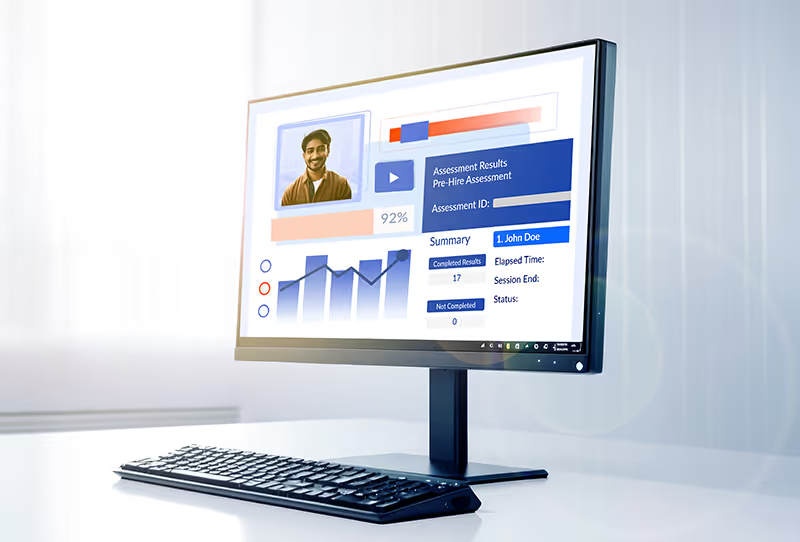
And it's no surprise hiring managers are moving away from the resumes to other screening methods. Pre-hire assessments, for example, add a little necessary friction to the application process, requiring candidates to opt-in to taking an assessment to be considered for the role — helping to eliminate the candidates using a spray-and-pray approach to finding employment.
To bridge that gap, recruiters are leaning heavily on AI, with some positive outcomes — “59% say AI is already helping them find candidates with skills they never would have found before.”
Job seekers, meanwhile, are adapting just as quickly — and often uneasily. “All generations, from Boomers to Gen Z, share the same struggle: they’re unsure how to stand out in new AI-driven hiring processes — yet the majority plan to use AI tools in their job search.” Roughly 81% of people already use or plan to use AI when applying for jobs, and nearly half say it boosts their interview confidence. In other words, both sides of the market are turning to the same technology to navigate a system that feels increasingly opaque and competitive.
Yet technology alone hasn’t solved the underlying issue. Fewer employers now cite pay, benefits, or unwillingness to work long hours as their main recruiting hurdles. Instead, 50% say candidates lack relevant experience, and another 26% say they struggle to evaluate informal or self-taught skills.
The eSkill lowdown: AI tools are making it both harder for candidates to stand out and for employers to single out talented applicants. In order to address the skills mismatch, employers need to find better ways to find the candidates with the skills they need — and in turn, employees need a better way to show off their expertise. AI has some use cases here, and so do pre-hire assessments.
Talk to sales to learn more about how the eSkill platform can help you hire.
4. White-collar demise, blue-collar rise
“Demise” might be too strong of a noun, but we’re keeping it because it rhymes.
Younger workers are adjusting their expectations and career plans. As a report from WorkPlace Intelligence says, “nearly half of Gen Z high school graduates are considering trade schools instead of four-year colleges.”
The reasoning is pragmatic: trades offer faster entry into paid work, far less student debt, and something many office jobs no longer guarantee — durability in the face of automation.
Meanwhile, competition is intensifying in the parts of the labor market still hiring. “The average number of applications per job has risen sharply for several blue-collar and service categories, including food prep and sanitation,” a sign that many displaced or uncertain white-collar workers are recalibrating toward roles with steadier demand and lower barriers to entry.
Quits rates in healthcare and social assistance are also slightly above the national average, highlighting uneven retention pressures even within growing sectors.
There are, however, early signs of structural support for the blue-collar side of that recovery. Beginning July 1, expanded Pell Grant eligibility for short-term training programs could reshape the manufacturing talent pipeline. In Bexar County, Texas, a publicly-funded 10-week Fast Track program trains students on the skills they need for entry-level maintenance technician roles.
Federal aid will now cover programs under 15 weeks — including credentials in CNC operation, industrial maintenance, and robotics — lowering the cost barrier that has long kept many workers out of technical fields. Combined with renewed national momentum around apprenticeships and pre-apprenticeships, the policy arrives as reshoring, infrastructure spending, and advanced manufacturing investments accelerate demand, even as older skilled workers retire.
For employers who need trained talent faster than two-year programs can deliver, Pell-backed short courses and “earn-and-learn” models offer a rare point of alignment between labor supply, economic necessity, and long-term workforce resilience.
The eSkill oracle’s prediction: blue collar pursuits will continue to rise. As skills development for blue collar roles becomes more accessible and demand continues to increase, companies investing in on-the-job skills development, apprenticeship pathways, and hiring for aptitude and ambition will forge ahead.
5. AI tools and agents: if you’re not ahead, you’re behind
In a January report, LinkedIn found that 42% of talent acquisition professionals are being asked to fill roles more quickly, while 39% are being pushed to find “hidden gem candidates” with skills they “never would have found before.”
Much of that investment is focused on early-stage screening. LinkedIn reports that 66% of recruiters intend to expand their use of AI for pre-screening interviews next year, with most believing it will lead to more valuable conversations by filtering for relevant skills sooner.
The productivity gains are real — and so are the growing pains. Indeed’s Hiring Lab reports that across eight countries, more than 80% of employed AI users save at least one hour per day with AI tools. Research from the London School of Economics and Protiviti suggests that with proper training, workers can double productivity and save up to 11 hours per week.
There are also mounting risks. KPMG found that 44% of U.S. workers use AI tools improperly at work, nearly half admit to uploading sensitive company information, and more than half rely on AI outputs without properly evaluating them. Still, companies appear willing to accept that tradeoff in pursuit of speed and efficiency. As one Resume.org survey put it, nearly two-thirds of employers even believe attributing layoffs to AI is more palatable to stakeholders than citing financial constraints.
(Psst…For more AI dos and don’ts, check out our blog detailing ethical use of AI in hiring.)
Taken together, the message is blunt: hiring teams are being asked to do more, faster, with fewer mistakes — in a market flooded with applicants and short on verified skills. AI is becoming the default solution, not because it is flawless, but because the traditional hiring model, built around resumes and manual screening, can no longer keep up.
An August Resume.org study even found that one-third of companies expect AI to run their entire hiring process by this year.
The eSkill forecast: more and more AI in hiring. Organizations are going to rev the engine on AI, but they might not take the proper precautions to prevent mistakes, which could lead to more problems. Savvy companies will take note.
6. Skills-first hiring processes will continue to gain favor
2025 may have seemed doom-and-gloom by comparison, but at the very least, 2026 will see some light at the end of the tunnel. One bright patch is that skills are going to be a priority for many organizations!
While skills assessments can’t help you close the skills gap, they can help you better identify candidates with the know-how to do the job and the potential to grow within your organization.
One survey from McLean & Co. found that skills-based hiring has the strongest level of implementation, planned or existing, among emerging HR trends.
With AI affecting hiring on both sides and broad skill mismatches occurring in multiple fields, a focus on hiring based on skills and aptitude is coming to the forefront.
Our final consultation with the eSkill oracle reveals one overarching truth: skills-first hiring will continue to gain in popularity. We promise we didn’t bribe the oracle to say that!