

Medical billing and coding is one of healthcare's most in-demand nonclinical skill sets. But the talent pipeline is changing, AI is reshaping the work, and the old playbook for hiring coders doesn't hold up anymore. Here's what to look for, what to test for, and why certifications aren't the whole story.
- Medical billing and coding is growing 7% through 2034, with ~14,200 openings per year. But AI-assisted coding tools are changing what the job looks like, which means the skills you're hiring for today may not be the same ones you needed three years ago.
- Certifications matter, but they're not the only signal. The CPC, CCS, and CBCS each serve different roles. Knowing which one fits your setting (and when to look past credentials entirely) will widen your candidate pool without lowering the bar.
- The candidate pool is shifting. Fewer traditional graduates, more certificate earners, more career changers. Employers who test for demonstrated skills rather than filtering on degrees will find talent their competitors are missing.
What medical billing and coding actually is (quickly)
Medical coders translate clinical documentation into standardized alphanumeric codes like ICD-10-CM, CPT, and HCPCS.
Every diagnosis, procedure, and lab test gets its own unique code. Medical billers take those codes and turn them into claims, submit them to payers, process Explanations of Benefits, follow up on denials, and handle patient balances. Some organizations split these into separate roles, but many smaller practices combine them.
The Bureau of Labor Statistics projects 7% employment growth for medical records specialists through 2034 (faster than average), with about 14,200 openings per year. The median pay sits at $50,250 annually, and the typical entry-level education is a postsecondary nondegree award.
And yep, you read that correctly. Not a bachelor's. Not even an associate's degree, necessarily. A certificate.
That last detail matters more than it used to.
The certification landscape (and what it means for hiring)
One of the most common questions from both candidates and recruiters is whether you need a certification to work in medical billing and coding. The short answer is that it depends on the employer, but 94% of employers either require or strongly prefer it, which means certification is less of a differentiator and more a baseline.
Here's a quick breakdown of the major medical billing and coding credentials and what each one tells you as a hiring manager:
- CBCS (Certified Billing and Coding Specialist) is issued by the National Healthcareer Association. It's the most accessible entry point, completable in about 12 weeks, and covers billing, insurance claims processing, and reimbursement procedures. If you're hiring for a billing-heavy role in a smaller practice or outpatient setting, this is a reasonable starting credential.
- CPC (Certified Professional Coder) comes from AAPC and is widely considered the standard for outpatient and physician-office coding. It's more rigorous, typically requiring 80-100 hours of study.
- CCS (Certified Coding Specialist) is AHIMA's credential and skews toward inpatient hospital coding with a focus on ICD-10-CM and ICD-10-PCS. If you're hiring for facility-based roles, this is the one that carries the most weight.
- CCA (Certified Coding Associate) is AHIMA's entry-level option, covering both inpatient and outpatient settings. Think of it as a stepping stone to the CCS.
For recruiters, the takeaway is that the right certification depends on the setting. A CPC is the wrong filter for a hospital inpatient coding role, and a CCS may be overkill for a billing clerk position at a two-physician practice. Matching the credential to the actual work avoids both over-filtering and under-screening.
Why the talent pipeline is changing
Here's where things get interesting for anyone trying to fill these roles. Dr. Cali Morrison, Senior Director of Workforce Education Strategy at EdAssist by Bright Horizons, studies the intersection of workforce learning and employer hiring. She sees a structural shift underway that healthcare recruiters can't afford to ignore.
"Right now, we are at the very beginning of the demographic cliff," Dr. Morrison explained. "In 2008, the birth rate dropped dramatically. We have fewer 18-year-olds graduating from high school right now than we ever have before. That birth rate hasn’t recovered to date, and doesn’t show signs of growing in the future."
The result? Fewer people flowing into traditional degree programs and more opting for shorter, stackable credentials that get them into the workforce faster. For medical billing and coding specifically, that means a growing share of candidates will arrive with a certificate rather than an associate's or bachelor's degree. And many of them will be career changers or adult learners, in addition to recent high school graduates.
Dr. Morrison sees this as an opportunity, not a problem. "Shorter-term programs mean their skills are likely fresher and may be more aligned with what you need right now," she said. "And the newer credentials have skills explicitly lined out, so as a hiring manager, you can see exactly how a candidate’s education fits with your role or not."
The practical implication for recruiters is that degree requirements are becoming a liability. If your job posting asks for an associate's degree and a candidate has a CBCS, six months of externship experience, and demonstrably accurate coding skills, you're losing that person to a competitor who doesn't have an arbitrary degree gate. Skills-based hiring widens the pool without lowering standards, especially when paired with objective skills testing.
AI isn't replacing coders, but it is changing what "good" looks like
This is the question everyone in the field is asking, and it deserves a careful answer.
In practice, AI coding tools scan clinical notes, suggest codes, and flag inconsistencies. They handle routine, high-volume coding faster than humans. But they also misinterpret clinical intent, hallucinate codes, and can't navigate complex payer rules without human oversight. This means the role isn't disappearing, but it’s likely assigning from evolving from "assign the code" to "validate the code, catch the error, handle the exception."
For recruiters, this means the skills profile for a strong medical coder in 2026 looks different than it did in 2020. You still need ICD-10 and CPT knowledge. But you also need someone who can evaluate AI-generated suggestions critically, navigate compliance edge cases, and adapt quickly as tools change. Testing for digital literacy, attention to detail, and problem-solving alongside coding knowledge gives you a more complete picture of whether someone will thrive in the role as it exists today.
What to actually test for
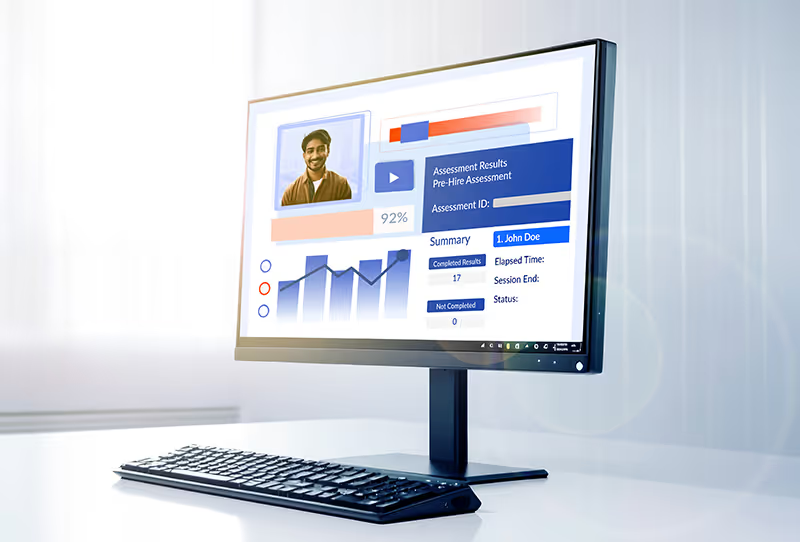
If you're using pre-hire assessments to screen medical billing and coding candidates (and given the volume of applicants and the specificity of the skills involved, you probably should be), the test should reflect the role's real demands.
For a medical coding role, that means:
- ICD-10-CM and CPT code assignment
- Anatomy and physiology fundamentals
- Coding guidelines
- HIPAA compliance
- Medical terminology
For a billing role, add:
- Claims processing
- Insurance and reimbursement workflows
- Accounts receivable knowledge
- Customer service skills (billers spend a lot of time on the phone with patients and payers)
The strongest assessments mix and match across these areas rather than relying on a generic, one-size-fits-all test. A coder working in a cardiology practice needs different depth than one handling general outpatient coding, for example, and a biller in a large hospital system needs a different level of Medicare and Medicaid knowledge than one at a private clinic.
And don't overlook the "soft" skills that are actually hard. Attention to detail, numerical reasoning, and the ability to process information quickly under pressure are all testable. A coding error is more than just a simple inconvenience, because it can become a denied claim, a compliance risk, or a patient billing dispute. Testing for accuracy before someone is handling live patient data is the entire point.
How medical billing and coding is shifting
Medical billing and coding is in a transition. The work is growing, the tools are changing, and the talent pipeline is shifting toward credentials, certificates, and non-traditional pathways. The employers who will hire well in this environment are the ones who know which certification actually fits their setting, who don't use degree requirements as an unnecessary filter, and who verify skills objectively rather than taking a resume at face value.
A well-built assessment won't tell you everything about a candidate. But it will tell you whether they can actually code accurately, navigate HIPAA requirements, and handle the digital demands of the role before you invest weeks in onboarding someone who can't.
Talk to sales to learn more about how the eSkill platform can help you hire.