

Government hiring has always been slow. Now it's slow, underfunded, and flooded with AI-polished resumes. Here's how state and local agencies are using skills assessments to hire smarter without adding headcount, time, or risk.
- State and local governments are hiring under pressure from every direction. Budget cuts, government hiring freezes, lean HR teams, and a surge of applicants (many AI-assisted) are forcing agencies to do more vetting with fewer resources.
- Tearing the paper ceiling only works if you replace it with something. Thirty-two states have dropped unnecessary degree requirements. Skills assessments fill the gap, giving agencies an objective, defensible way to evaluate candidates based on ability rather than credentials.
- Where you place the test in your process matters as much as which test you use. High-volume entry-level roles? Test at application. High-stakes individual hire? Test after the recruiter screen. Getting the timing right is the difference between a useful filter and a wasted resource.
Government organizations were doing merit-based hiring before it was cool, leveraging civil service exams, scored applications, and structured scoring rubrics. The public sector wrote the playbook on evaluating candidates by ability rather than connections.
And yet, if you work in state or local government HR right now, the hiring process probably feels less like a well-oiled meritocracy and more like trying to fill a bathtub with a teaspoon while someone pokes holes in the bottom.
Now, the average job opening receives 242 applications, more than double the volume from five years ago. This is driven largely by AI tools that let candidates generate and submit tailored resumes at machine speed. LinkedIn alone processes 11,000 applications per minute, a 45% year-over-year surge. And with the U.S. unemployment rate at 4.2% and over 300,000 federal workers having separated since 2025, many of those displaced workers are now looking at state and local government openings.
The result is that government inboxes are overflowing, but the signal-to-noise ratio has collapsed. Work for America’s From the Frontlines 2026 report found that even when applicant volume is up, obstacles in the internal systems can't convert that interest into hires in the public sector. Another study said that 69% of respondents cited slow time-to-hire in the public sector as their top challenge.
The applicants are there. The systems to process them aren't.
Dominique Fernandez, eSkill's Customer Success Manager for the public sector, has been working with government clients for six years. She's seen the squeeze up close.
"Budget cuts are a big deal right now. Hiring has slowed down,” she said. “They're having to use fewer resources and do more…. They're also getting a huge amount of applicants and resumes. Everyone can make a resume with AI and make them seem like they're rockstars. But when you get them in the actual situation of what they'll do day to day, or how they handle a specific type of software like Microsoft Excel, they may not actually be able to do the work at hand."
Tearing the paper ceiling (and what goes in its place)
There's a bipartisan bright spot in all of this. Over the past few years, multiple states have eliminated unnecessary degree requirements for state government jobs. The movement, championed by Opportunity@Work and its Tear the Paper Ceiling campaign, is built on a simple premise: 70 million American workers gained their skills through routes other than a four-year degree. If they can do the work, they should be able to get the job.
Brookings research found that state and local government employees hold bachelor's degrees at higher rates (57%) than either federal (49%) or private sector (36%) workers. This likely means that degree requirements have been disproportionately screening out the exact talent pool governments need.
But dropping the degree requirement creates a new problem. If you're no longer using a diploma as a proxy for competence, what replaces it?
That's where skills assessments come in.
"Skills tests help agencies assess without degrees required,” Dominique explained. “They know the individual from a skill level. Pennsylvania, Colorado, Maryland, and many other states are expanding their candidate pools by not requiring degrees. A lot of individuals are very much self-taught. These assessments can help you understand their actual skill level much more accurately and early in the process.”
What state and local agencies are actually testing for
If you're imagining some dusty civil service exam from the 1980s, think again. The most common pre-hire tests for government roles may come down to assessing digital literacy and public works functionality.
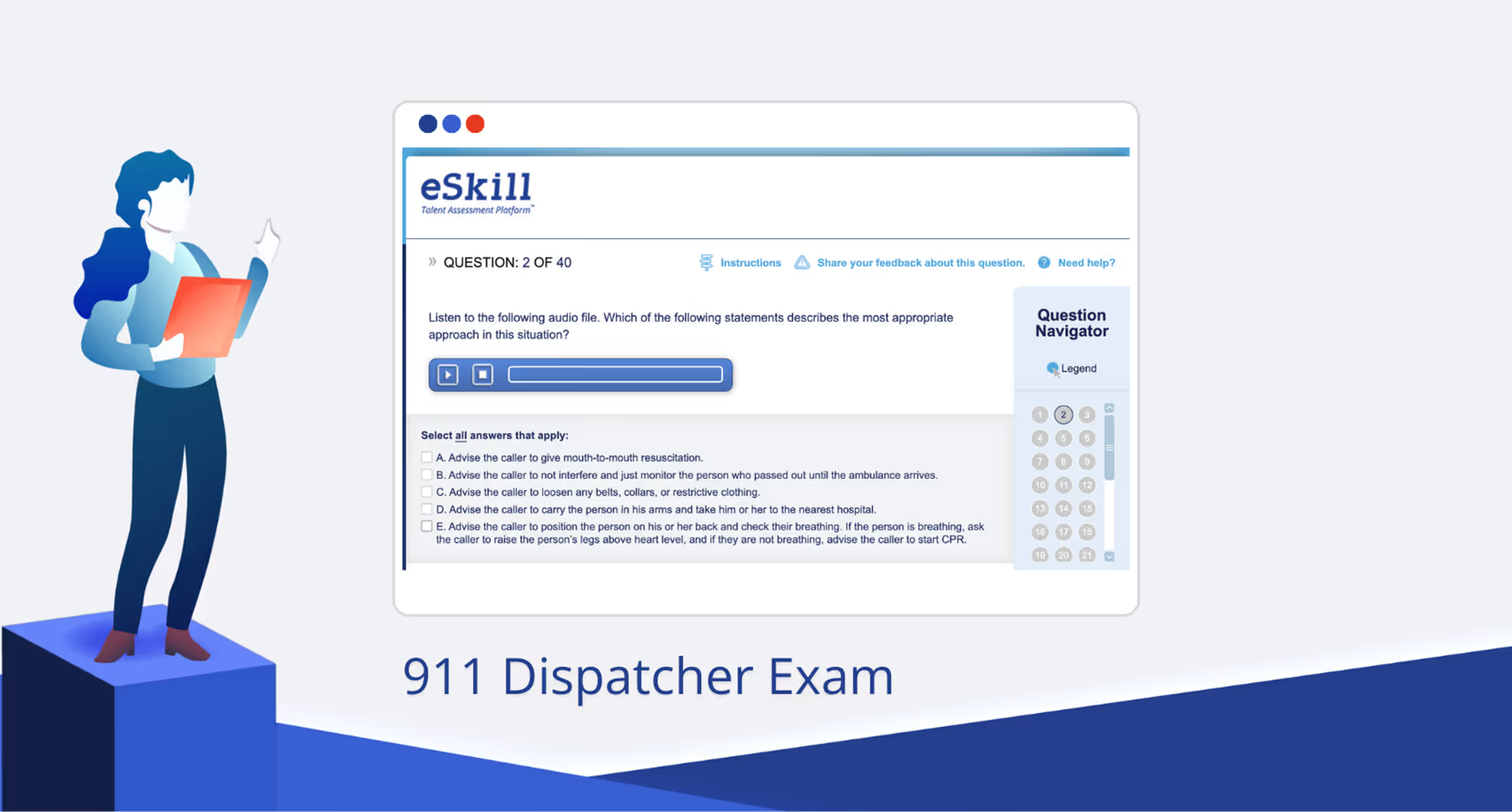
"Most of the time it's administrative and clerical,” Dominique shared, stressing that digital skills are now critical. “Typing tests, data entry, anything regarding Excel, Outlook, any of the Microsoft suite. Excel simulations are probably the single most-used assessment."
Those administrative and clerical roles are also the highest-turnover positions in government, often the first cut during freezes and budget tightening. Testing for them early makes sense because volume is high, turnover is expensive, and the skills are objectively measurable.
But the testing doesn't stop at hard skills. For management and director-level roles, agencies are increasingly looking at emotional intelligence, critical thinking, adaptability, and leadership.
"With the new generations, things are changing,” Domique said. “You need to be innovative with different ideas, ideologies. Critical thinking is a big deal in public sector right now."
Some of her clients are getting creative. Rather than relying solely on eSkill's content library, they're adding custom video-response questions. They'll present a scenario ("a colleague on your project isn't pulling their weight, what do you do?") and capture the candidate's actual response on video.
"They're getting their pure reaction," Dominique explained. "These later-stage assessments are open-ended. They want the individual's real thinking."
Getting the timing right
One of the most common mistakes Dominique sees is placing the assessment at the wrong point in the process. Her guidance depends on the type of role:
- High-volume, entry-level roles. Test at the point of application. "If you NEED a typing level at 40 words per minute because the government entity requires that, you want to make sure they're at that level right then and there." At this stage, the assessment functions as a knockout. It saves recruiters from reviewing hundreds of resumes that won't pan out.
- Higher-stakes individual hires. Test after the recruiter screen. "If this is a higher-paying role with lower attrition where the individual will grow, the skills test usually comes after vetting the resume and having some type of recruitment call." The agency has already invested time; the assessment confirms what the conversation suggested.
- Late-stage behavioral assessments. Some agencies add a second, shorter assessment near the end of the process. This one isn't a knockout. It's an additional data point, used alongside interviews and references to build a complete picture.
And as budgets tighten, Dominique has been encouraging her government clients to think beyond hiring:
"For the ones in a freeze, I try to reposition it so they can use the assessment for training too,” she said. “There are gaps in their current team. Use assessments as a benchmark. Identify where the problems are. Build customized training from the scoring. Use it for promotional decisions."
How to leverage skills validation in the public sector hiring process
Government hiring lives under a level of legal scrutiny that most private employers never face. Every assessment has to be defensible against adverse impact claims, EEOC-compliant, and documented thoroughly enough to survive an audit.
This is one of the reasons government agencies were early adopters of skills testing in the first place. Subjective interviews create legal exposure. Validated, job-related assessments reduce it. When the content is built by subject matter experts, weighted appropriately to the role, and administered consistently, the assessment becomes a paper trail that protects the agency.
Dominique's advice on weighting is practical. For entry-level roles, the majority of questions should be beginner-level, with a smaller portion at intermediate and only a small percentage being expert-level. For mid-level roles, flip the mix.
You want a good benchmark of understanding where this individual's range is,” she said. “Maybe they score very high on beginner questions, but when it comes to intermediate and expert, not so much. That's still useful. That's a person with potential who can start in an entry-level position and work their way up."
And critically, the assessment needs to integrate with the systems agencies already use. Most state and local governments run on government-specific ATS platforms. If the skills test doesn't plug into the existing workflow, it becomes another manual step in a process that already has too many.
Prince George's County, for example, integrated eSkill into their process to screen large applicant pools efficiently without adding burden to their HR team.
Making every hire count
Government HR teams in 2026 are operating in a paradox. There are more applicants, fewer resources, higher stakes, and less room for error. The agencies that are handling it well are placing objective skills checkpoints at the right moments in their process, using validated content that holds up to scrutiny, and treating their assessment platform as a tool that serves hiring, training, and promotion.
Legacy processes are comfortable. They're also expensive and time-consuming, and could be costing you top applicants.
And the candidates are out there. Many of them don't have degrees, but they still could be the right fit. The question is whether your process can identify them before they accept a job somewhere faster.
See how eSkill helps state and local governments build defensible, efficient hiring processes →
Talk to sales