
The federal government has long been in support of merit-based hiring — a long string of executive orders, acts, and initiatives support the fact. Local and state governments, along with private companies, are also turning toward the fairer, more equitable practice.
- Merit-based hiring shifts focus from degrees to skills. Candidates are evaluated on demonstrated abilities (through assessments, work samples, or structured interviews) rather than formal education.
- A long bipartisan history underpins today’s reforms. From the Pendleton Act (1883) to Obama-era testing changes, Trump’s 2020 Executive Order, Biden’s 2024 Chance to Compete Act, and OPM’s new 2025 Merit Hiring Plan, governments have continually advanced skills-first hiring.
- Adoption is expanding across sectors. State and local governments (like the City of Chicago) and private employers (like Walmart) are also implementing merit-based hiring to broaden talent pools and strengthen workforce readiness.
Just a couple of months ago, the US Office of Personnel Management announced the 2025 Merit Hiring Plan in a memorandum. It’s an initiative based on an executive order signed by President Trump in January 2025, EO 14170 — which promised to expand merit-based hiring in the federal government by focusing on technical skills and competency assessments, and removing degree requirements where possible for federal hiring.
Wait a second. But that executive order was based on previous bipartisan efforts — from the Biden administration, the previous Trump administration, the Obama administration, and more efforts stretching all the way back to the 1880s, after president Garfield was shot by a disgruntled office seeker who couldn’t believe he wasn’t awarded a political position under the “spoils system” of hiring popularized by president Andrew Jackson.
EO 13932, for example, signed by President Trump in June of 2020, sought to “[modernize] and [reform] the assessment and hiring of federal job candidates,” and was transformed into the Chance to Compete Act of 2024 — which was passed by bipartisan, unanimous consent in the Senate under the Biden administration.
And when it comes to the Chance to Compete Act, which established a requirement for “federal agencies to use technical assessments to fill most positions in the competitive service” — that had already been happening when the Obama administration established USA Hire, a digital platform developed under the OPM, to assess candidates with digital, competency-based assessments.
And while the government has been pushing for merit-based hiring at a federal level, state and local governments have also been pursuing merit-based hiring, too, like Alaska, Maryland, Virginia, and the City of Chicago — the mayor of which signed an executive order to promote skills-based hiring and remove barriers to city government roles for Chicagoans without college degrees.
Private companies, too, are pursuing merit-based hiring — mega-corporations from Walmart to Delta Airlines are removing degree requirements from job roles, and asking for requisite skills and experience instead.
Even mid-market and small businesses, met with an influx of job applications, are using merit-based hiring methods to find qualified workers.
So why is every organization, private or public, pursuing merit-based hiring?
What is merit-based hiring?
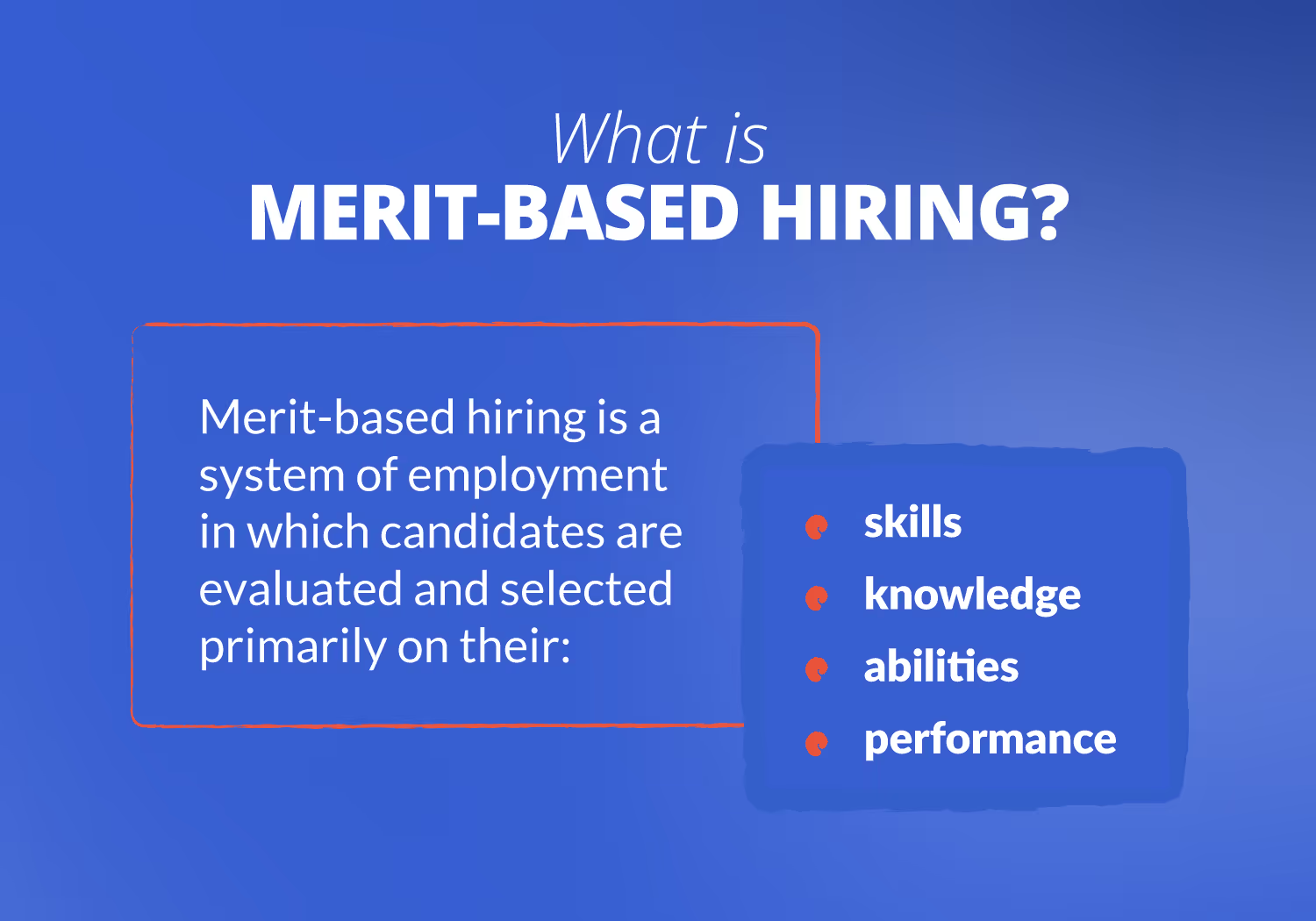
Merit-based hiring is a system of employment in which candidates are evaluated and selected primarily on their skills, knowledge, abilities, and performance. Evaluations of merit are often performed through technical assessments, work samples, or structured interviews.
Typically, merit-based hiring is framed as a divergence away from degree-based hiring. Degree-based hiring uses formal education credentials (like a bachelor’s or master’s degree) as the main filter for eligibility. It assumes that completing a degree signals readiness, even if a candidate hasn’t directly demonstrated the specific skills needed for the role.
What is the “merit system”?
The merit system is the opposite of the “spoils system,” a practice that once dominated U.S. politics.
Under the spoils system, government jobs were handed out as rewards to political supporters, friends, and allies, regardless of whether they were qualified. This system reached a breaking point in 1881, when President James A. Garfield was assassinated by Charles Guiteau, a disgruntled office seeker who believed he was owed a government job.
The outrage over Garfield’s death pushed Congress to pass the Pendleton Civil Service Reform Act of 1883, which laid the foundation for the modern merit system in the United States.
At its core, the merit system is the process of recruiting, hiring, and promoting government employees based on their skills, qualifications, and performance — not on political favoritism or personal connections. In this way, it ensures that public servants are chosen for their ability to do the job well and fairly, rather than for their loyalty to a political party or individual.
The Pendleton Act was the turning point for U.S. hiring practices. It created the Civil Service Commission and introduced civil service examinations, which required applicants to prove their competency through testing rather than relying on connections.
Initially, the Act only covered about 10% of federal government jobs, but over time, it was expanded to cover the vast majority of positions. This was a major step toward reducing corruption and professionalizing the federal workforce.
The merit system continues to guide government hiring today. Its principles — fair competition, equal opportunity, and selection based on ability — remain at the heart of civil service in the U.S. and in many other democracies.
While reforms have updated and modernized the process (such as the introduction of structured interviews, skills assessments, and online testing platforms), the Pendleton Act’s vision of a fair, professional, and politically neutral civil service endures.
Public adoption of merit-based hiring has also been matched by efforts in the private sector. Many companies now emphasize structured, skills-based approaches to recruitment as a way to reduce bias, improve job performance, and strengthen trust in hiring outcomes.
In both public and private spheres, the legacy of the Pendleton Act is a hiring philosophy that continues to shape modern workforce practices.
How has merit-based hiring progressed in government?
The 2025 Merit Hiring Plan memorandum notes that “the federal hiring process is marked by inefficiencies and struggles to attract top candidates. The Merit Hiring Plan addresses these problems by prioritizing merit-based recruitment, eliminating discriminatory practices, and streamlining processes.”
The plan further emphasizes the move away from degree requirements toward skills-based hiring, directing agencies to drop unnecessary educational qualifications. Instead, they are required to rely on technical and alternative assessments and discontinue the use of outdated self-assessments.
None of this is new, however. While civil service exams have been around for a long time, they’ve seen some key developments, such as a move away from examination in the ‘90s (and a turn toward resumes and essays), and then a refocus on assessments during the Obama administration, when self-questionaries were thrown out the window in support of digital testing, in order to shorten the federal hiring process and increase merit-based hiring once again.
Obama-era guidance
During the Clinton administration, civil service exams were pared back under the “Reinventing Government” initiative, and agencies shifted their focus toward resumes and self-assessed questionnaires.
But a return to structured assessments came under the Obama administration. In the 2010s, the federal government began implementing digital cognitive ability tests to hire, which directly led to the creation of the USA Hire platform by the US Office of Personnel Management (OPM) in 2010.
This initiative aimed to make federal hiring faster, more transparent, and less reliant on long, narrative-style self-assessment questionnaires, where applicants simply rated themselves.
Since then, USA Hire has grown significantly — today it’s used by 80+ agencies, for over a hundred federal positions, and assesses nearly a million applicants per year.
2020 Executive Order
“My Administration is committed to modernizing and reforming civil service hiring through improved identification of skills requirements and effective assessments of the skills job seekers possess. We encourage these same practices in the private sector. Modernizing our country’s processes for identifying and hiring talent will provide America a more inclusive and demand-driven labor force.”
2020 Executive Order
In a memorandum on Trump’s 2020 Executive Order, it’s written that this order “reminded agencies of their legal obligation to use valid, competency-based assessments and directed them to scale back reliance upon educational qualifications as a substitute for competencies in the Federal hiring process” — citing that relying on degree-based hiring burdens low-income Americans and decreases economic mobility for many.
The EO also states that US private employers have “modernized their recruitment practices to better identify and secure talent through skills- and competency-based hiring,” and that the federal government should follow privacy companies’ lead.
The Chance to Compete Act of 2024
“Under the act, the Office of Personnel Management (OPM) must develop and implement a plan for transitioning to using technical assessments for hiring into competitive service positions unless the hiring agency certifies that it is impracticable. No later than 18 months after the act's enactment, OPM must provide Congress with the plan for federal agencies to transition to the use of technical assessments. The plan must be implemented within three years after the act's enactment.”
Chance to Compete Act of 2024
The Chance to Compete Act of 2024, signed under the Biden administration, followed up on Trump’s executive order to establish technical assessments as the default for hiring. Indicative of its bipartisan nature, the act passed the US House of Representatives by a vote of 422-2.
The act “requires federal agencies to use technical assessments to fill most positions in the competitive service.” The act also authorized agencies to identify SMEs and agency talent teams to provide hiring support and develop position-specific assessments.
Trump’s 2025 executive order on federal hiring
In 2025, President Trump issued a new executive order reaffirming the federal government’s commitment to merit-based hiring. The order again emphasizes the use of objective, skills-based assessments over traditional self-assessments and questionnaires, aiming to make hiring both more rigorous and equitable.
In the memorandum, agencies are strongly encouraged to adopt USA Hire, a platform that provides validated, skills-based assessments for 135 job series — covering roughly 65% of positions listed on USAJOBS.
The memorandum also notes that one best practice is to pair an initial USA Hire assessment with structured tools such as resume reviews, interviews, or writing samples. This approach allows agencies to both “screen out” unqualified applicants and “screen in” those who demonstrate strong skills from the start.
Talk to sales to learn more about how the eSkill platform can help you hire.

Are DEI and merit-based hiring at odds?
Some commentators frame DEI as conflicting with merit-based hiring. But in reality, merit-based hiring has enjoyed bipartisan support for decades — and, increasingly, it’s being recognized as a powerful driver of DEI.
Take the private sector: Walmart leaders have emphasized that skills-first hiring not only widens talent pools but also strengthens DEI outcomes, a point reinforced by external research.
Degree requirements, by contrast, have often acted as barriers — unintentionally reinforcing socioeconomic and racial disparities by shutting out otherwise qualified candidates. Removing those requirements opens the door to a much broader, more diverse pool of talent, and many companies are doing just that.
So while executive orders or policy debates may occasionally frame merit hiring and DEI as opposing forces, the evidence shows they’re actually complementary. Skills-based, merit-driven hiring both advances fairness and supports diversity.
How private companies are implementing merit-based hiring
While government tends to learn from the private sector, merit-based hiring has experienced the opposite effect — private companies began to follow in the footsteps established by government entities.
But over time, the innovation began flowing back into the public sector: structured interviews, personality and skills testing, and statistical validation techniques were refined in business, then adopted by governments to modernize civil service exams.
In the 1920s, for example, AT&T created the “Management Progress Study,” one of the first large-scale corporate attempts to use assessments to identify and promote managerial talent. Procter & Gamble also started using systematic recruitment practices and aptitude tests, inspired partly by civil service methods.
Still, for years, many employers relied on degree requirements as a shorthand for skills. But research shows that this practice often excludes qualified talent. In fact, more than 60% of middle-skill jobs are considered “soft bachelor’s” roles — jobs that list a four-year degree even when a degree has little bearing on the actual skills needed.
Now, the shift toward skills-first hiring is picking up: Walmart, for example, announced in 2023 that it was removing degree requirements for a number of corporate positions, signaling a broader commitment to evaluating skills directly.
Smaller companies are also following the trend. Take Marlin Steel Wire Products, a manufacturing company that got its start producing wire baskets, for example. The company switched to competency-based hiring, hiring based on both skills and aptitude. As a result, the company has been making better hires and reduced their turnover rate.
A survey by Intelligent.com from 2023 also found that 45% of companies plan to drop bachelor’s degree requirements for at least some roles in 2024. According to Indeed Hiring Lab (2024), the trend continues to gain momentum as employers seek to expand talent pipelines while improving equity and retention.
Referrals: good or bad?
How do referrals play into all this? By one estimate, referred candidates make up about 30–50% of all new hires, even though referrals often account for only around 7% of the applicant pool.
A study also found that about 33.1% of people hired through nepotism felt unqualified, and 35.9% believed they received preferential treatment. Additionally, 28.4% experienced tension from colleagues suspicious of their hiring route
Networking sits in a gray area when it comes to merit-based hiring. It can support meritocratic principles when used well, but it can also undermine them if it turns into nepotism or favoritism.
Studies show referral hires have higher retention rates (about 40% higher one-year retention) and greater job satisfaction. That aligns with merit hiring goals, since successful, longer-tenured employees often reflect better initial selection. However, people tend to refer candidates from their own backgrounds or networks. This can reinforce homogeneity and unintentionally exclude qualified outsiders, especially underrepresented groups.
Referrals should be treated as a sourcing channel, not a selection shortcut. Candidates should still complete structured interviews or skills assessments.
Why merit-based hiring?
There are many reasons to pursue merit-based hiring, but let’s start with the most obvious: it’s simply fairer. Candidates are evaluated on what they can do, not on proxies like pedigree or privilege. But fairness is just the beginning.
Merit-based hiring also widens your talent pool. By focusing on skills instead of rigid degree requirements, you instantly tap into a broader set of candidates — many of whom bring real-world experience, adaptability, and problem-solving abilities that traditional filters overlook.
It also helps you secure better-qualified candidates. Research shows that degrees aren’t always a reliable measure of capability, while structured skills assessments can reliably predict on-the-job performance. This means fewer hiring mistakes, less turnover, and stronger long-term retention.
Finally, merit-based hiring aligns with the demands of a modern workforce. Job seekers increasingly expect hiring processes to be transparent, skills-focused, and equitable. Companies that embrace this approach are better positioned to attract top performers who value fairness and growth opportunities. This, in turn, leads to more successful companies, with employees who value their team, the mission, and their work.
At eSkill, we help organizations put merit-based hiring into practice with customizable, hard skills tests designed to match the competencies you need for each role. Whether you’re hiring for medical coders, welders, or public-sector positions, our assessments ensure that the best candidates rise to the top — based on skills and merit.