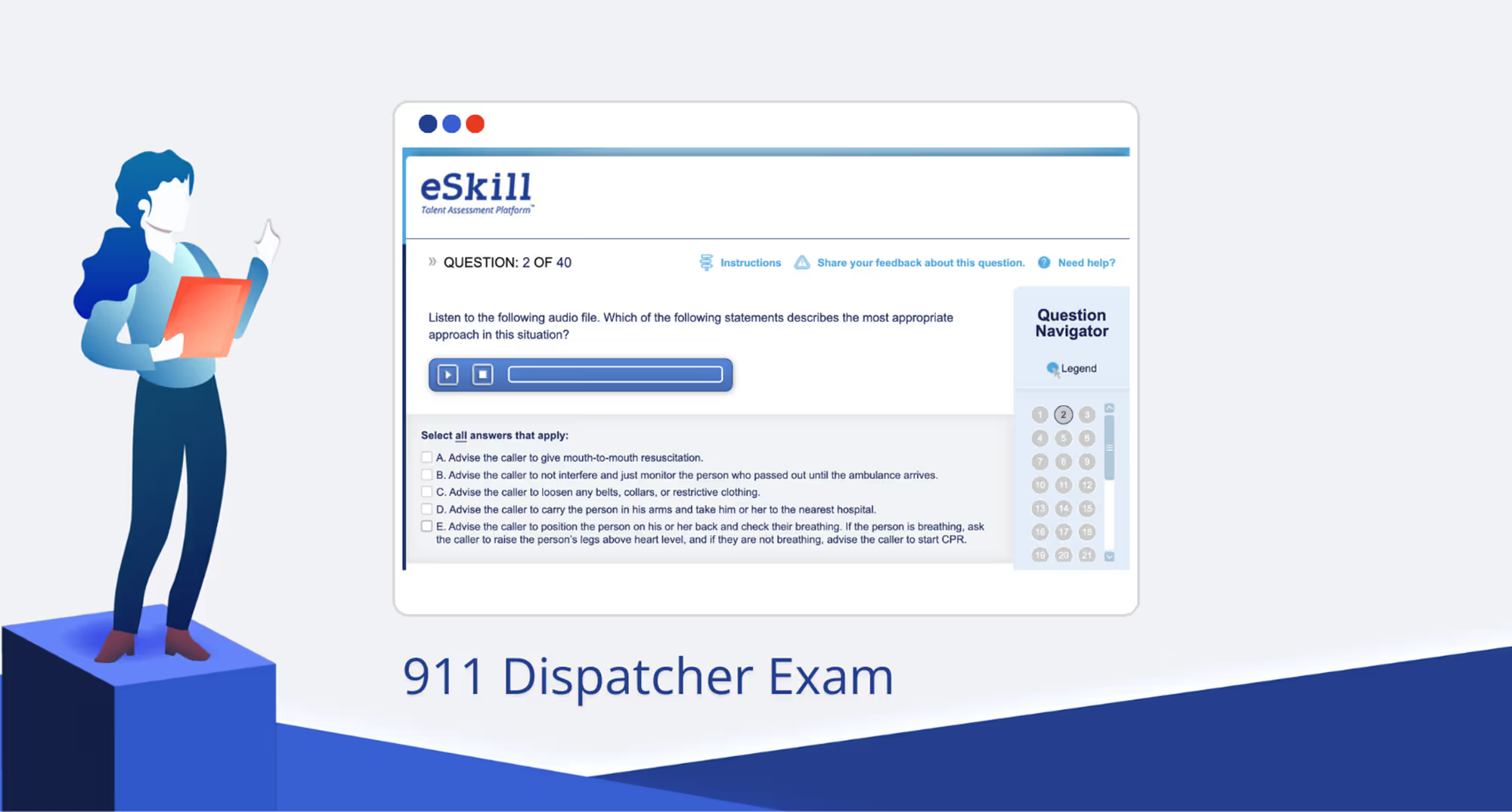


Many state and local governments are moving toward digitizing some, if not all, of their civil service exams. Why? Implementing online exams — even on a hybrid basis — speeds up the hiring process and cuts costs. For candidates, it increases accessibility.
What you should know:
- Digital testing has revolutionized government hiring by eliminating the logistical burden of paper tests and allowing for automated scoring, scalable administration, and continuous year-round recruitment.
- Challenges remain around accessibility and test security, including concerns over disability accommodations and proctoring.
- Many cities and states are going digital, but allowing for paper tests when requested depending on candidate preference or hiring protocols.
“We are very close to making paper and pencil exams a thing of the past.”
In New York City, the Department of Citywide Administrative Services has opened several centers equipped with computers for candidates wanting to apply to government positions and take civil service exams.
They’re called Computer-Based Testing and Application Centers (CTACs), and they make the online city personnel hiring process more accessible and convenient for every New Yorker — particularly those without access to a computer or a steady internet connection.
And that opening quote? That’s what New York DCAS Commissioner Lisette Camilo said around seven years ago in reference to it all, when the DCAS opened its fourth and latest (at the time) CTAC in Staten Island.
Now, there’s a testing center in each of New York’s five boroughs. And CTACs are open to the public six days a week, including evenings and weekends.
It’s an important concession to improve accessibility for the city’s residents — since NYC rarely uses paper-based civil service exams or applications anymore.
And it’s not just the city. New York State, too, has expanded access to civil service exams by building 12 CTACs for applicants to state-level positions. They also waived civil service exam fees for candidates through the end of 2025 and are offering the tests on a more frequent basis.
Some cities go fully remote for tests — using online proctoring to ensure integrity for some at-home digital testing, like Los Angeles.
Most states and cities, even the ones that have gone (mostly) fully digital, still allow candidates to take an in-person, paper test if they desire — embracing a hybrid approach. Some are still in the middle of a paper-to-online transition.
In the state of Texas, for example, firefighters for the state can choose to take their civil service exam online at one of its many testing centers, or on paper in Austin.
Cities that are making the switch, like Seattle, value the increased test availability — by making testing for police officers completely remote (and firefighting can be remote, too) and expanding testing to a take-anytime basis, they make the process easy for candidates — and they can fill job openings as they come up. But candidates can also elect to take tests in-person.
And still other municipalities rely only on cold, hard test booklets. Like in San Antonio: the civil service exam for firefighters is offered once a year, on paper. Over 2000 candidates gather at the Henry B. Gonzalez Convention Center to take pencil to paper for the annual August exam.
The once-a-year annual firefighting exam might seem like a cost-effective approach — you only need to rent out the convention center once, print out so many test booklets once a year — but it limits the pool of candidates and remains less accessible to the majority of applicants.
And the more you attempt to widen accessibility, the more you end up paying for renting out space, printing out test booklets, hiring proctoring personnel, and scoring tests. Not to mention the burden on candidates, like travel and parking expenses and the limitations on when they can test.
Embracing digital solutions (even for just some tests) almost always comes out less costly, while expanding access for applicants.
But before we go further into city-and-state use cases, let’s go back to where it all began: the first time government testing went digital.
The history of US government test digitization
US civil service hiring has long relied on standardized exams, traditionally administered with pencil and paper in proctored settings — at least since the 1930s, with the federal government leading and city and state governments following.
In the late 20th century, most state and local governments still held in-person written tests in large halls to ensure merit-based hiring, particularly for clerical and public safety roles.
Early steps toward digitization began in the 1990s and early 2000s, when personal computers enabled basic skills tests (like typing and data entry) to move from paper onto computer programs.
For example, by the mid-2000s, New York State had introduced a computer-based performance exam for a clerical “Keyboard Specialist” position. Such instances were initial forays, often limited to specific skills assessments.
Federal USA Hire tests
The push for broader digitization of civil service exams accelerated in the 2010s as technology improved and e-government initiatives gained momentum. At the federal level, the Office of Personnel Management (OPM) began developing online “USA Hire” assessments after a 2010 executive order from President Obama, aiming to “build speed and quality into the selection process.”
This federal effort signaled a broader trend that inspired state and local governments to modernize their own hiring exams.
State governments started converting high-volume civil service tests to online formats around this time. For instance, California’s Department of Human Resources (CalHR) piloted online exams for common job classifications (like Office Assistant and Office Technician) by 2014.
By the mid-2010s, California was routinely offering many civil service examinations through its online Examination and Certification Online System (ECOS).
Other states followed similar trajectories, gradually phasing in computer-based testing for various roles. Municipal and county governments also embraced digital testing in the 2010s.
Many partnered with emerging HR technology vendors to move their civil service exams online. NEOGOV, for example, became a popular applicant tracking system in the public sector and supported online test administration for city and county HR departments.
By the latter half of the decade, a growing number of jurisdictions had at least partially digitized their hiring exams – often starting with clerical, IT, or public safety entry exams – while still offering some traditional in-person tests for roles requiring hands-on components.
The COVID pandemic
The COVID-19 pandemic proved to be a tipping point.
By 2021, dozens of states and cities had launched remote testing options with online proctoring to keep hiring moving. For example, the City of Los Angeles rapidly transitioned to conducting “most government personnel [tests] – and even interviews – virtually” as a way to ensure equity and safety during the pandemic.
Similarly, many civil service commissions adopted remote exam solutions in 2020–2021, ranging from proctored video-based tests for police and firefighter candidates to online written exams for office positions. By the mid-2020s, digitized testing has become the norm rather than the exception in government hiring.
The statement underscored that modernizing the exam process is key to rebuilding the public workforce post-pandemic. Across the country, many jurisdictions have declared traditional paper exams obsolete.
This historical shift over roughly two decades – from scattered early pilots to widespread online testing – represents a significant digital transformation in public-sector HR.
But it’s not over yet. While many state and local governments have gone on with digital-only or hybrid approaches, it’s not all there. Some states have problems with the accessibility of their digital tests, while others have issues with proctoring.
Digital testing initiatives across states and cities
Many cities and states have employed digital testing in their hiring processes, especially on a hybrid scale. While the full extent of municipalities employing digital testing goes outside of the scope of this blog, we wanted to name a few notable examples.
New York City
We’ve covered NYC a bit at the beginning of this blog, but let’s recap: NYC uses digital testing wherever civil service exams are.
In NYC, over 80% of city government positions require candidates to take and pass a civil service exam. Standardized testing helps ensure the hiring and promotion processes are fair, competitive, and result in the City hiring the most qualified candidate for the job.
The DCAS — which manages recruitment and training for citywide employees, among other responsibilities — typically administers over 180 exams to more than 110,000 candidates on an annual basis.
While the tests are digital, most applicants still need to complete the tests at a CTAC — only some digital tests are fully remote, like “education and experience” exams.
CTACs have served over 600,000 New Yorkers since the first one opened in Manhattan in 2007.
Canton, Ohio
We love you, Canton — a true US icon. Not only are you the birthplace of the National Football League and the final resting place for president William McKinley, but you’ve also been a trusted client of eSkill for civil service exams across roles. Canton, Ohio is a national treasure.
But back off, Nicholas Cage. Canton’s civil service exam model is available for everyone to steal.
Canton uses eSkill to test for multiple government roles, engaging in both remote testing and digital testing at their city offices through the eSkill platform.
Seattle
Seattle tests for police officers on an as-needed basis, all online. Police officer exams are taken on a continuous basis, allowing candidates to test nearly any day of the year.
Prospective firefighters, too, can take their entry level exam remotely online.
Texas
In Texas, the Texas Commission on Fire Protection testing for some roles can be completed at a center online or in the capital on paper. While you still need to be located at an in-person testing center, it’s a step in the right direction.
Los Angeles
LA employs both proctored and unproctored remote online exams for civil service positions — transitioning to online testing for the majority of roles following the COVID pandemic.
The city explicitly shifted to remote exams to “ensure equity in the exam process” and protect candidate health during COVID-19.
Live proctors or AI-based proctoring are used for high-stakes tests. This has allowed LA to continue hiring with minimal disruption, though officials note the need to review recorded sessions for integrity, which can take time.
Chicago
The mayor of the City of Chicago recently signed an executive order removing degree requirements for government-level roles — opening up city jobs to a wider pool of Chicagoans. Chicago is also an eSkill customer — using our pre-hire tests to support their pro-worker mission.
Louisiana
Louisiana introduced remote online testing for civil service public safety entry exams (police officer, firefighter, dispatcher, etc.) in the mid-2020s.
The Office of State Examiner (OSE) allows applicants statewide to take these exams from home. However, if candidates want to take the exam remotely, they have to cough up $40 for the proctoring extension — or they can choose to take the exam for free in person.
And the OSE additionally acknowledges further limitations: no ADA disability accommodations are currently offered in the online mode (candidates who need accommodations must use in-person testing), highlighting ongoing challenges in fully equitable access.
However, the new testing option has greatly improved rural access – applicants no longer travel to testing sites, which is important in Louisiana’s many small municipalities. The online exam is also available on-demand (limited to once per 30 days per candidate).
Key platforms and technologies
Some large civil service systems built their own digital testing infrastructure. For example, NYC’s OASys (Online Application System) was developed to handle exam applications and computer-based testing at the CTAC centers. The tool includes interactive tutorials and scheduling tools for candidates.
California’s ECOS was an internal system developed over 2011–2018 to move various exam processes online.
These in-house systems often required substantial investment but allowed customization.
Increasingly, however, even public agencies that developed custom solutions are augmenting them with commercial vendors for tests and proctoring.
Public Safety Testing Networks
Entry-level law enforcement and other public safety roles have seen the emergence of third-party testing networks.
National Testing Network (NTN) and its sister company Ergometrics pioneered video-based scenario tests (e.g., for police and firefighter candidates) and set up a network of testing centers and online proctoring options. Seattle’s police exam, for example, uses NTN’s FrontLine National test which can be taken online with remote proctoring or at a testing center.
Public Safety Testing (PST) in some regions (like Washington State) similarly offers in-home online testing for police with strict equipment and environment requirements.
These networks often handle test administration and scoring, then forward results to the agencies selected by the candidate, saving local HR departments from having to proctor exams themselves. They often include simulation-based assessments (like judgment scenarios or multimedia questions) that benefit from computer delivery.
Proctoring
To uphold exam integrity outside of testing centers, agencies rely on proctoring software.
ProctorU, PSI’s Bridge, Examity, and similar services provide live or AI-assisted remote proctors who monitor candidates via webcam, verify IDs, and flag cheating behaviors.
Remote proctoring tech typically includes features like browser lockdown, video recording, screen monitoring, and identity verification. While these tools greatly expand where and when exams can be taken, they also introduce new considerations around privacy and candidate experience.
Specialized online vendors
A number of companies focus on providing online skills tests and cognitive assessments that can be tailored for government hiring. eSkill (that’s us!) is one such platform explicitly serving federal, state, and local agencies. We allow civil service commissions to digitize their legacy tests or use off-the-shelf modules (for typing, math, reasoning, etc.) with features like remote proctoring and browser lockdown.
Government HR suites (ATS with exam integration)
Many state and local HR departments use applicant tracking systems that include testing functionality. NEOGOV (GovernmentJobs.com) is a widely-used platform in the public sector that allows agencies to post jobs, accept applications, and administer exams through integrations.
Our platform integrates directly with NEOGOV. The City of Canton, for example, takes applications through GovernmentJobs and then delivers civil service tests via an integrated online testing tool (eSkill).
Similarly, Los Angeles uses NEOGOV for its exam notifications and to deliver online tests (for example, sending candidates links to remote test portals via their GovernmentJobs account).
Benefits of digitizing government tests
There are quite a few benefits to implementing online testing for civil service exams, even on just a hybrid basis.
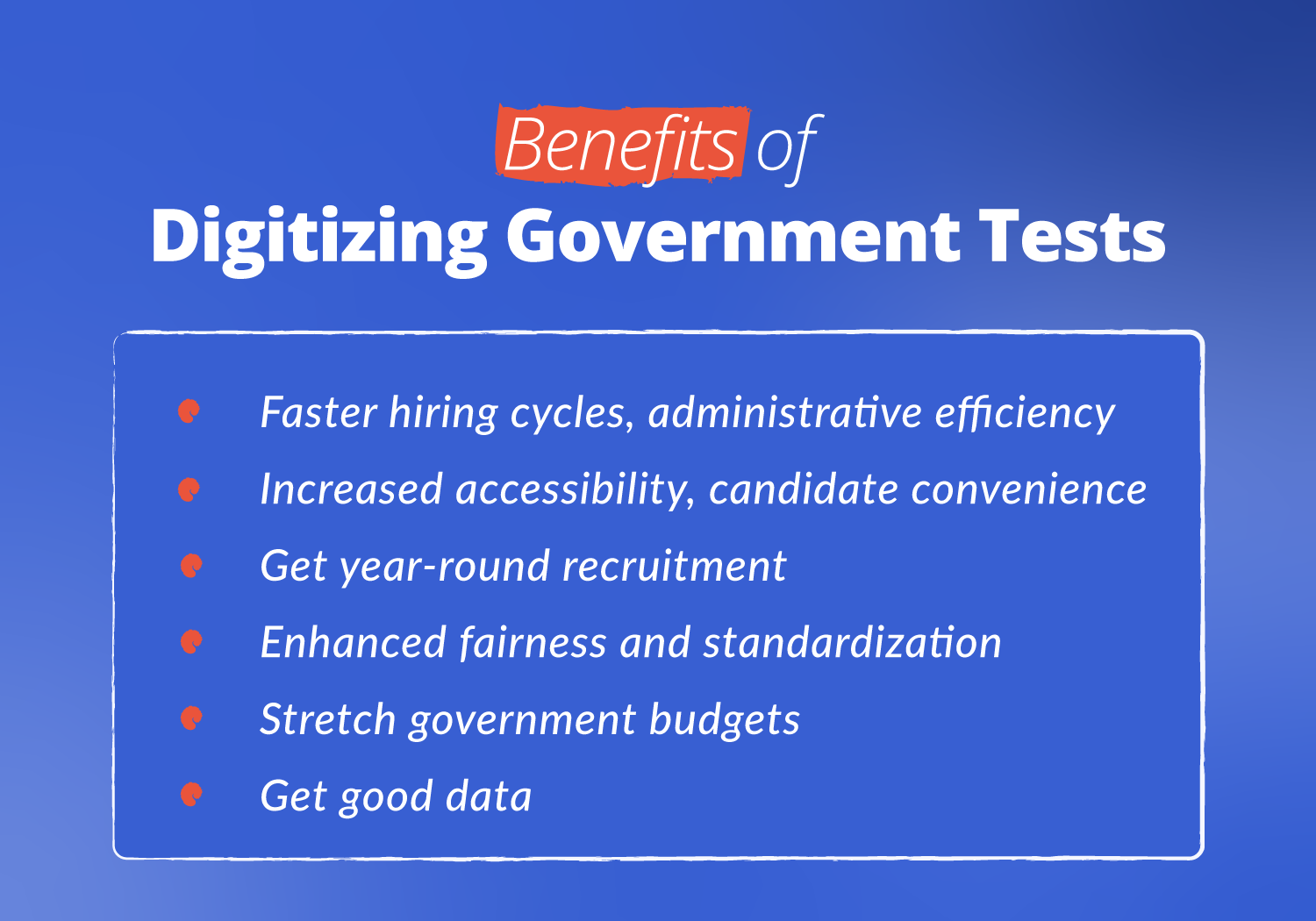
Faster hiring cycles, administrative efficiency
One of the clearest outcomes has been a reduction in the time and labor required to administer exams and produce hiring lists. Automated scoring of online tests means results are available immediately or within days, rather than weeks.
California’s experience is instructive – when more exams went online, processing times were reduced, allowing the HR department to conduct more exams overall with the same staff.
In some cases, candidates see their scores as soon as they finish an online test, and eligibility lists can be generated almost on the fly. New York City, after opening its computer testing centers, was able to handle over 110,000 exam takers per year, with machine scoring replacing mountains of paperwork.
This efficiency also translates to cost savings: agencies save on printing thousands of test booklets and scantron sheets, renting exam halls, and paying proctors overtime to monitor large sessions.
Increased accessibility, candidate convenience
Digital testing has lowered geographic and scheduling barriers, making public jobs more accessible to diverse candidates. Under old regimes, someone interested in a state or city job might have had to travel to a testing center on a single Saturday morning that exams were offered. Now, with online exams, candidates from anywhere (including out-of-state or rural areas) can participate without costly travel.
In Seattle’s case, moving to continuous online testing for police not only expanded the pool nationally but also lets local candidates choose a convenient date rather than wait for a biannual test date. Remote proctoring means even a working adult can schedule an evening or weekend exam from home, accommodating those who cannot take time off to attend a weekday test.
Additionally, jurisdictions like NYC and LA that invested in computer labs ensure that those who lack personal computers or internet can still walk into a public facility and take a computer-based test on-site.
The result is a broader, more inclusive reach – agencies report increased numbers of test applications once they enable online options. Likewise, Louisiana OSE’s remote testing likely opened up opportunities in towns where people previously might not have bothered to drive hours to a test center.
Flexibility equals accessibility, and digitization has provided that in spades.
Year-round recruitment
Like we’ve mentioned, the City of San Antonio tests for firefighters once a year. Many other cities still using paper civil service exams for public safety roles also follow a pretty sparse schedule. But cities like Seattle, by adopting online civil service exams, can now test candidates year-round.
Because administering an online test is low-cost and not constrained by physical logistics, agencies can keep exam postings “open” year-round or offer them monthly/quarterly.
This benefits workforce planning – vacancies can be filled as they arise rather than waiting for the next test date to produce a new list. It also leads to a bigger pool of candidates to fill roles and ensure candidates aren’t lost just because they missed a one-time exam date.
Continuous testing also dovetails with modern hiring practices by enabling just-in-time recruitment and reducing the reliance on long eligibility lists that may go stale. In practical terms, an agency that switched to online testing can post a job and test applicants within the same month, which was nearly impossible under the old batch exam system.
This responsiveness is particularly important for fast-changing fields like IT, where waiting a year for an exam could mean losing talent to the private sector. Now, tests are keeping pace with hiring needs.
Enhanced fairness and standardization
When properly implemented, digital exams can enhance fairness in several ways. First, computer-based administration standardizes the testing experience – every candidate gets the same timed sections, identical presentation of questions, and objective scoring, free from potential variations in proctoring or human error in scoring. The removal of handwritten answer sheets eliminates risks like scoring mistakes or illegible responses.
Many online tests for government roles also incorporate item-banking and randomization (delivering questions in random order or drawing from a large question pool) to ensure no candidate has an undue advantage – techniques harder to execute in paper format.
Additionally, new types of assessments aimed at fairness have been deployed on digital platforms: for example, situational judgment tests, interactive simulations, or multi-media questions that can better evaluate soft skills and reduce adverse impact.
It should be noted that fairness gains depend on careful test design; nonetheless, the digital format has enabled broader use of validated testing tools and consistent conditions for all examinees.
Talk to sales to learn more about how the eSkill platform can help you hire.
Stretch government budgets
Government roles are one of the only types of positions where you have to pay to apply. Talk about hiring barriers. Some cities charge candidates a fee to apply for roles or take civil service exams.
But with online testing, cities and states may be able to waive fees more frequently or cut them altogether.
Although exact savings vary, many governments have reported cost benefits from exam digitization. Printing and mailing costs drop to near zero. Overtime or temp staffing for large test administrations can be reduced because smaller rolling test sessions or on-demand testing require fewer proctors at any given time.
Facilities rental for big exam halls is also eliminated when people test from home or existing computer labs.
On a state scale, those savings can be much larger. Additionally, faster hiring yields cost avoidance – vacancies get filled sooner, improving agency productivity and reducing overtime costs from staff covering empty positions.
While there are upfront investments (software licenses, platform development, and equipment), the return on investment has generally been positive as per the growing adoption.
Get good data
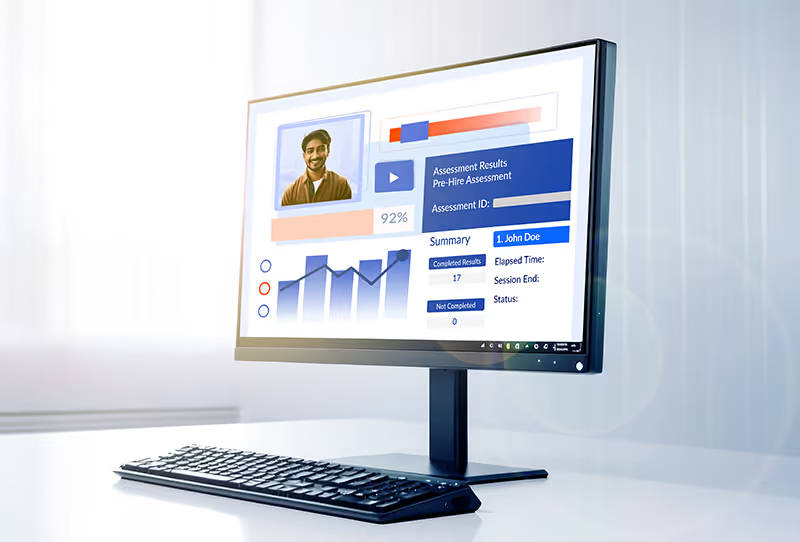
An often-overlooked benefit is that digital exams produce rich data for HR analytics. Item-level data can be analyzed to improve test questions (for example, you can see which items might be too easy or have disparate impact).
Agencies can more easily monitor their applicant flow and pass rates by demographics to ensure compliance with EEO goals, because results are stored electronically. For example, if a city finds that an online exam has lower pass rates for a certain group, they can quickly flag that and review the test for potential biases – a process that was slower with paper exams scattered across files.
Additionally, online systems enable audit trails (logs of candidate answers, time taken, proctor flags, etc.) which help investigate any challenges or appeals. All of this contributes to a more transparent and accountable merit system.
Paving the way to full digitization
Many agencies kept in-person testing centers as a safety net. New York City’s approach to open CTAC computer centers in every borough was explicitly to avoid leaving behind those without home internet or devices.
Even so, advocacy groups sometimes worry that older applicants, in particular, might struggle with an online interface or be less comfortable typing out essay responses versus writing on paper.
Agencies must continuously ensure that online exams are as user-friendly as possible and that alternative arrangements exist for those who truly cannot access them.
The consensus is that digitization should increase access, not decrease it; thus, public-sector employers are careful to monitor participation rates across demographics as they implement online testing.
Accessibility and accommodations
Ensuring online exams are accessible to people with disabilities is both a legal requirement and a moral imperative.
Additionally, certain accommodations that were straightforward in person (like a human reader for a visually impaired test-taker or a private room for someone with ADHD) are more complex to deliver online.
Some remote proctoring platforms may not yet fully support assistive tech or may flag assistive behaviors as “suspicious” (for instance, a candidate talking aloud to themselves or using accessibility software might be misinterpreted by an AI proctor).
Agencies are working with vendors to improve this (for example, newer versions of testing software are adopting WCAG 2.1 standards and allowing live proctors to assist with accommodations).
In the meantime, many public employers choose to run dual systems (online and paper, when requested) to be inclusive.
Test security and cheating
Perhaps the most discussed controversy is whether online, especially unproctored, exams can be made secure against cheating. In a controlled testing center, proctors check IDs, watch for crib notes, and prevent collusion. Online, the fear is that candidates might look up answers, have someone else take the test, or otherwise gain unfair advantage.
Many state/local agencies have taken a cautious route by using remote proctoring. Good proctoring solutions allow for both human oversight, when necessary, and implement ant-cheat technology that automatically flags suspicious behaviors without overburdening human proctors.
Privacy and data security
Candidates may be uncomfortable with a stranger (or AI) watching them in their home via webcam and even doing “room scans.”
Many publish clear consent forms and FAQs about what data is collected (video, audio, screen capture) and how it’s used. Nevertheless, the idea that a recording of one’s bedroom or home office is stored on a server has raised eyebrows.
Agencies need to ensure that vendor systems have strong encryption and that exam content isn’t easily leaked (if questions get circulated online, it undermines the exam’s validity).
Achieving the right level of security without alienating candidates is an ongoing balancing act.
Transition pains
Change management is critical: agencies have had to train their staff on new systems and update civil service rules (sometimes a slow process) to officially recognize digital procedures.
Moreover, not every attempt at digitization succeeds on the first try – New York State actually discontinued a specific computer-based clerical test around 2008 due to issues and went back to decentralized testing for that title, illustrating that if the technology or implementation isn’t right, agencies may pull back temporarily.
The key has been for governments to learn and adapt – nearly all who faced early challenges have tried again with improved systems.
The point of digitized tests
While some cities have gone for fully remote (like Los Angeles), hybrid remote or in-person (like Seattle), or majority online but proctored in-person (like NYC), many municipalities exist somewhere on the remote-online-in-person-paper spectrum.
Still, some cities and states haven’t let go of paper testing and pencil-paper booklets.
The places that have, however? Candidates are benefiting from easier access and quicker results, and agencies are benefiting from faster hiring and lower costs per test administration.
That said, each jurisdiction navigates these waters in its own context.
Nonetheless, the prevailing view is that the challenges facing test digitization are being addressed one by one – through better technology, updated policies, and better approaches – and that digital testing is here to stay as a cornerstone of modern merit-based hiring in the public sector.
It’s time number-two pencils gave way to government’s number-one solution: online testing.