


Agencies at the federal level may not be hiring as much, but state-level and local government bodies are. How do these bodies handle the influx of federal laid-off applicants, while still being thorough with applications?
- Federal government layoffs in 2025 are driving more applicants to state and local jobs. Applications to federal roles dropped 40%, while state and local applications rose by 31% and 35%.
- State and local agencies face shortages in cybersecurity/IT, nurses, firefighters, 911 dispatchers, and more — all essential to community infrastructure and safety.
- Common pre-hire assessments for government include firefighter/police officer tests, clerical & administrative skills tests, data & digital literacy tests, public works assessments, and math & reading skills tests.
Federal jobs once symbolized stability, but in 2025, the trend is clear — Washington is downsizing.
As of mid‑2025, over 275,000 civilian federal employee layoffs have been announced — that’s roughly 12% of the civilian federal workforce. These reductions span key departments: the Department of Defense, Veterans Affairs, Health and Human Services, the USDA (including the Forest Service, NRCS, and National Park Service), and others like the Department of Education and State.
While DC has the spotlight for these layoffs, the reality is that most federal employees live in metropolitan areas beyond the capital — meaning the impact is nationwide.
Based on past federal layoffs, it’s expected that about 15% of these workers will join state or local governments.
And many cities and states are embracing these new workers — some, like the states of California, Virginia, New York, and the city of San Antonio have launched initiatives to invite these workers to apply to local public service roles.
Hiring interest, too, has shifted — applications to federal jobs dropped 40%, while state and local job applications jumped by 31% and 35%, respectively.
But managing an influx of applicants with a system often beset by bureaucratic hurdles — it takes roughly 3x as long to make a hire in the public sector versus the private — can create its own problems.
Couple that with the fact federal skillsets don’t always match local needs — workers used to desk jobs aren’t exactly the right fit for local fire departments — and that many state-, county- , and city-level hiring teams are still struggling to recruit and retain hires for key positions, and government HR departments are often overwhelmed and unable to process high volumes of candidates in an efficient manner.
How can local governments recruit the right candidates, speed up the hiring process, and still maintain appropriate oversight into hires?
The state of public sector employment
Local governments employ the majority of public sector workers — with roughly 15 million personnel, including hires for school districts, police, fire departments, park services, and utilities.
State governments follow, employing about 5 million workers. Together, the two make up the wide majority of public sector civilian employees and overall, state and local employment accounts for approximately 13 percent of the nation's workforce.
The federal government, on the other hand, employs around 2.3 to 3 million workers, excluding military and contractors. With the mass federal layoffs that took place this year, that number may be lower.
Local government agencies, on the other hand, added about 80,000 jobs in June 2025 alone, with most of the growth in education roles.
While civil service exams have long been key in federal, state, and local hiring processes, it’s important to note how they’ve been changing to adapt to new volumes of candidates and new hiring protocols.
Government civil service exams
Government civil service exams are standardized tests used by federal, state, and local agencies to ensure hiring is based on merit rather than favoritism. They measure the skills and abilities required for specific public sector roles — from administrative and law enforcement positions to technical and professional specialties.
Formats vary. Some tests are multiple-choice, others are written or performance-based. They may assess broad subjects like reading comprehension and problem-solving, or drill into job-specific technical skills.
Increasingly, governments are digitizing these assessments, allowing for online testing with secure proctoring to improve accessibility and efficiency. The federal government, for example, relies on USA Hire digital pre-hire tests to measure candidates’ general competencies.
However, not all municipalities rely on digital civil service exams or pre-hire testing. Some use civil service exams, but do so on pencil-and-paper. And some simply hire for roles based on resumes, rather than filtering by way of exam.
But faced with high volumes of applications, many government HR teams are finding digital tests increasingly worth it.
Most in-demand government roles
State and local governments across the U.S. continue to face labor shortages in critical roles, despite an influx of candidates.
In-demand roles span a number of fields and specialties. Some fields needing local support, like cybersecurity, are benefiting from federal talent pools looking for work. Others — like firefighters and 911 dispatchers — are still facing shortages.
These are some of the top in-demand roles for state and local governments.
Cybersecurity & IT Specialists
State and local agencies face constant threats (ransomware, data breaches) and have ramped up cyber hiring, but demand far outstrips supply.
A White House-supported study in Q3 2024 found ~1.58 million cybersecurity jobs open nationwide, with only 1.32 million workers available – a talent gap of 265,000 unfilled roles.
With growing security needs, many states are actively recruiting cybersecurity professionals — particularly those laid off from federal agencies. While for many in-demand local roles there appears to be a mismatch with federal skillsets, that’s not the case for cybersecurity.
Firefighters
Fire and emergency medical services are also experiencing staffing shortages, especially in fast-growing or rural communities. Many areas rely on volunteer firefighters, but volunteer numbers have dropped over 20% since the 1980s, leaving gaps that career firefighters must fill.
A shortage of wildland firefighters is creating serious capacity issues in the US Forest Service, while smaller counties (like Manistee, MI) are struggling to maintain volunteer responder pools amid rising emergency calls.
Police officers
Police agencies nationwide are struggling to recruit and retain officers. A 2024 survey of 1,158 law enforcement agencies found over 70% report recruitment is more difficult than five years ago. Departments are operating at only ~91% of authorized staffing on average (nearly a 10% vacancy rate).
Large cities and rural areas alike have unfilled police positions, and many officers are retiring or transferring to smaller agencies for better conditions.
In response to police staffing shortfalls, many municipalities are delegating non‑patrol duties to civilian staff — freeing sworn officers to focus on core enforcement tasks.
911 Dispatchers
Emergency call centers are in crisis-level shortage. Nationwide, 911 centers averaged a 25% vacancy rate from 2019–2022, with some centers over 70% unstaffed.
Dispatch centers struggle to keep enough staff to handle increasing call volumes, leading to fatigue and overtime for existing dispatchers.
The role remains high-stress with high turnover. As of 2025, nearly all jurisdictions report dispatcher shortages, often requiring mandatory overtime to cover shifts.
Public Works Laborers and Skilled Tradespeople
State and local public works agencies report significant demand for skilled trade workers – including electricians, plumbers, HVAC technicians, equipment operators, mechanics, and general maintenance crews.
These “boots on the ground” roles have been hard to fill, as private construction and industry often offer higher wages.
Indeed, surveys show maintenance jobs have among the fewest qualified candidates per opening, with over half of governments not getting enough applicants for these roles.
K–12 Teachers
The teaching profession is experiencing a well-documented shortage across virtually all states.
By 2024, an estimated 406,000 teaching positions nationwide were either unfilled or filled by under-qualified teachers – roughly 1 in 8 classrooms lacking a fully certified teacher.
A National Center for Education Statistics survey found 74% of school districts struggled to hire enough qualified educators for the 2024–25 school year, with special education, science, and foreign language teachers being the scarcest.
Rural and high-poverty districts are especially hard-hit.
The situation has improved slightly from the peak of the pandemic teacher exodus, but remains critical: about half of educators say their schools are still understaffed, impacting workload and class sizes.
Registered Nurses, EMTs and Paramedics
Nurses are in high demand nationwide, and state and local government healthcare facilities are no exception. Public hospitals, state psychiatric hospitals, correctional healthcare units, and local public health clinics have faced severe nurse shortages.
For example, some state-run hospitals report vacancy rates well into the double digits for nursing staff. The nursing shortfall is exacerbated in the public sector because private hospitals often offer higher pay.
Many of these government roles are impacted by a number of issues — long time-to-hire (during which candidates might find roles elsewhere), inability to single out qualified candidates or applicants with sufficient aptitude to learn on-the-job, high turnover, and recruitment problems.
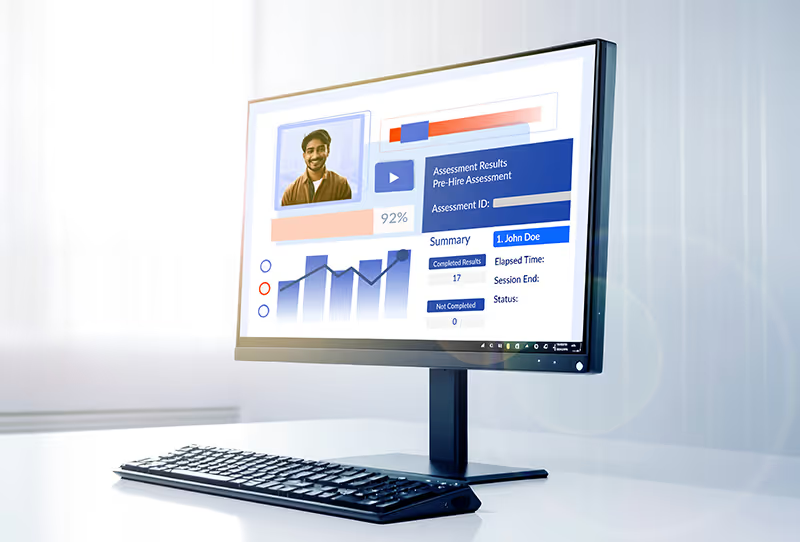
Using pre-hire tests can relieve at least some of these problems — shortening time-to-hire, identifying the right candidates, and reducing turnover as a result.
Talk to sales to learn more about how the eSkill platform can help you hire.
The top five government pre-hire assessments
Governments can use general pre-hire tests to test aptitude for roles — like basic math and reading skills — or they can test for specialized roles, like administrative positions.
Typically, pre-hire tests are used for high-volume roles.
Here are five of the most common and valuable pre-hire assessments for government jobs.
Firefighter and police officer tests
Public safety positions require candidates who can think quickly, follow strict procedures, and remain calm under pressure. Pre-hire assessments for firefighters and police officers often include situational judgment questions, which measure decision-making skills in high-stakes or emergency scenarios, and cognitive ability tests to evaluate reading comprehension, memory recall, and reasoning.
Many municipalities also require psychological evaluations and background checks to ensure candidates meet the demands of the role.
Clerical and Administrative Skills tests
Administrative and clerical roles are the backbone of government operations, ensuring that records are accurate, correspondence is managed, and systems run smoothly.
Common clerical skills tests may assess:
- Typing speed and accuracy
- Filing and data entry
- Proofreading and grammar
- Microsoft Office or other software proficiency
- Organization and prioritization skills
For example, a county clerk’s office might require a candidate to complete a simulation of processing requests under time constraints.
Data and digital literacy tests
Government roles increasingly require comfort with data handling, cybersecurity awareness, and digital tools. Data and digital literacy tests measure a candidate’s ability to:
- Use spreadsheets and databases for recordkeeping and reporting.
- Interpret charts and graphs for decision-making.
- Understand cybersecurity basics to protect sensitive citizen data.
- Navigate specialized government platforms, such as permit systems or case management software.
With the rise of e-government services, digital competency is now essential for even traditionally “non-technical” roles.
Public works
Public works departments handle vital community infrastructure like roads, water systems, and public spaces. Pre-hire testing ensures workers have the right mix of technical skills and safety awareness.
Assessments may include:
- Mechanical aptitude tests for equipment operation and maintenance.
- Safety and compliance knowledge tests aligned with OSHA or municipal regulations.
- Basic construction math for measurements, load calculations, and project planning.
- Reading blueprints and schematics for repair or installation work.
These tests help ensure new hires can work safely and effectively from day one.
Math and reading skills
Even if the role isn’t highly technical, most government jobs require a baseline level of math and reading comprehension. Assessments in this area may test:
- Arithmetic (addition, subtraction, multiplication, division)
- Fractions, decimals, and percentages
- Word problems for applying math to real-world scenarios
- Reading comprehension for understanding policies, legal texts, and procedural instructions
These core skills support accuracy and efficiency across all levels of public service.
How eSkill can help you test for government roles
eSkill’s customizable assessment platform makes it easy for federal, state, and local agencies to design tests tailored to specific roles. Whether you need a ready-to-use civil service exam or a blended test that combines multiple skill areas — like situational judgment, clerical accuracy, and math.
With our platform, you can:
- Choose from thousands of validated questions (or add your own)
- Create multi-subject assessments to reflect the exact requirements of the role
- Deliver tests online, with secure remote proctoring options
- Get instant scoring and detailed reports to make fair, data-driven hiring decisions.
By streamlining the assessment process, eSkill helps agencies hire qualified candidates faster while maintaining compliance and fairness. When it comes to governments struggling with high volumes of candidates or high-turnover positions, our tests can help you find the right people for your roles.