

92% of U.S. jobs require digital skills. A third of workers don't have them. And the gap isn't distributed evenly across people, places, or paychecks. Here's what employers need to know about testing for basic computer skills in a workforce that's more digitally divided than most people realize.
- 92% of U.S. jobs now require digital skills, including 95% of entry-level positions. But roughly one-third of American workers still lack foundational digital proficiency. The gap is widest in rural areas, among older workers, and in industries that only recently went digital.
- The digital skills gap is also a pay gap. Brookings research found that high-digitalization jobs pay an average of $79,000, compared to $35,000 for low-digitalization roles. Employers who verify digital proficiency at the point of hire aren't just screening better. They're setting candidates up for higher-earning careers.
- Resumes don't capture computer skills accurately. Self-reported proficiency is unreliable, and AI-polished applications make it worse. A short digital literacy simulation tells you in 15 minutes what a resume can't tell you at all.
Why one-third of workers still lack basic computer skills
There's a common assumption that in 2026, everyone knows how to use a computer. It's wrong, and it's costing employers time and money.
The National Skills Coalition and the Federal Reserve Bank of Atlanta analyzed 43 million job postings and found that 92% of U.S. jobs require digital skills. For entry-level roles requiring zero to two years of experience, that number jumps to 95%. At the same time, roughly one in three American workers lacks foundational digital skills. Not advanced programming. Foundational. As in: navigating a web browser, managing files, using email, and working in basic office applications.
This isn't a niche problem. It shows up in every industry that hires at volume. Healthcare support staff who can't navigate an EHR system. Warehouse workers who struggle with inventory management software. Retail employees who freeze when the POS system throws an error. Administrative assistants who can't build a basic spreadsheet. These are real, recurring hiring failures that a 15-minute assessment could have prevented.
The geographic divide in digital skills
The digital skills divide isn't evenly distributed.
Brookings Metro's analysis of digitalization across 761 occupations found that the gap plays out sharply across geography. In large metro areas, 30% of jobs have a high digitalization level, while in micropolitan and rural areas, that drops to 20%.
Heartland cities like Morristown, Tennessee, and Brownsville, Texas, sit at the bottom of the digitalization scale, while tech hubs like San Jose and Washington, D.C. perhaps unsurprisingly sit at the top.
That geographic divide translates directly into pay. High-digitalization jobs typically pay more than low-digitization jobs, and the wage premium for digital proficiency has actually grown over the last decade.
For employers hiring in regions where broadband access has only recently expanded or where the local workforce skews toward industries that didn't historically require computer skills (think manufacturing, agriculture, construction), you’re looking at a major skill gap that’s no one’s fault.
You can't assume a 25-year-old candidate in a rural county has the same digital baseline as one in a metro tech hub. Testing eliminates the assumption.
Government investment in digital skills training
State and local governments have recognized the digital skills gap as an economic development issue, and they're putting big money behind it:
- Delaware partnered with Google in August 2026 to expand digital skills training through the Grow with Google program, targeting residents who need foundational technology skills for workforce entry.
- Morris County, New Jersey, received a $1 million digital literacy grant to train workers in basic computer proficiency and job-readiness skills.
- Boston invested $1 million to expand digital literacy programming across the city, focusing on underserved communities.
These investments show that there's a growing pool of workers who are actively building digital skills through non-traditional pathways. Certificate programs, library-based training, community college courses, and government-funded workforce programs are all producing candidates who have impressive computer skills.
However, these candidates might not have the traditional credentials or work history that make them visible in a resume screen. Skills-based hiring and objective testing surface these candidates. Degree requirements and keyword-matching ATS filters bury them.
How AI is raising the bar for computer skills in entry-level roles
AI tools are making it easier for candidates to produce polished, professional-looking applications, which means more people who lack basic computer skills can still submit impressive resumes.
At the same time, AI is raising the actual digital skill floor for most jobs, not lowering it. Workers now need to navigate AI-assisted tools, collaborate with automated systems, and work across more software platforms than ever.
This means there’s a growing disconnect between what candidates appear to be capable of on paper, and what they can actually do once you sit them in front of a keyboard.
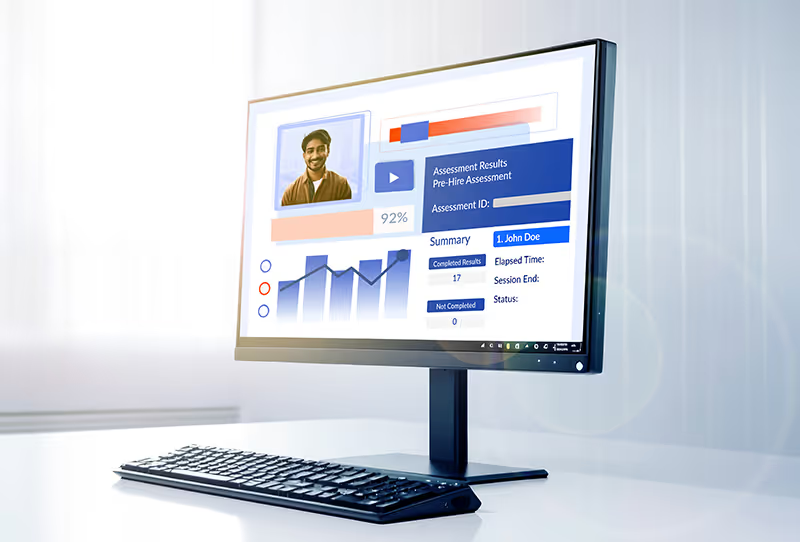
For recruiters, this makes objective computer skills testing perhaps more important than ever. A digital literacy simulation that puts candidates in a realistic computing environment and asks them to perform basic tasks like work in a spreadsheet or learn a project management tool provides a signal that no amount of resume-reading can replicate.
What to look for in a computer skills test
If you haven't used a computer skills assessment before, or if you're working with a dated version from a few years ago, here's what a well-built test looks like in 2026:
- Basic digital literacy. Can the candidate navigate a desktop, use a browser, manage files and folders, and understand basic cybersecurity practices? This is the baseline, and it's where a surprising number of candidates fall short.
- Microsoft Office proficiency. Excel, Word, Outlook, and PowerPoint remain the backbone of most office environments. Simulation-based questions that place candidates in a working application and ask them to perform actual tasks (format a spreadsheet, schedule a meeting, create a document) are far more revealing than multiple-choice questions about what a feature does.
- Typing and data entry accuracy. For roles that involve high volumes of data input, correspondence, or documentation, speed and accuracy are measurable and predictive of on-the-job performance.
- Multi-tasking and chat simulations. Plenty of entry-level roles now require working across multiple screens and communication channels simultaneously. Simulation-based assessments that replicate this environment test a skill that's nearly impossible to evaluate in an interview.
The strongest assessments combine several of these areas into a single, role-specific test. A candidate applying for a front desk role at a medical clinic needs a different mix than one applying for a logistics coordinator position. The test should reflect the job, not a generic benchmark.
Closing the digital skills gap at the point of hire
The digital skills gap is real, it's geographic, it's economic, and it's not going away on its own. Government investment in digital literacy is helping, but employers can't wait for the entire workforce to catch up. What they can do is verify, at the point of hire, that candidates have the foundational computer skills the role requires.
A short assessment can both filter out candidates who aren’t quite ready for your role, but it also can surface candidates who are ready but whose resumes don't show it, people who learned through workforce programs, self-study, or on-the-job experience rather than formal education. This can significantly expand your candidate pool and go a long way in helping you find the right person for the job.
See how eSkill's digital literacy and computer skills assessments work