

The accounting talent shortage isn't letting up. With 1% unemployment for accountants, 115,000+ annual openings, and a pipeline that can't keep up, hiring the right finance and accounting staff has never been harder or more important to get right.
- The accounting profession is facing a massive shortage. 115,000+ openings per year, a 1.0% unemployment rate for accountants, and a shrinking pipeline of new graduates mean every open role is a competition.
- The CPA still matters for audit and public accounting, but employers increasingly need hybrid skills. 87% of finance leaders are paying premiums for candidates who combine technical accounting knowledge with data analytics, Excel proficiency, and advisory capabilities.
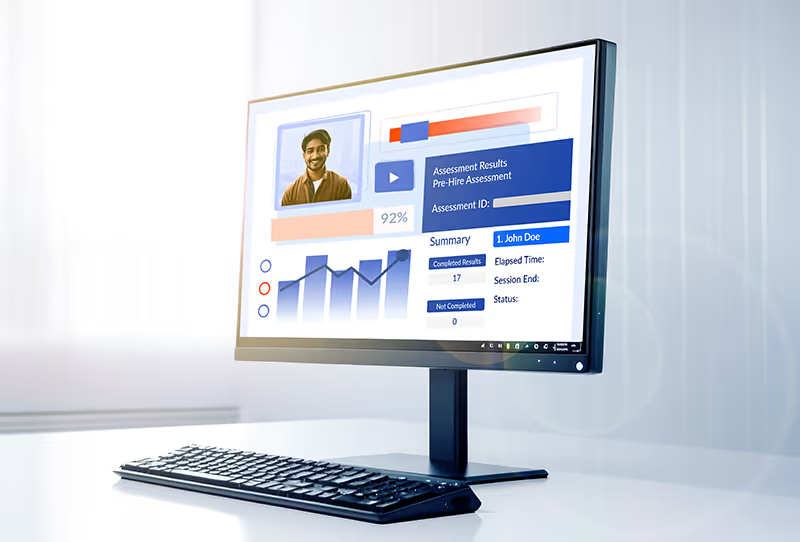
- Pre-hire testing gives you a faster, more objective way to verify skills before the offer. When the talent pool is this thin, you can't afford to spend weeks interviewing candidates who look great on paper but can't reconcile a ledger or navigate a pivot table.
There's a reason accounting and finance roles consistently rank among the hardest positions to fill. The talent pool is small, the stakes are real high, and every bad hire shows up directly on the balance sheet.
Whether you're staffing a bookkeeper for a small practice or a senior accountant for a mid-market firm, the challenge comes down to knowing how to verify that someone actually has the skills you need before you make the hire.
The accounting shortage is getting worse
The Bureau of Labor Statistics projects 5% growth and roughly 115,300 openings per year for accountants and auditors through 2035. On the bookkeeping side, the BLS projects about 144,100 annual openings for bookkeeping, accounting, and auditing clerks, though overall employment in those roles is expected to decline 6% as automation absorbs more routine tasks.
The supply side is where things get painful. Accounting graduates dropped roughly 47,000 in 2023, down 10% from 2021. With 75% of CPAs having reached retirement eligibility by 2020, the replacements aren't coming fast enough.
There is a current small bright spot in enrollment, with AICPA data showing accounting enrollment at four-year colleges rose 8.9% in spring 2026, but that's growth off a historically low base that will take years to materially affect the pipeline.
Unsurprisingly, 61% of finance and accounting leaders say finding skilled talent is harder than it was a year ago, even as 74% plan to increase permanent headcount in the second half of 2026. The demand is there. The candidates aren't.
What employers actually need to test for
The days of hiring an accountant who only needs to know debits and credits are long gone. Finance teams are being asked to do more strategic, advisory work, and the skills profile has shifted accordingly.
Here's what matters in 2026, role by role.
Bookkeepers and accounting clerks
The core skills for bookkeeping and accounting clerks are still foundational, which includes accounts payable and receivable workflows, general ledger management, bank reconciliations, and a solid grasp of accounting fundamentals.
However, even at this level, employers need people who can work in digital environments with minimal ramp time.
Skills tests to consider:
- Accounting and Bookkeeping Principles
- Numerical Proofreading
- Data entry accuracy
Staff and senior accountants
Financial accounting knowledge is important, but Excel competency matters a great deal here.
Accountants live in spreadsheets, and need to know how to navigate VLOOKUPs, pivot tables, conditional formatting, and nested formulas. Excel simulation assessments that put candidates in a working environment and ask them to perform actual tasks are far more revealing than asking someone to rate their own Excel skills on a scale of 1 to 10.
Skills tests to consider:
- Financial Accounting
- MS Office – Excel Simulation
- Numerical Proofreading
- Attention to detail
Compliance-adjacent roles
Risk and regulatory knowledge increasingly drives the hire for compliance-focused roles. Finance is one of the most heavily regulated industries, and roles touching audit, financial reporting, or banking need candidates who understand compliance frameworks specific to their sector.
Skills tests to consider:
- Anti-Money Laundering
- Know Your Customer protocols
- Regulatory compliance fundamentals
Public accounting and audit roles
The CPA remains the most influential credential. The new CPA exam structure reflects the profession's evolution, adding discipline sections in business analysis, information systems, and tax compliance alongside the core.
But while CPA credential tells you someone passed an exam, it doesn't tell you how they perform under the day-to-day pressure of close cycles, client deliverables, and shifting deadlines. Supplementing the credential check with a skills assessment fills that gap.
Skills tests to consider:
Why "good on paper" isn't good enough in accounting
When it comes to staffing your firm, the consequences of a bad hire are significant. A marketing hire who underperforms might produce weaker campaigns, but an accounting hire who underperforms produces errors in your financials, compliance gaps in your reporting, or reconciliation backlogs that cascade through the close cycle.
And the hiring landscape only makes this worse. When talent is scarce, there's pressure to move fast and extend offers before candidates accept elsewhere. But speed without validation is how you end up three months into onboarding someone who can't handle the work. This just costs you the time and money you were trying to save, plus the institutional knowledge of whoever left because they burned out covering for the temporary new hire.
A well-built pre-hire assessment gives you an objective data point on whether someone can actually do the accounting work you need done. It can help you ensure that their skills are current, accurate, and deep enough for your real-life, day-to-day needs.
For financial services organizations using eSkill, the strongest assessments combine multiple skill areas into a single test to assess any of the following:
- Accounting fundamentals alongside Excel simulation
- Numerical proofreading alongside attention to detail
- Compliance knowledge alongside data entry accuracy
This mix-and-match approach produces a more complete picture than any single-subject test can provide, and it's customizable to the actual demands of the role you need to hire for.
The hybrid skill set is the new baseline
CPA Practice Advisor reported in August 2026 that CPA firms are now facing a "dual talent crunch," struggling to find both workers and essential skills. Leaders increasingly need professionals who pair core technical accounting with data analytics, AI fluency, and advisory capabilities.
This shift means testing needs to go beyond making sure that accountants can manage a simple data entry. Now, employers need to be looking for candidates who can work across systems, interpret data for non-financial stakeholders, and adapt as automation reshapes which tasks are handled by humans.
Getting it right when you can't afford to get it wrong
The accounting talent market in 2026 is defined by scarcity. There aren't enough qualified candidates, the ones who are available have leverage, and the cost of a bad hire in finance is higher than in almost any other function.
Pre-hire skills testing doesn't solve the supply problem. Nothing does, short of time and pipeline investment. But it does solve the verification problem. It tells you, before the offer, whether a candidate's skills match the role's actual demands. In a market where you're competing for every qualified accountant, that clarity is worth its weight in billable hours.
See how eSkill helps financial services organizations hire with confidence