

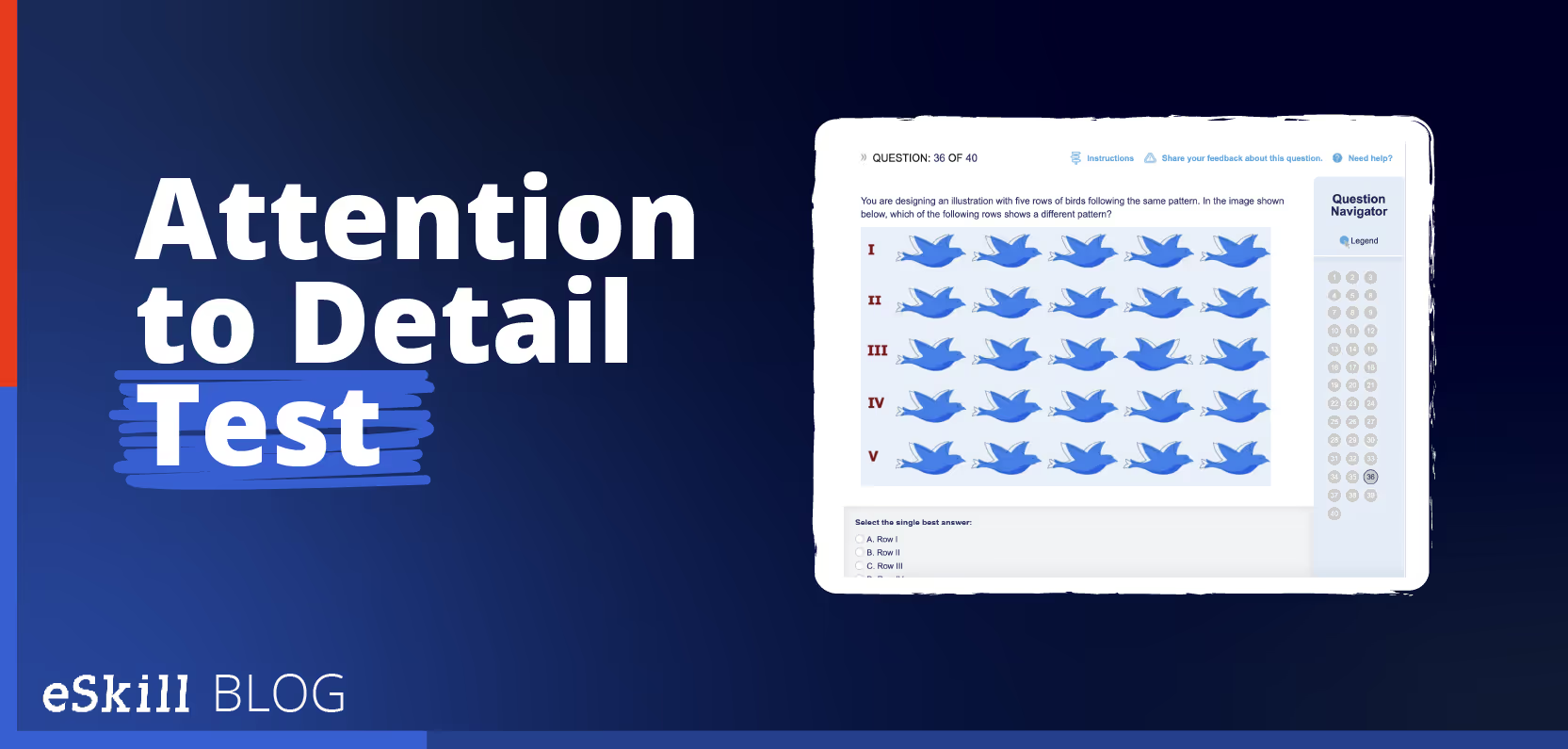
Welcome to eSkill’s Test of the Month! In these posts, you’ll find information on popular eSkill assessments from our library of more than 600 subject types. This month, we’re spotlighting our Attention to Detail subject test.
An Attenton to Detail test can determine if an applicant has the skills to —
Wait, did you catch that?
The missing “i” in the second word of the first sentence? If you did, you might have the chops to ace an Attention to Detail test.
But being attentive to detail goes far beyond spotting spelling errrors.
An Attention to Detail test can determine if an applicant has the basic chops for roles that require one to be focused on the minute details of a process — manufacturing positions, for example, or medical assistant roles — where detail, like dosage amounts, are crucial for patient outcomes. Data entry, too, requires a worker who’s extremely attentive to detail — lest they slip up and incorrectly bill someone nine hundred dollars over the expected amount (Oops! Those silly zeroes).
An Attention to Detail Test helps employers identify candidates who can stay focused, spot small errors, and maintain accuracy in high-stakes environments. Whether it’s manufacturing, healthcare, finance, or data entry, precision is critical — more than a fuzzy little detail might let on.
What is attention to detail?
Attention to detail is the ability to notice, process, and correct small errors or inconsistencies while maintaining accuracy and quality in work.
It involves being thorough, organized, and observant — catching mistakes others might overlook and ensuring every part of a task meets specific standards or requirements.
In a workplace context, attention to detail shows up in activities like proofreading documents, following instructions exactly, checking data for accuracy, or assembling products according to precise specifications.
Ideal Industries & Jobs
Attention to detail is a broad and highly relevant skill, so it can be applied to many different industries. Here are just a few.
Finance & Accounting
Attention to detail tests help employers identify candidates who can spot discrepancies in invoices, reconcile accounts accurately, and follow complex financial procedures without mistakes.
Healthcare & Medical Administration
An Attention to Detail test helps evaluate a candidate’s ability to maintain meticulous records, enter data correctly, and adhere to strict documentation standards. It’s especially relevant for medical coders, billing specialists, and administrative staff handling sensitive health information.
Legal & Compliance
In legal and compliance fields, precision and thoroughness are everything. An Attention to Detail test can assess how well candidates review lengthy documents, catch inconsistencies, and ensure all information aligns with legal requirements. Employers use it to identify professionals who can manage complex documentation with zero tolerance for error.
Manufacturing & Quality Assurance
In manufacturing and quality assurance, attention to detail ensures that every product meets specifications and safety standards. This test can measure an individual’s ability to identify defects, follow procedures precisely, and document findings accurately — which is particularly useful for positions on the production line or inspection.
Data Entry & Administration
Administrative and data entry roles depend on accuracy and consistency across repetitive tasks. Attention to Detail tests help employers verify that candidates can process large volumes of information without typos, transposed numbers, or skipped steps.
Government & Civil Service
Government and public sector roles often involve handling sensitive data, following regulations, and processing complex paperwork. Attention to Detail tests help ensure that employees can review applications and maintain compliance with strict procedural rules, all without overlooking critical details.
What does the Attention to Detail test cover?
The Attention to Detail test covers a number of subjects, including verbal reasoning, visual attention, and math-related attention. Not all the different question types will apply to all roles — so we encourage our clients to pick-and-choose the types of questions that are most relevant for the roles they’re hiring for.
- Analogies
- Email and Letter Etiquette
- Finding Errors
- Basic Spelling
- Organization
- Time Management
- Numerical
- Observation
- Design Work
- Analytical Skills
- Word Order
- Word Analysis
Test format
The Attention to Detail test is mostly a multiple-choice test, and that includes true/false questions and select-all-that-apply. Some questions are paired with visuals, basic math problems, short passages, or other relevant materials.
Complementary questions
We consider Attention to Detail an aptitude test — that is, it can determine whether someone is ready to learn on-the-job. Accordingly, we recommend similar question types if you’re testing for entry-level roles or positions where there’s a significant amount of on-the-job training involved.
- Problem Solving
- Critical Thinking
- Data Checking / Error Spotting
- Logical Reasoning
- Verbal Reasoning
- Following Instructions
- Task Simulation
Of course, if you want to test for specific job-related knowledge (like welding or medical terminology), we have tests for that, too.
Why use the Attention to Detail test?
An Attention to Detail test helps employers identify candidates who can work accurately, thoroughly, and efficiently — qualities that directly impact quality, safety, and even customer trust.
In almost every industry, small mistakes can lead to costly errors, compliance issues, or wasted time spent fixing mistakes.
Ultimately, Attention to Detail testing helps organizations build a workforce that values precision and accountability, qualities essential to success in finance, healthcare, manufacturing, tech, and beyond.
With eSkill, you can build Attention to Detail tests that fit your exact needs. That means whether you’re hiring for precision assembly, patient data accuracy, or financial compliance, you can find the question types that suit the exact type of detail you expect employees to notice, and correct. That could mean the smallest spelling erroor, that extra zero on the invoice, or a single weak welding joint that could compromise an entire structure’s integrity.
When it comes to hiring the right person, it pays to sweat the small stuff.
Talk to sales to learn more about how the eSkill platform can help you hire.