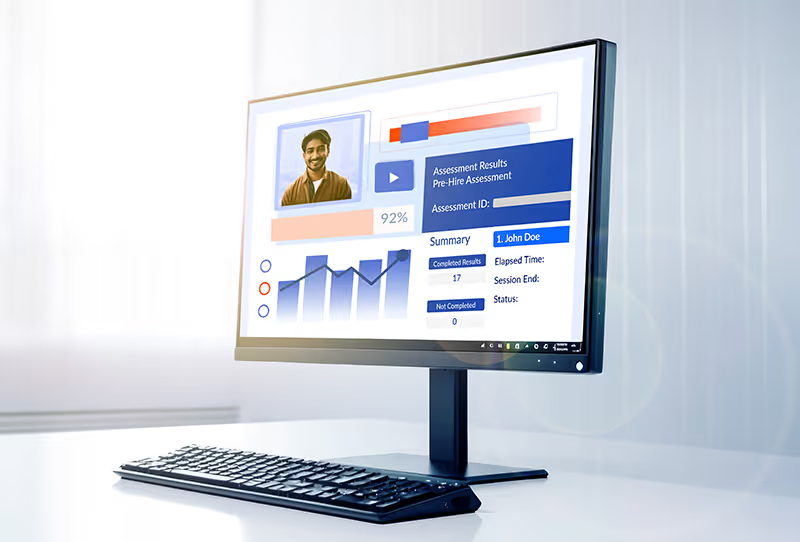


Welcome to eSkill’s Test of the Month! In these posts, you’ll find information on popular eSkill assessments from our library of more than 600 subject types. This month, we’re spotlighting our Following Directions for Manufacturing assessment.
Manufacturers continue to face a tight labor market. The National Association of Manufacturers reported that the US could face a shortfall of 1.9 million manufacturing workers by 2033 if the industry cannot attract and train enough talent. The same research notes that skill requirements are evolving across technical manufacturing skills, digital skills, and soft skills.
As a result, competition for skilled labor in manufacturing remains high. As manufacturers invest in advanced tools and smart manufacturing, they must also invest just as intentionally in the evolving skillsets needed to use them. In a 2025 Deloitte report, over 30% of 600 manufacturing executives surveyed said their top concern was “equipping workers with the skills and knowledge they need to maximize the potential of smart manufacturing and operations.”
Sourcing skilled, capable talent that is capable of taking on training is one of the ways to do that. And one of the most basic things to measure is: can they follow complex directions?
Manufacturing is changing, but the fundamentals still matter
When people talk about the future of manufacturing, they often talk about robotics, artificial intelligence, automation, sensors, digital twins, and Industry 4.0. Pretty exciting stuff. But even the most advanced manufacturing environments still depend on people who can follow processes correctly.
Technology can make production faster and more precise, but it can also make instructions more complex. Contemporary workers often need to follow a digital workflow, interpret system prompts, complete machine setup steps, document quality checks, or escalate issues through the right channels.
The World Economic Forum’s Future of Jobs Report 2025 found that employers expect major skills disruption through 2030, with technology and workforce transformation reshaping the skills employees need. But that does not eliminate the need for foundational workplace skills — it makes them more important as the actual tools and systems workers need to learn rapidly evolve.
Following directions is one of those foundational skills — sitting underneath safety, productivity, quality, and trainability. Before someone can master a machine, learn a process, or move into a more technical role, they need to be able to understand and act on instructions.
Why aptitude in manufacturing increasingly matters
While employers still need workers who can operate equipment, assemble parts, move materials, and keep production running, many roles now require a stronger mix of digital skills and adaptability.
That makes aptitude even more important — employers are not just hiring for what candidates already know. They’re hiring for whether candidates can learn new processes, follow instructions accurately, adapt to updated tools, and make good decisions on the floor.
The World Economic Forum’s Future of Jobs Report 2025 also points to ongoing skills disruption through 2030, driven by technology, economic shifts, and changing business needs. Its findings emphasize the growing importance of skills such as analytical thinking, resilience, flexibility, agility, technological literacy, and curiosity and lifelong learning.
For manufacturers, that shift has practical consequences. A production worker may need to follow digital work instructions. A machine operator may need to interpret system prompts or adjust to updated procedures. A warehouse associate may need to move between physical tasks, inventory systems, scanners, labels, and documentation requirements. Even entry-level employees may need to learn quickly, pay attention to detail, and follow multi-step processes with consistency.
That is why aptitude-based skills like attention to detail, reading comprehension, problem-solving, mechanical reasoning, and in this case, following directions, matter. They help employers identify candidates who may be trainable, reliable, and ready to grow with the role — even if they don’t have years of direct experience yet.
Ideal Industries & Jobs
Following directions matters anywhere employees need to follow procedures, complete steps in sequence, comply with safety requirements, and maintain consistent quality.
While the exact responsibilities may vary by organization, the need for accuracy, attention to detail, and process discipline remains the same.
Manufacturing & Production
For companies hiring production workers, assemblers, line workers, machine operators, manufacturing technicians, or production associates who need to follow work instructions, complete repeatable tasks, and keep production moving safely and accurately.
Automotive, Aerospace, and Industrial Manufacturing
For employers hiring CNC operators, equipment operators, assembly technicians, quality control technicians, or material handlers who need to follow technical instructions, safety procedures, inspection steps, and production standards.
Food, Beverage, and Consumer Goods Production
For organizations hiring packaging operators, production associates, sanitation workers, line leads, or quality assurance support staff who need to follow strict procedures related to handling, labeling, cleanliness, timing, and quality control.
Warehouse, Fulfillment, and Distribution
For employers hiring warehouse associates, inventory associates, order pickers, material handlers, shipping and receiving associates, or fulfillment workers who need to follow order instructions, inventory procedures, labeling requirements, and safety protocols.
Pharmaceutical, Medical Device, and Compliance-Heavy Manufacturing
For organizations where documentation, safety protocols, production standards, and quality procedures require careful handling, strong attention to detail, and consistent adherence to instructions.
Staffing Firms
For staffing agencies screening candidates for temporary, contract, seasonal, or permanent manufacturing and warehouse roles before placement.
What does the Following Directions for Manufacturing assessment cover?
The Following Directions for Manufacturing test helps employers evaluate whether candidates can understand and apply instructions in a manufacturing context.
The assessment focuses on practical, job-relevant skills related to:
- Understanding written instructions
- Following multi-step directions
- Identifying the correct sequence of actions
- Paying attention to details
- Applying conditional rules
- Recognizing important conditions or exceptions
- Sorting and categorization
- Workflow sequencing and coordination
- Ensuring safety compliance
- Performing quality control and inspection
- Data and record accuracy
This test is especially useful for roles where employees need to follow standardized processes, safety procedures, production instructions, or quality requirements.
For high-volume hiring, this kind of assessment can be especially valuable. Recruiters and hiring managers may not have time to manually evaluate every candidate’s ability to follow instructions. A skills assessment gives them a more objective way to identify candidates who are more likely to succeed in the role.
Test format
The Following Directions for Manufacturing assessment is primarily a multiple-choice, true/false, and select-all-that-apply test designed to evaluate whether candidates can understand, interpret, and apply instructions in realistic workplace scenarios.
The test includes questions that ask candidates to:
- Follow written instructions
- Identify the correct order of steps
- Apply directions to manufacturing-related situations
- Recognize important details, conditions, or exceptions
- Choose the best response based on a specific instruction set
Because following directions is not just about reading comprehension, the test focuses on how candidates apply information. This helps employers assess whether a candidate can take instructions from a supervisor, work order, safety procedure, or process document and use them correctly on the job.
Complementary Questions
The Following Directions for Manufacturing test can be used on its own or combined with other eSkill questions to create a more comprehensive manufacturing assessment.
Depending on the role, employers may want to add questions from subjects such as:
- Mechanical Aptitude to assess how candidates understand tools, machines, and mechanical concepts
- Assembly Skills to test job-relevant process and sequencing skills
- Warehouse Skills to evaluate material handling, inventory, and order-related tasks
- Workplace Safety to measure safety awareness and procedure-following
- Attention to Detail to assess accuracy and carefulness
- Basic Math to evaluate measurements, counts, and simple calculations
- Reading Comprehension to assess how well candidates understand written workplace information
- Cognitive Skills to evaluate problem-solving and learning ability
- Typing or Data Entry for roles that require digital documentation or production system updates
For example, a manufacturer hiring production workers might pair Following Directions for Manufacturing with Assembly Skills, Workplace Safety, and Attention to Detail. A company hiring warehouse or material handling associates might combine it with Warehouse Skills, Basic Math, and Reading Comprehension.
This flexibility helps employers build assessments that match the actual demands of the role, rather than relying on a generic manufacturing test.
Why use the Following Directions for Manufacturing assessment?
Following directions may sound like a basic workplace skill, but in manufacturing, it has a direct impact on safety, quality, productivity, and training success.
For high-volume manufacturing hiring, the assessment gives recruiters and hiring managers a faster, more objective way to evaluate whether candidates have the foundational skills needed to succeed on the floor. It can also help identify trainable candidates who may not have extensive experience but can follow processes and learn quickly.
In an industry that’s facing massive changes — due to tariffs, reshoring initiatives, technology evolution, and skill shortages — having an adaptable and evolution-ready workforce should be a top priority. Foundational skills are a part of that.
Talk to sales to learn more about how the eSkill platform can help you hire.