
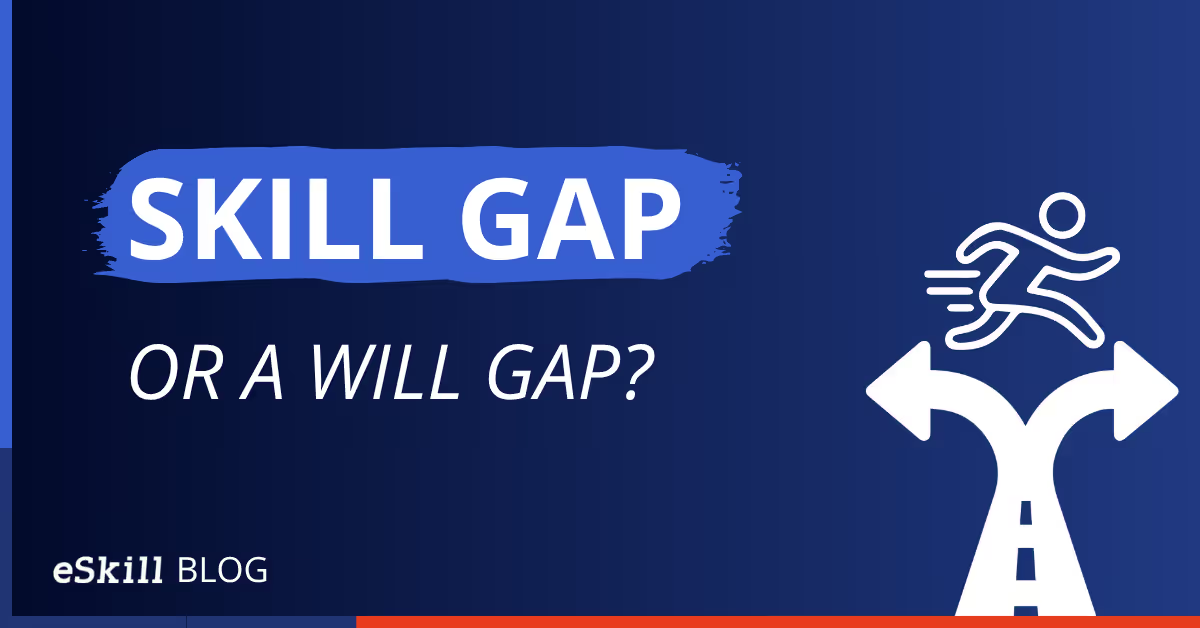
Your crash course in HR phrases coined by consulting firms, news websites, and TikTok influencers alike — ones that all point to overarching sentiments in the labor market around burnout and a lack of available jobs.
- McKinsey identifies skill, will, and time gaps as key drivers of lost productivity — costing a median S&P 500 company about $480 million annually, with the skill gap alone accounting for a 22% productivity loss.
- Employee disengagement is at record highs, reflected in viral work trends like quiet quitting, job hugging, and quiet cracking — all signaling widespread burnout, stalled growth, and fear-driven job retention amid a cooling labor market.
- While the labor market as a whole puts a damper on employee sentiment, employers can improve retention and motivation in their own workplaces through balanced workloads, career development, supportive leadership, autonomy, fair compensation, and psychological safety — addressing not just capability (skill) but also motivation and engagement (will).
A 2024 McKinsey report identifies three reasons for a “lack of productivity in employees.”
One: Workers don’t have the skills necessary to be successful in the role, i.e., the company is facing a skill gap.
Two: Employees aren’t engaged or energized by the work they’re doing, i.e., the company is contending with a will gap.
Or three: Workers spend time in ways that don’t increase value — like spending too much time in low-value meetings or not prioritizing their tasks well, i.e., workers are dealing with a time gap.
These three reasons together can cost a median S&P 500 company roughly $480 million a year — nearly half of which is due to attrition and vacancies as a result of skill, will, and time gaps.
On its own, the skill gap is responsible for $116 million of this figure, representative of a 22% reduction in productivity — by far the greatest drop among the three reasons identified. However, a lack of engagement can lead to $91 million in lost productivity, or a 6% drop.
Gallup, in fact, reports that employees who are disengaged at work cost the world $8.8 trillion in lost productivity.
We spend plenty of time talking about widespread skills gaps here at eSkill (if you could guess). Now, let’s take some time to cover the will gap. That includes all the popular terms, Tiktok-derived or otherwise — like quiet cracking, quiet quitting, job hugging — that testify to an all-time low for job satisfaction.
We’ll also go over what employers can do about it, especially in the face of overarching trends in hiring and work, some of the causes of which are outside HR’s scope or control.
Job satisfaction at an all-time low
Attrition levels may have fallen since the height of the pandemic, but disengagement levels are still high, according to McKinsey research.
According to Glassdoor data, mentions of the term “burnout” on the platform are the highest since they started collecting the data in 2016 — and 50% higher than Q4 2019, before the COVID-19 pandemic.
Part of this is due to employers assigning workers new job duties — without properly compensating them for expanded responsibilities. In a survey from MyPerfectResume of a thousand workers, over three-quarters said they’ve received new job duties without either a promotion or raise. Over half said they’d been promised promotions or opportunities that never came to pass (what is now being referred to as ghost growth), and over a third said they had never been appropriately compensated for an increased workload.
Talent will typically quit when they’re unsatisfied with their job growth — in fact, that’s part of the motion that led to The Great Resignation in 2021. Workers quit their jobs en masse to pursue more flexibility, greater pay, and more job opportunities in a post-COVID era.
And for the most part, they found those things. In 2021 and 2022, job switchers reported greater pay and greater satisfaction in their roles. However, in 2025, at least one of those factors has flipped — workers switching jobs tend to take lower paying roles, rather than higher-paying ones.
This, in turn, has led to the phenomenon of “job hugging” — where workers stick to their jobs, even if they’re unsatisfied. This is due to companies both downsizing — indicating a loss in job numbers, not a growth — and a lack of better opportunities.
And that dissatisfaction, without any escape, has led to these increased rates of burnout — and birthed a number of buzzwords, like quiet cracking and bare-minimum Mondays, that evidence an attempt by employees to balance work-life on their own terms.
An overview of terms that represent the will gap
A lot of these terms emerged out of the depths of social media, but the ideas and sentiments they represent have been around a lot longer. The conglomeration of terms, however, has demonstrated that worker dissatisfaction has reached a fever pitch.
Let’s go over the major ones, where they came from, and what they mean.
Quiet quitting
We’re starting with one of the most popular terms out of the bunch (which also happens to be one of the older ones). “Quiet quitting” refers to the practice of doing the bare minimum required by a job, putting in no more work than is absolutely necessary.
The term emerged on Tiktok around 2022, most often attributed to career coach Bryan Creely, who popularized the term through a TikTok clip.
Resume Builder did a study where they found 1 in 4 workers are quiet quitting — reporting disengagement and feelings of burnout. However, a majority (9 in 10) also said they could be incentivized to work harder.
Unlike what may be suggested by popular perceptions around the Gen Z work ethic, the majority of quiet quitters are those in the middle of their careers, in the 34 to 44 age range.
For quiet quitters, the top reasons (over 45%) for not going above and beyond involves not wanting to do more work for no additional pay, and not wanting to compromise their mental health.
Quiet quitting may lead to actual quitting, eventually.
That is, unless a worker is also job hugging.
Job hugging
Job hugging, a recent term coined by consultants at Korn Ferry in August 2025, arose out of the current unstable economic climate and mass layoffs rocking many industries. It describes the current tendency for employees to hang onto their jobs, not out of a sense of satisfaction or responsibility, but because of a fear about job security in a time when employment opportunities are at a low.
Let’s contrast that with the Great Resignation.
The Great Resignation of 2021 resulted from masses of individuals — buoyed by historic highs in job openings — who switched jobs and increased their wages in the process — but now, that trend has flipped.
It hasn’t happened since the Great Recession. Typically, “wages grow at a faster clip each year for workers who switch jobs, compared to those who stay in their current role.” Yet for the last six months, the annual wage growth for those who stayed in their jobs has actually been higher than that of job switchers. It’s not a huge margin, but it is evidence of a lack of job openings and opportunities.
According to a report from Eagle Hill Consulting, most employees plan to stay in their jobs for the next six months, and that workers’ confidence in the job market fell to its lowest level since the consulting firm began publishing its Employee Retention Index two years ago.
And if employees are job hugging out of a fear of job security, it might mean they’re also going through the motions — instead of feeling engaged at work.
It’s up to HR managers to sniff out whether employees are motivated or not, since it’s unlikely one will simply quit. They can’t just point at low turnover rates and say they’re doing a good job. That could mean looking at drops in performance, or looking at conversations with managers around development opportunities. It can also mean looking at internal mobility to see if employees are moving into different roles.
Quiet cracking
Quiet quitting is so 2022. Newsflash, we’re all quiet cracking now (some of us). Especially the ones of us who are job hugging.
While quiet quitting simply refers to comfortably doing the bare minimum at work, quiet cracking is the idea of persistent dissatisfaction in the workplace that leads to disengagement and poor performance — as well as the desire to quit.
The term was coined by TalentLMS in their report that polled a thousand employees in the US this past March. “Quiet cracking” was reported by over half of the US employees they surveyed, with 1 in 5 reporting experiencing workplace unhappiness frequently or constantly, while 34% experience it occasionally. Another 47% say they rarely or never feel unhappy at work.
It’s a feeling of disconnection to the work, and a feeling of resignation without actually resigning. It’s characterized by a lack of growth opportunities, and leads to decreased productivity.
Since the current job market provides limited opportunities for employees to escape their current roles, there’s no easy solution to quiet cracking.
In layman’s terms: we all used to quiet quit, but now since we’re also job hugging, we have to resort to quiet cracking. Understand?
Act your wage
The phrase “act your wage” doesn’t trace back to a single origin, but it found its footing on TikTok, where it became a rallying cry for workers questioning the value of overextending themselves at underpaying jobs. The term echoes the long-standing labor concept of “work-to-rule,” in which employees do only what their job descriptions require — nothing more, nothing less.
Some trace the phrase’s viral moment to 2020, when TikToker Stephanie Anne used it while discussing boundaries in the workplace. Others credit creator Sarai Marie Soto, who popularized “act your wage” in 2022 through her fictional character Veronica—a worker who humorously refuses to take on extra duties without extra pay.
Though its exact origins remain murky, “act your wage” has clearly struck a chord on TikTok and beyond, resonating with a generation disillusioned by unpaid overtime, shrinking raises, and the fading promise of hustle culture.
Bare-minimum Mondays
Another TikTok-born workplace trend, “bare minimum Mondays,” gained traction in 2023 as a rallying cry for easing into the week. The idea is simple: start Monday by doing just enough to get by — answering emails, tackling manageable tasks, and giving yourself space to reset after the weekend. Proponents frame it as a form of self-care, a way to reclaim autonomy in a culture that often demands constant output.
Advocates argue that slowing down at the start of the week can help prevent burnout and foster healthier boundaries, especially for workers navigating remote or hybrid schedules. Critics, however, see it as another sign of declining ambition — a symptom, not a cure, of a disengaged workforce.
Grumpy staying
Coined by Business Insider in 2023, “grumpy staying” describes a growing subset of workers who, while unhappy in their jobs, feel unable or unwilling to leave. The term captures the uneasy middle ground between “quiet quitting” and “quiet cracking” — employees who aren’t fully disengaged but have lost enthusiasm for their roles and see few viable alternatives in a cooling labor market.
Like quiet cracking, grumpy staying emerged in the aftermath of the Great Resignation, as the once-frenzied job market began to slow and workers who had hoped to jump ship instead found themselves stuck. The trend underscores a shift from empowered exits to reluctant endurance — an era defined less by quitting loudly or quietly, and more by staying put with a sigh.
Coffee badging
As return-to-office mandates tighten, some employees are finding creative ways to appear compliant — literally. The phenomenon, known as “coffee badging,” refers to workers who show up at the office long enough to swipe their badge, grab a coffee, chat briefly with coworkers, and then head home to continue working remotely.
According to a July survey by Owl Labs, which makes videoconferencing equipment, 44% of hybrid employees admitted to coffee badging—showing face just enough to be counted as “in the office.” A separate LinkedIn poll found similar behavior: 19% of respondents said they or their coworkers coffee badge regularly, while 31% had done so at least once. That translates to roughly one in five white-collar workers, estimates John Frehse, head of global labor strategy at consulting firm Ankura.
What began as a quiet act of rebellion has become a symbol of the growing tension between corporate RTO policies and employees’ desire for flexibility — a small, caffeinated protest against the return of office life.
Quiet firing
“Quiet firing” describes a workplace phenomenon in which employers indirectly push employees out rather than terminating them outright. Instead of issuing a formal dismissal, managers may create conditions that make an employee’s position untenable — such as withholding promotions, cutting hours, excluding them from projects, or offering little to no feedback — until the person leaves voluntarily.
The term gained traction in 2022 after recruiter Bonnie Dilber’s viral LinkedIn post brought widespread attention to the practice. While “quiet firing” isn’t new, its reemergence in the age of social media has reframed the conversation around power dynamics at work, prompting employees to recognize the subtler ways organizations sometimes offload unwanted staff without having to say the words “you’re fired.”
Lazy girl jobs
A Tiktok trend among Gen Z workers, “lazy girl jobs” represent changing attitudes toward work among younger groups and a rejection of hustle culture.
The phrase, popularized on social media, refers to roles that are stable, low-stress, and reasonably well-paid — jobs that allow young professionals to maintain financial security without sacrificing their mental health or personal time.
Advocates of the trend argue that these positions aren’t actually “lazy” at all, but rather a reclamation of balance in a labor market that often equates overwork with ambition. “
Loud quitting
Roughly One in five employees are now “loud quitting” — a term describing workers who are not just disengaged, but openly vocal about their dissatisfaction. Whereas “quiet quitting” reflected a subtler form of withdrawal — doing only what’s required and no more — loud quitting represents the next stage of workplace discontent, marked by frustration that spills into action.
Rather than just mentally checking out, loud quitters make their dissatisfaction known in ways that can directly undermine an organization’s goals. They may criticize leadership, resist direction, or discourage others — behaviors that, collectively, signal not only burnout but a breakdown in trust between workers and their employers.
Talk to sales to learn more about how the eSkill platform can help you hire.
Why so many terms?
It seems like every news outlet, LinkedIn influencer, or wannabe HR TikTok star is trying to coin a new term to describe employee burnout — loud quitting, grumpy staying, bare minimum Mondays, lazy girl jobs, quiet thriving — and it also seems like a lot of these terms could be used interchangeably (Is there really a difference between quiet cracking, quiet quitting, and grumpy staying?).
It’s because many different groups — news outlets, consulting firms, employees themselves — have independently converged on the same idea, and the same sentiments rumbling under the labor force.
Worker dissatisfaction is at a high, job opportunities are at a low, and things look pretty bleak. It’s no wonder terms are popping up here and there.
But luckily, HR managers and companies are in the position to do something about it, regardless of outside factors.
How to increase worker retention, close the will gap, and increase (healthy) productivity
With job openings at an all-time low and abundant mass layoffs across industries, the job market is bound to cause some disengagement. But even when the overall labor outlook is grim, companies can support their own workers and address the will gap in their own organizations.
In fields that struggle to hire, low pay and high stress are often part of the cause (911 dispatchers, nurses and support staff, for example) — but there are many additional factors that workers cite as just as or even more important than wages, like development opportunities.
When workers think about what they want, and what growth and support means to them, the answers are pretty straightforward: better pay, better work-life balance, leadership, a clear promotion path, autonomy, and the ability to upskill.
The social exchange theory
Social exchange theory (SET), rooted in sociology and social psychology, explains workplace behavior through reciprocity: when employees feel valued, supported, and treated fairly, they respond with higher performance, commitment, and citizenship behaviors.
This sense of mutual obligation underpins concepts like perceived organizational support, justice, trust, and psychological contracts — all key to engagement and retention.
Foundational work by Blau (1964) and Cropanzano & Mitchell (2005) shows that fair, supportive management drives positive employee outcomes by reinforcing this exchange dynamic.
However, critics argue that SET can be too broad and assumes equal, rational exchanges that don’t reflect modern work realities. In today’s global, hybrid, and tech-mediated environments, relationships are often more fluid and shaped by culture and context.
Researchers now advocate expanding SET to include factors like psychological safety, workplace spirituality, and virtual trust. Some employers now offer mental health incentives, like paying for therapy, gym memberships, and allowing for mental health days when employees need them.
Despite its limitations, the theory endures because it captures a core truth of organizational life: when employees feel their efforts are recognized and reciprocated, they’re more motivated to contribute to the organization’s success.
Fixing skill gaps
The gap between what employees can do (competence) and want to do (motivation) should be addressed via meaningful work, clarity, autonomy, feedback, and alignment.
When an organization faces a gap between what employees can do (competence) and what they want to do (motivation), that gap often signals misalignment — not just in skills, but in roles, incentives, and culture.
Addressing it meaningfully means giving employees work that matters, articulating clear purpose, and tying roles to outcomes rather than rote tasks. In practice, leaders should ensure clarity (so employees understand expectations and purpose), autonomy (so they can own their work), frequent feedback (so they can calibrate and improve), and alignment (so their efforts connect to broader goals). This kind of structure reduces the tension between competence and motivation, making it less likely that capable people feel frustrated or underutilized.
Moreover, the evolving pace of industry demands makes skill-gaps a persistent challenge. As technologies shift and markets transform, the competencies required today may be obsolete tomorrow. For example, only 24% of workers globally feel confident they have the skills needed for advancement, highlighting how many feel mismatched or behind.
To bridge these gaps over time, organizations must build continuous learning systems, integrate skill assessments into their hiring process (eSkill can help!), and include dynamic training approaches — rather than one-off upskilling efforts. This ensures that employees stay relevant, engaged, and capable of meeting both current and future needs.
Career development, training & upskilling
Stalled career growth is driving top talent at organizations across the board to quit.
A major reason high performers leave their jobs is a lack of career development and advancement opportunities. Promotion rates have fallen in 10 of 11 industries (all except manufacturing) this year, fueling widespread feelings of stagnation. When employees can’t envision a clear path forward — or feel trapped in lateral roles — their engagement and loyalty decline.
Research shows that nearly 60% of professionals would quit if their employer failed to provide professional development or continuing education opportunities.
To counteract this, organizations must go beyond surface-level training and build intentional growth pathways. That means offering structured upskilling programs, mentorship, rotational assignments, and opportunities to take on stretch projects.
As MIT Sloan notes, effective development happens when employees can learn, experiment, and reflect within a supportive environment. When done right, these efforts not only strengthen retention but also build internal talent pipelines — reducing the need to hire externally.
Supportive leadership, trust, and recognition
Supportive leadership plays a foundational role in enabling psychological safety, which in turn undergirds trust, innovation, and engagement. Leaders who demonstrate empathy, consult team members, solicit input, and show concern for individuals help foster positive team climates —and that climate often exerts a stronger direct effect on psychological safety than pure structural or policy efforts.
Studies also find that psychological safety mediates the impact of leadership on outcomes like performance and job satisfaction, meaning that even strong leaders will struggle if their teams don’t feel safe voicing dissent or admitting mistakes.
Recognition and trust go hand in hand: people must feel seen, heard, and valued. Small acts — public praise, genuine feedback, celebration of effort — signal that leadership notices and appreciates contributions. Over time, these build reciprocity, making employees more willing to take initiative, share ideas, and stretch themselves. In environments lacking recognition, even competent employees may feel demotivated, sidelined, or invisible, which erodes retention.
Compensation, benefits, and financial wellness
Compensation and benefits are central to the employer-employee relationship, but their impact on retention is more nuanced than pay alone.
While toxic culture or poor leadership are more frequently cited reasons for quitting, perceived unfairness in pay can quietly erode morale and trust. When compensation feels opaque or inequitable, dissatisfaction grows — even if it’s not the first complaint employees voice.
Beyond base pay, benefits and financial wellness programs like health coverage, retirement planning, and student loan assistance communicate genuine care for employees’ overall well-being.
Transparency and fairness in pay structures, bonuses, and benefits are essential to prevent resentment and disengagement. Ultimately, pairing fair compensation with career development, recognition, and growth opportunities builds deeper loyalty — proving that while money matters, meaning and equity matter more.
Work environment, culture, psychological safety
A workplace’s culture — its shared norms, values, and unwritten rules — shapes performance and retention more powerfully than most formal programs.
When people feel psychologically unsafe — afraid to voice ideas or admit mistakes — learning and innovation stagnate. But when they feel supported, heard, and respected, productivity gets better.
Teams thrive when leaders model vulnerability, encourage open dialogue, and treat failure as a chance to learn rather than a source of blame.
When employees know they belong, can speak freely, and won’t be punished for honest missteps, they contribute more fully — and turnover drops as engagement rises.
Work-life balance, flexibility, and well-being
Ineffective distribution of workload leads to disengagement, burnout, and ultimately, increased turnover.
One study from McLean & Co. found that employees who thought they had a reasonable workload were two times more likely to be engaged at work.
Addressing workloads isn’t exactly about eliminating work for employees. Rather, managers should strive to balance total workload across their staff, finding the right amount for each employee at a given time. That way, you avoid the risks of both burnout and boredom.
Why address gaps?
Any gaps — skill gaps, will gaps, or time gaps — will have an impact on your company, and not just one that comes in the form of dollar bills (although that one might be the most obvious).
It’ll cost you the time and resources that go into addressing attrition, and it’ll cost you the opportunities lost to lower productivity.
It might also cost you your company culture. It might cost you your best hires.
In any case, it’ll definitely cost you more than the upfront investment it takes to address these gaps — whether that means implementing skills-based testing into the hiring process (hello there 👋), putting more resources into learning and development, or putting more efforts into supporting your employees.
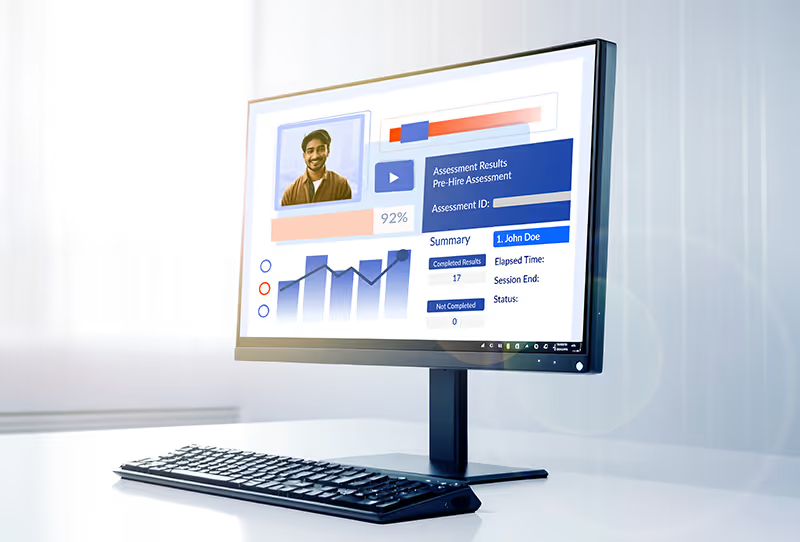
Skills testing, on its own, can make for a better match between employee and organization — creating a harmony between applicant skills and goals, and company needs. While we can’t promise some of these employees won’t eventually become dissatisfied with their jobs, we do see increased productivity when pairing the right candidate with the right role.
A separate McKinsey study found that by addressing just six employee factors — among them compensation, meaningful work, workplace flexibility, and career development — organizations could save up to an estimated $56 million annually.
Skill gap or a will gap? Sometimes, it’s both. And it’s up to companies and HR teams to support their team on all fronts.