

Hard skills tests give employers a clearer picture of candidate capability — far more than resumes, cover letters, or even behavioral tests. This guide explains what they are and how to use them to hire effectively.
- Hard skills tests help employers move beyond resumes and interviews by providing objective, job-relevant data on a candidate’s ability to perform specific tasks.
- These tests are best used early in the hiring funnel and should be tailored to the role — mixing and matching multiple-choice questions, software simulations or real-world tasks from multiple different subjects — to assess essential, measurable abilities.
- To use them effectively and fairly, employers should ensure tests are applicable to job duties, consistent, accessible, and part of a broader evaluation strategy that includes structured interviews and reference checks, avoiding overreliance on test scores alone.
Resumes can be embellished. Interviews can be rehearsed.
But hard skills tests can give you clear, objective insight into whether a candidate has the technical ability to succeed in the role.
Whether you're hiring a welder, a nurse, or a data scientist, job-relevant skills tests help you move beyond guesswork and toward evidence-based hiring decisions.
In this guide, we’ll walk you through what hard skills tests are, when and how to use them, how to interpret results, and how to avoid common mistakes.
What are hard skills?
Hard skills are specific, teachable abilities or knowledge sets that are typically acquired through education, training, or hands-on experience. They are measurable and often job-specific, meaning they can be tested or evaluated objectively.

These skills form the foundation of many roles, from operating a CNC machine to drafting a sales email to configuring network security. They often appear in job descriptions as "must-have" requirements, because they are necessary to perform core job functions.
Unlike soft skills or behavioral qualities, which are more subjective in nature, hard skills have right and wrong answers.
Here are just a few examples of hard skills, categorized by industry:
Healthcare: Medical terminology, EHR navigation, medication dosage calculations
Manufacturing: Blueprint reading, mechanical reasoning, welding techniques
Finance & Admin: Excel proficiency, typing speed, data entry accuracy
Customer Service: Multitasking, CRM usage, drafting customer emails
These are all measurable skills that can be verified through standardized or custom assessments.
What are technical skills?
Technical skills are a subset of hard skills that typically involve specialized knowledge in using specific tools, software, or methodologies. Think of them as the hands-on or computer-based skills that keep businesses running. These include things like:
- Operating manufacturing machinery
- Using medical coding software or EHR systems (like Cerner, Epic, or Medisoft)
- Troubleshooting IT networks
- Using CRM platforms like Salesforce
- Running SQL queries
In many industries, technical skills are evolving quickly alongside technology. That’s why regularly testing for them can help ensure candidates are up to date.
Why hard skills matter
According to a 2019 report by the Society for Human Resource Management, HR leaders viewed a nationwide skills shortage as one of the top concerns in the field. 75% of those experiencing recruiting difficulties at the time said there was a shortage of skills in candidates applying for job openings.
That’s a big problem, since possessing the hard skills needed for job duties is among the top predictors of good on-the-job performance.
When you test for hard skills, you can:
- Reduce time-to-hire by quickly filtering unqualified applicants
- Increase quality-of-hire by focusing on job-relevant ability
- Improve retention by aligning skills with job demands
What’s the difference between hard skills and soft skills?
Hard skills = What you can do (technical abilities)
Soft skills = How you work (communication, teamwork, adaptability)
When evaluating job candidates, employers often look at two key categories of competencies: hard skills and soft skills. Hard skills are usually the minimum requirements for performing a specific job and are often assessed through resumes, certifications, or pre-employment tests.
In contrast, soft skills are the interpersonal and behavioral traits that shape how someone works, collaborates, and communicates. These include qualities like emotional intelligence, adaptability, time management, leadership, and teamwork.
Unlike hard skills, soft skills are more difficult to quantify but are crucial in today’s workplace. They determine how effectively someone can work within a team, respond to feedback, or navigate conflict — qualities that are essential for long-term success in most roles.
While hard skills can get a candidate through the door, soft skills often determine how well they thrive and grow within a company. For example, a software developer may have strong coding abilities (a hard skill), but without good communication and problem-solving skills (soft skills), they may struggle to work on a cross-functional team or ascend to a managerial position.
A well-rounded hiring process evaluates both, using a mix of hard skills assessments, behavioral interviews, and reference checks — ensuring candidates not only can do the work, but can do it effectively with others.
What are hard skills tests?
Hard skills tests are structured assessments used to evaluate a candidate’s ability to perform job-specific tasks. These can take the form of multiple-choice quizzes, job simulations, open-ended responses, or even video prompts.
Unlike resume reviews or interviews, which rely heavily on subjective judgment, hard skills tests produce objective, comparable data. They give hiring managers a clearer picture of which candidates are genuinely qualified, allowing them to move forward with greater confidence.
Why hard skills testing matters in modern hiring
We’re in a hiring environment where resumes don’t always tell the full story. In fact, one study found that 78% of job applicants admit to stretching the truth on their resume.
Hard skills testing reduces your reliance on resumes and helps ensure fairness. It also expands access to candidates who may lack traditional credentials but are highly capable.
This is especially important in skills-based hiring initiatives, where the focus is on what candidates can do, not just where they’ve been.
How to use hard skills tests in the hiring process
There is no one right way to use hard skills when hiring. Some employers choose to use these tests at the beginning of their hiring process to filter out candidates without the right skills for the role. Other recruiters — like those hiring for entry-level jobs — may use assessments to gauge what skills new hires have, and where they may need some on-the-job learning or some extra pointers.
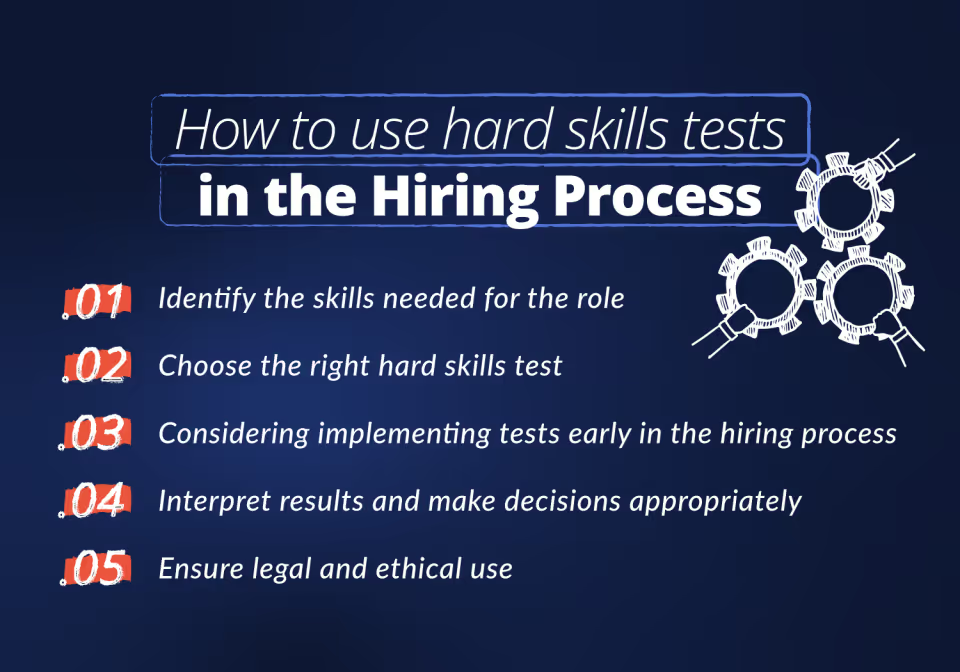
Regardless of how you use hard skills tests, there are some universal steps in the process to keep in mind:
- Identify the skills needed for the role
Start by breaking down the job description and talking to current team members. What tasks do they perform regularly? What tools do they use? What skills separate top performers from the rest?
For example, if you’re hiring for a healthcare role, you might assess medical terminology and coding. For a welding position, you might test blueprint reading or welding symbol recognition. For a data clerk , you might assess attention to detail or digital literacy.
- Choose the right hard skills test
Hard skills tests can either be standardized or custom. Standardized tests are fast to implement, cover a wide range of job functions, and are benchmarked against a wide test-taker library. Custom tests allow you to create hyper-specific assessments that measure your specific job or position requirements. Custom tests allow you to mix and match questions from different subjects or create your own questions from scratch.
Test formats may include:
- Multiple-choice questions
- Job simulations
- Short written responses
- Video questions
- Consider implementing tests early in the hiring process
Administering tests early in the funnel can save time and reduce bias. Rather than relying on degrees or years of experience, you’re screening based on real ability — improving hiring quality and ensuring a level playing field.
Make sure the test is intuitive, accessible, and relevant. Keep it around 30 minutes unless the role demands deep specialization. And always explain to candidates why they’re being tested and how it fits into the hiring process.
- Interpret results and make decisions appropriately
Once tests are complete, score them using auto-grading (for multiple-choice) or rubrics (for writing samples or code). You can benchmark results by comparing against current employees or setting thresholds (like 80% correct) for advancement.
But test scores shouldn’t be the only factor. Combine them with interviews, reference checks, and behavioral assessments. If a promising candidate scores slightly below the benchmark but has strong experience, they may still be worth considering.
- Ensure legal and ethical use
To stay compliant with EEOC guidelines, always use job-relevant tests. Don’t test for skills the job doesn’t require. Be transparent about how the results will be used, and ensure consistency across all applicants for the same role.
Hard skills tests that are validated and properly administered can actually reduce the risk of discrimination claims by ensuring all candidates are measured by the same objective standard.
Common pitfalls to avoid
When using hard skills tests in your hiring process, it’s important to avoid common missteps that can undermine their effectiveness.
One major pitfall is using tests that are too long or not directly relevant to the role, which can frustrate candidates and lead to drop-off.
Just as damaging is the tendency to over-rely on raw test scores while ignoring the broader context—such as a candidate’s learning potential, past experience, or performance in interviews.
Another common issue is a lack of consistency. Administering different tests for similar roles can introduce bias and erode fairness across your hiring funnel.
And once the test is done, the process shouldn’t end there. Failing to communicate next steps or share results with candidates leaves them in the dark and reflects poorly on your brand.
By steering clear of these pitfalls, you create a more respectful, transparent, and legally compliant hiring experience that works for both you and your applicants.
How to get started
Audit your current hiring funnel. Where are you losing time? Are you spending hours sorting through hundreds of applications and resumes? Are poor candidates slipping through the cracks? Are hires turning over quickly? Then choose a pilot role, select a relevant test, and begin testing.
Many employers start with a few high-volume roles or departments (like customer service or entry-level tech) and expand once they get used to the process.
By implementing hard skills testing, you’ll build a more reliable, equitable, and efficient hiring process — one that’s built on what truly matters: the ability to do the job.
FAQ
What are hard skills tests?
Hard skills tests are assessments that measure a candidate’s ability to perform specific, job-related tasks. These might include tasks like using Excel, writing code, reading blueprints, or operating specialized machinery. Unlike personality or behavioral assessments, hard skills tests focus on concrete, teachable abilities.
How are hard skills tests different from soft skills or behavioral assessments?
Hard skills tests evaluate technical or functional knowledge directly related to a job. In contrast, soft skills assessments look at interpersonal qualities like communication, teamwork, or adaptability. Behavioral assessments dig into traits and tendencies, such as whether a person is more detail-oriented or spontaneous. Each type of assessment has a different focus, but only hard skills tests show whether someone can do the actual work required on day one.
When should I use a hard skills test during the hiring process?
Employers can use hard skills tests at different stages of hiring. Some use them early on as a pre-screening filter to eliminate unqualified candidates. Others introduce them after an initial resume review or phone screen to help rank the top contenders. In some cases, companies use them right before extending an offer, as a final check to ensure a candidate has the technical know-how needed for the role.
Can hard skills tests replace interviews?
No — and they shouldn’t. Hard skills tests are a powerful complement to interviews, not a substitute. They help verify skills that candidates claim on their resumes and can guide the interview by highlighting areas of strength or concern. But interviews are still essential for understanding a candidate’s communication style, problem-solving approach, and cultural fit.
How long should a hard skills test be?
Most effective hard skills tests take between 15 and 30 minutes to complete. Anything much longer can frustrate candidates and lead to drop-offs, especially early in the hiring funnel. The goal is to keep the test focused on only the most essential skills for the role.
Can I make my own test?
Yes. With eSkill, you can create your own test — and in many cases, it’s a smart move. Customizing your test allows you to target the exact skills your team needs. If you do choose to build a test, make sure it’s clearly job-related, easy to understand, and free of unnecessary complexity or bias.
Are hard skills tests legal?
Hard skills tests are legal to use in hiring as long as they are directly relevant to the job, fairly administered to all candidates applying for the same role, and free from discriminatory language or requirements. In fact, when used correctly, skills tests can help companies reduce legal risk by standardizing evaluation criteria.
Do hard skills tests reduce bias in hiring?
Yes, they can. Because these tests focus on what a candidate can actually do — rather than where they went to school, who they know, or how they present themselves in a traditional interview — they remove many common sources of unconscious bias. This creates a more level playing field for candidates from diverse backgrounds.
What if a great candidate performs poorly on the test?
No hiring tool is perfect. If a candidate with strong credentials underperforms, it’s worth considering whether nerves, test design, or misunderstanding the instructions played a role. Employers should use skills tests as one data point among several — not the sole deciding factor.
How do I get started with hard skills assessments?
Find a pre-hire assessment provider who fits your needs! eSkill specializes in customizable, hard skills assessments that help companies identify candidates who can do the job. Reach out to our team today to learn how to get started and improve your hiring.
Talk to sales to learn more about how the eSkill platform can help you hire.