
While behavioral assessments can provide a little more insight into your candidates than skills testing alone, hard skills tests are by far the better predictors of job performance.
- Technical skills tests are significantly more predictive of job performance than behavioral assessments, according to major meta-analyses by Sackett (2022) and Schmidt & Hunter (1998).
- Behavioral assessments can add value — especially for customer-facing or emotionally demanding roles — but should be used as a supplement, not a replacement.
- Employers should prioritize technical tests, especially for roles in healthcare, engineering, trades, customer service, and logistics. Behavioral assessments should only be added when justified by the role’s requirements, and when they won’t overburden candidates or add unnecessary costs.
Almost everyone knows their Myers-Briggs type. Are you an INTP? An ESTJ, perhaps? Or maybe you’re part of the ultra-rare INFJ club?
An article in Psychology Today states that over 80% of the Fortune 100 companies use the Myers-Briggs test within their organizations.
When it comes to hiring, however, they’re about as predictive of your job performance as your astrological chart (Can someone tell us what being an Aries sun, Aquarius moon, and Cancer rising means for hiring purposes?). Not only does the MBTI test lack predictive validity, it also lacks test reliability: about 50% of people get a different type when retaking the test after a few weeks.
Not only is it not predictive, but the Myers-Briggs test wasn’t even designed by psychologists. It was designed by Katharine Cook Briggs and her daughter, Isabel Briggs Myers (no flak intended, just making a point) during World War II on the basis of Carl Jung’s theory of psychological types. And while well-intentioned, hiring managers everywhere have taken this personality assessment and ran with it.
We won’t cover a string of other problems with the MBTI since that’s been done extensively elsewhere, but we will describe what sorts of tests do impact hiring outcomes. And we hate to say it, but the Myers-Briggs test, DiSC, and other personality tests don’t predict much when it comes to hiring.
The only personality test to have some predictive validity when it comes to hiring outcomes is one framed on the Big Five traits — that is, Openness, Conscientiousness, Extraversion, Agreeableness, and Neuroticism (OCEAN). And that’s only when the questions in the personality test are overtly contextualized for work situations (like adding “at work” at the end of a question, like “Do you maintain an organized schedule…at work?”).
And further, the only work-contextualized major trait to have some validity across job types is Conscientiousness (the tendency to be responsible, organized, and thorough with your work) in the Big Five framework, followed by emotional stability (Neuroticism), and Extraversion for some people-facing roles — and that’s pretty much it when it comes to behavioral assessments.
Add on the fact that candidates can lie on written behavioral assessments to appear more aligned to the role or company culture — and they do, by the way (especially since these tests are typically self-assessments) — and the predictiveness of these assessments falls even lower.
To assess whether a candidate’s behavior aligns with what success looks like in the role — because soft skills, whether adaptability or social intelligence, are still important in jobs — other measures are needed. But if you shouldn’t use personality tests, what else is out there?
Hard skills tests should form the foundation of your candidate evaluation. They give you data on whether someone can actually do the job at hand — and that should be the first step in any hiring practice, where applicable. That’s the “hard skills” step of the process.
But once you’ve narrowed your pool, there are tools that can help tease out how candidates might approach the work — their personality, communication style, and how they fit into your team.
For example, you could implement structured interviews with consistent, job-relevant questions and behavioral scoring rubrics. They reduce bias and keep the focus on what matters — without overburdening your candidate with an extra test.
And if you’re keen on including soft skill assessments — integrity tests, emotional intelligence tests, and situational judgment tests (SJTs) are all more valid predictors of job success outcomes than your usual personality tests, according to Sackett’s 2022 meta-analysis of job predictors.
All that said, here’s a pertinent reminder: behavioral and emotional assessments are not highly valid on their own.
The best hiring processes combine multiple hiring predictors — like structured interviews and job knowledge tests — and don’t overburden the candidate or the hiring manager. And the very best job predictors? Behind structured interviews, it’s job knowledge tests and work sample assessments.
Now that we’ve touched on everything that we’re going to cover, let’s get into the specifics.
What is a technical skills test?
A technical skills test is an assessment used to evaluate a candidate’s ability to perform specific, job-related tasks that require specialized knowledge or expertise.
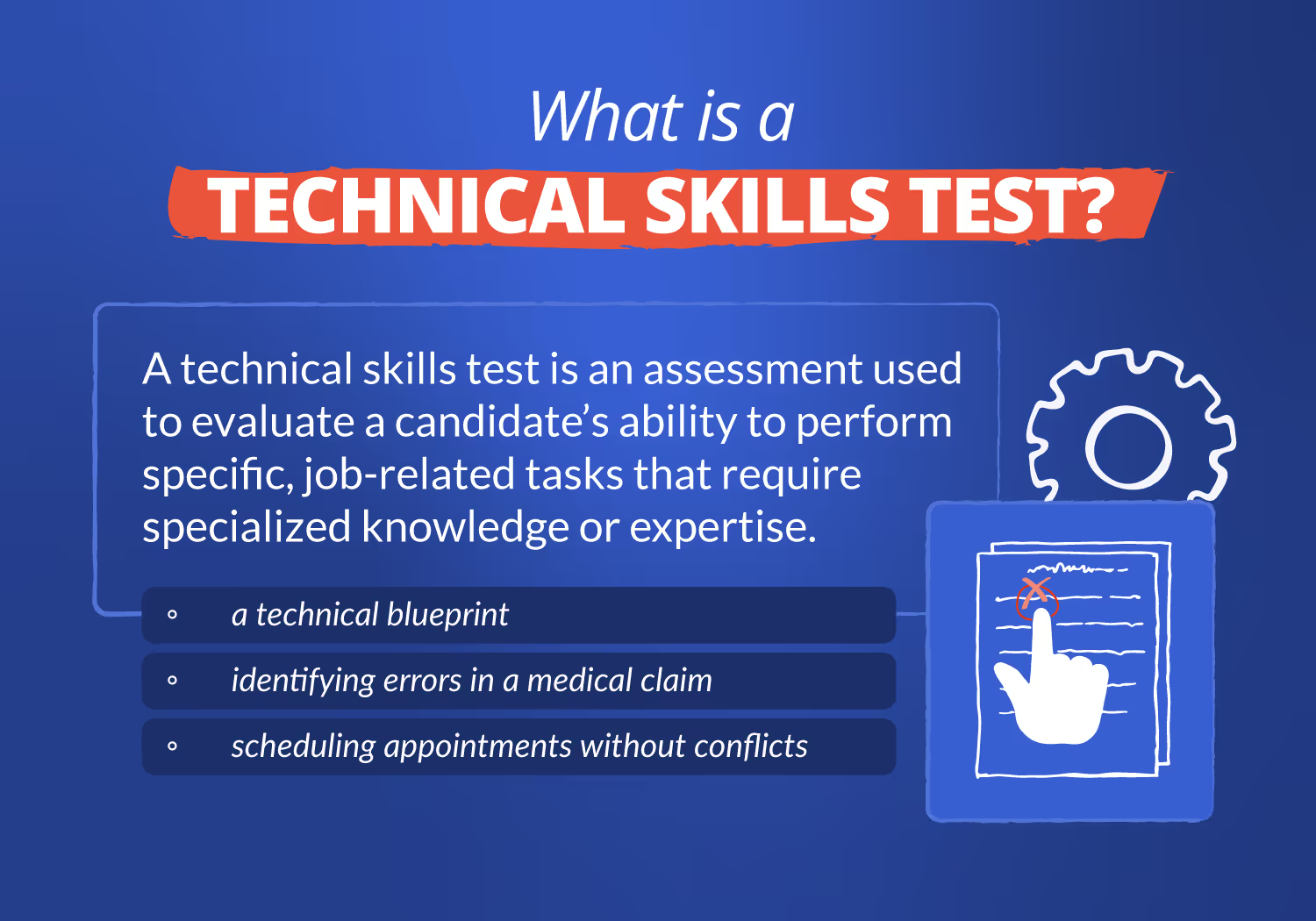
These aren’t abstract personality questions — they’re practical evaluations tied directly to the work at hand.
Depending on the role, a technical skills test might include interpreting a technical blueprint, processing a government benefits application, identifying errors in a medical claim, scheduling appointments without conflicts, or otherwise answering industry-specific questions. For roles in fields like IT, healthcare, finance, engineering, or skilled trades, these tests are especially useful for validating whether a candidate can perform the critical tasks required on day one.
Employers use technical skills tests both to confirm competence and to predict job performance with greater accuracy. Unlike resumes or interviews — which are prone to exaggeration and bias — skills tests offer objective data that can help hiring teams make confident, evidence-based decisions.
What is a behavioral test?
A behavioral test is a tool used to evaluate a candidate’s personality traits, soft skills, and workplace behavior.
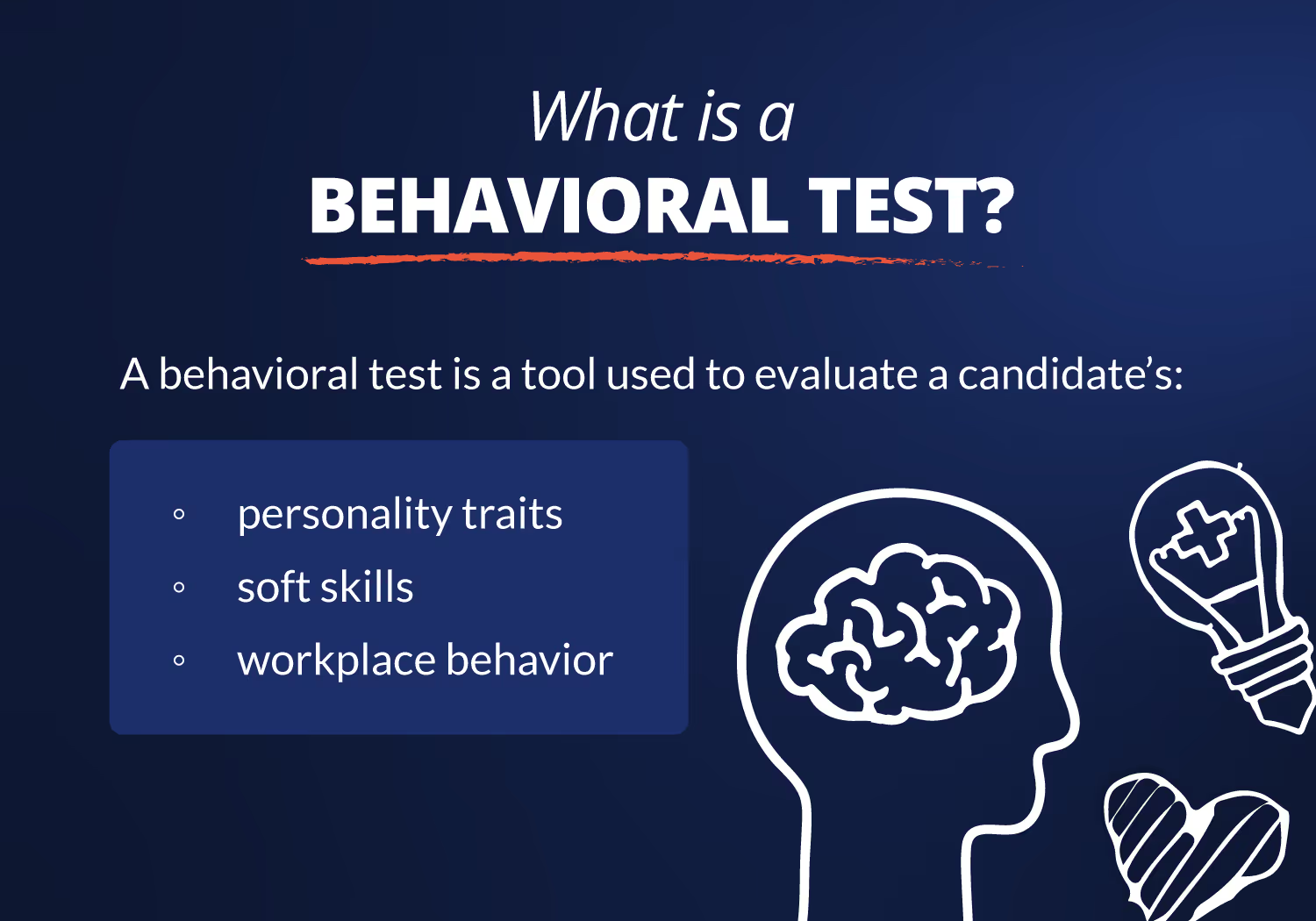
Behavioral tests are usually self-report questionnaires or scenario-based assessments. For example, they could include Likert-scale questions (like ranking yourself from 1-10 from “strongly agree” to “strongly disagree” on statements like “I enjoy taking the lead in group settings”), situational judgment tests (SJTs) which evaluate how a person responds to work-related scenarios, and personality frameworks like the Big Five (OCEAN).
These, like most skills tests, are often delivered online and take 10–30 minutes to complete.
However — some, like the Myers-Briggs assessment, show no predictive validity for job outcomes. The personality trait to show the most meaningful amount of predictive validity across job types is the Conscientiousness trait from the Big Five test, when contextualized for work — with a validity coefficient of 0.25. Contextualized Neuroticism (or “emotional stability”) and Extraversion can both have a small correlative impact on hiring, with validity coefficients of 0.23 and 0.21, respectively. Note: a validity coefficient under 0.20 is generally considered “weak” in terms of correlation.
One study found that while Conscientious (one of the dimensions on the popular Big Five personality test) was the top valid predictor across job roles, Extraversion was also a valid predictor for two positions involving social interaction: those of managers and salespeople.
Predictive validity: what the research says
According to both Paul R. Sackett’s 2022 meta-analysis and Schmidt & Hunter’s 1998 meta-analysis, skills tests outperform behavioral assessments in terms of validity co-efficients. By a lot.
Structured interviews, followed by job knowledge tests, empirically keyed biodata (if you’re wondering what that is, we explain it more thoroughly in another blog), work sample tests, and cognitive ability tests, all outperform situational judgment tests and work-contextualized personality traits, including Conscientiousness, Extraversion, and Agreeableness — according to Sackett’s meta-analysis.
To put it plainly: job-relevant technical tests (like work samples or knowledge assessments) are much better predictors of future job performance than personality tests, all ranking above 0.40 for validity coefficients.
Even hobbies contextualized to job responsibilities can be better predictors than the typical personality test (Does your content writer like to read, for example?).
That said, combining question types for both hard and soft skills — provided you have the bandwidth for that and it’s not an unnecessary burden on your candidate — could give you the most insightful results, especially for particular customer-facing or empathy-driven roles.
What about the type of job?
You may wonder: what about when behavior is the job? Like in customer-facing roles?
While technical skills tests are predictive for many types of roles, behavioral tests might be a little bit more useful as an addendum when it comes to certain roles.
Technical skills tests are often more predictive for:
- Engineering, IT, and software development roles
- Healthcare roles (e.g., nurses, coders, lab techs)
- Skilled trades (e.g., electricians, welders)
- Customer service (when testing product knowledge or computer navigation)
- Manufacturing and logistics
These roles often require hard, measurable skills — so testing those directly gives you a clearer signal.
Behavioral tests could be more useful when:
- Culture fit and interpersonal dynamics are crucial (like in small startups or customer-facing roles)
- The job requires high emotional intelligence or self-regulation (for example, therapists, salespeople, managers)
- You're choosing between otherwise technically qualified candidates
Even then, behavioral tests should usually be used as a supplement — not a standalone hiring tool.
Here’s an example of how a behavioral test could work: for a customer service role, a behavioral test might evaluate empathy, patience, and problem-solving under pressure, because a candidate who scores high in conscientiousness and agreeableness may be better suited to the demands of the job. However, a situational judgment or integrity test might work better in this situation than a stand-alone Big Five personality test.
Why skills tests?
Why skills tests at all? Why not just use the resume, the interview, and be done with it?
Well, depending on the role, skills testing might be the most streamlined way to find good candidates. Especially in the face of AI resumes and cover letters flooding ATS screeners and recruiters, skills tests can help filter the noise and allow truly skilled candidates to shine.
They’re among the most predictive hiring tools available.
Decades of research confirm it: skills tests — including work sample tests and job knowledge assessments — are among the most reliable predictors of job performance. The two landmark meta-analyses by both Schmidt & Hunter (1998) and Sackett (2022) found that work samples and cognitive ability tests outperform interviews, education, and even personality assessments in forecasting job success.
They help you hire faster — and fairer.=
For high-volume, high-turnover, or hard-to-fill roles, skills tests allow you to quickly screen in overlooked talent — like career switchers, veterans, or candidates without traditional degrees — based on what they can do, not what’s on their resume. This approach supports skills-based hiring, a growing trend backed by major employers and policymakers alike.
They catch red flags that resumes and interviews miss.
About 78% of candidates admit to stretching the truth on their resumes. Interviews can be rehearsed — or swayed by charisma. But job-relevant skills tests, especially ones with anti-cheat tools, make it much harder to fake competence.
They reduce bias and subjectivity.
Unstructured interviews and gut-feel hiring decisions are breeding grounds for unconscious bias. Skills tests offer a more objective, data-driven way to compare candidates on a level playing field — especially when paired with structured interviews and clear rubrics.
Actually predictive types of behavioral assessments
Now, when it comes to behavioral tests, they fall on the far end of the predictiveness scale. However, that doesn’t mean they can’t serve as a good addition to your hiring process — in fact, combining different assessors — interviews, hard skills tests, and more — can deliver one of the more predictive hiring outcomes, rather than each alone.
Be sure to consider the role you’re hiring for and take into account which traits would lead to the most on-the-role success.
Integrity tests
Integrity tests are designed to evaluate a candidate's honesty, reliability, and potential for engaging in counterproductive work behaviors such as theft, absenteeism, or rule-breaking.
Research shows that integrity tests have moderate to high predictive validity for counterproductive behaviors and modest validity for overall job performance, making them especially valuable in roles where trustworthiness is crucial, such as retail, finance, and security positions.
Emotional intelligence assessments
Emotional intelligence (EI) assessments may measure self-reported traits like self-awareness, empathy, and emotional regulation, treating EI as a stable personality construct rather than a cognitive skill. These assessments often overlap with broader personality traits (such as extraversion and neuroticism). While they may provide some insight into interpersonal dynamics or leadership potential, they are generally not strong standalone predictors of hiring success and are best used alongside other tools.
Situational Judgment Tests
Situational judgment tests (SJTs) present candidates with hypothetical work-related scenarios and assess how they would respond.
These tests come in two main forms: knowledge-based SJTs, which ask candidates to identify the most effective response, and behavioral tendency SJTs, which ask how candidates are likely to behave in the given situation. SJTs generally have moderate predictive validity for job performance.
Knowledge-based SJTs tend to align more with cognitive ability, making them useful for roles requiring sound judgment and decision-making, while behavioral tendency SJTs are more reflective of soft skills and interpersonal behavior.
Should I include a behavioral assessment?
Behavioral assessments can seem like a thoughtful addition to your hiring toolkit — and in the right circumstances, they are. But used indiscriminately, they can waste time, inflate costs, and even open you up to legal risk.
Here’s when they do and don’t make sense.
Skip them when they increase testing fatigue.
If your hiring process already includes a technical or cognitive assessment, adding a behavioral component can push the total time over the acceptable threshold.
Skip them if you're on a tight budget.
While behavioral tests might be interesting, they offer low standalone predictive validity — meaning they’re poor predictors of job performance on their own. Meta-analyses consistently show that cognitive ability and work sample tests outperform personality tests in forecasting job success.
They can also introduce compliance risk. Because personality and behavior-based tests often lack a clear tie to specific job duties, they may fail the EEOC’s requirement for job-relatedness and business necessity under Title VII.
Do use them when behavior is core to the job.
In customer-facing, leadership, or team-based roles, assessing traits like empathy, collaboration, or stress tolerance can complement a hard skills test. But even then, keep the behavioral assessment brief and clearly aligned to job success. Pairing it with structured interviews or situational judgment tests (SJTs) often yields better results.
Do use them to break a tie.
If you’re down to two top candidates with similar technical scores, a behavioral assessment can serve as a helpful tiebreaker — especially when it’s job-relevant. Just make sure you're transparent about how it factors into your decision-making.
If you’re using assessments at all, behavioral assessments might seem like a thoughtful add-on to your tools.
The final verdict on behavioral tests vs. technical skills tests
If your goal is to predict who can actually do the job, technical skills tests — like job knowledge assessments or work sample tests — should be your go-to. Backed by decades of research, they consistently outperform behavioral assessments in terms of predictive validity and job relevance.
That said, behavioral tests aren’t without value. When used strategically — for example, to assess leadership potential, cultural alignment, or interpersonal style — they can offer helpful context, especially in later stages of the hiring process or for people-facing roles.
But on their own, behavioral assessments are not strong predictors of performance and should never be the sole basis for a hiring decision.
To wrap all that info up in a neat little package: if you're building a fair, effective, and evidence-based hiring process, start with job-relevant skills tests. Use behavioral assessments only when they serve a specific, validated purpose — and never at the expense of candidate experience, budget, or compliance.
And if you’re going to ask a candidate what their Myers-Briggs type is, you might as well ask them what their star sign is as well.
Talk to sales to learn more about how the eSkill platform can help you hire.