

See how you can increase your recruiting ROI by reducing the risk of bad hires and streamlining your hiring process.
Screening candidates in 2025 is not the same as 2024, 2023, or any other time in history, for that matter. Especially when you consider AI resumes and cover letters overwhelming recruiters, and recruiters firing back with their own AI-powered screeners and interview tools.
We have some great news: there’s a better way to identify who is actually the right fit for a role. And no, it doesn’t involve using a stuttering AI-generated humanoid agent awkwardly delivering auto-generated questions to an apprehensive human candidate.
If you landed on this page, you likely already know eSkill champions hard skills pre-employment testing as a data-backed solution to hiring dilemmas (if you didn’t know, now you do!). And you’re curious about exactly how much eSkill can save you. That’s why we launched our ROI calculator: to give you a transparent look into what you can save, based on your organization’s hiring practices and needs. Take a look, plug in some numbers, and play around with the output.
In the meantime, let’s review what ROI in recruitment even means — and why it’s important, both for a company’s HR team and the bottom line.
What is ROI in recruitment?
In a nutshell, ROI in recruitment is your return on your hiring efforts, relative to the costs involved.
It’s a number that indicates how effective (and efficient) your hiring procedures are, and can additionally give you insight into the value of an employee against the costs it took to hire and retain them.
The better the hire, plus the less time and resources it took to find that excellent hire, means the higher your recruiting ROI.
What’s the value behind a “better hire”? Your return might include, to put it in utilitarian terms, increased revenue and productivity. But it also might mean reduced turnover costs from hiring individuals who are happy with their jobs and their teams, plus improved team performance from hiring individuals who work well together. Shorter time-to-fill can also translate to less operational disruption for a company, keeping your return on hiring high.
Your costs, on the other hand, might include the amount you spend on posting to job boards or running ads, your recruiters' salaries or fees you pay a staffing agency, the cost of background checks, time your team spends reviewing resumes or interviewing the candidates, onboarding and training expenses, and the cost of your hiring software, like your ATS. And it could also involve the costs in retaining a hire — like benefits packages and bonuses.
Why does ROI in recruitment matter?
Having solid data behind your ROI numbers in recruitment can help justify hiring budgets. Not only that, but good data can help you identify which sourcing strategies work best (what job boards are resulting in the best quality hires?) and pinpoint hiring processes that need improvement.
However, ROI in recruitment, like ROI for any siloed company department, can actually be kind of difficult to measure. Financial benefits from a hire can manifest in many different ways — you can’t quite put an exact number to “increased productivity” or bad hires avoided.
But there are some numbers that are pretty clear. According to the SHRM, the average cost-per-hire is nearly $5,000. And the cost to replace a bad hire averages around $52,000, according to McKinsey research.
How do you maximize ROI in recruitment?
If you want to maximize your ROI on recruitment, you can focus on a few different efforts.
Your top-of-mind goal should always be improving the quality of your hires.
If you can do that, and also reduce time-to-hire and recruitment costs in the process, then you’re on a sure path to maximizing your recruiting ROI.
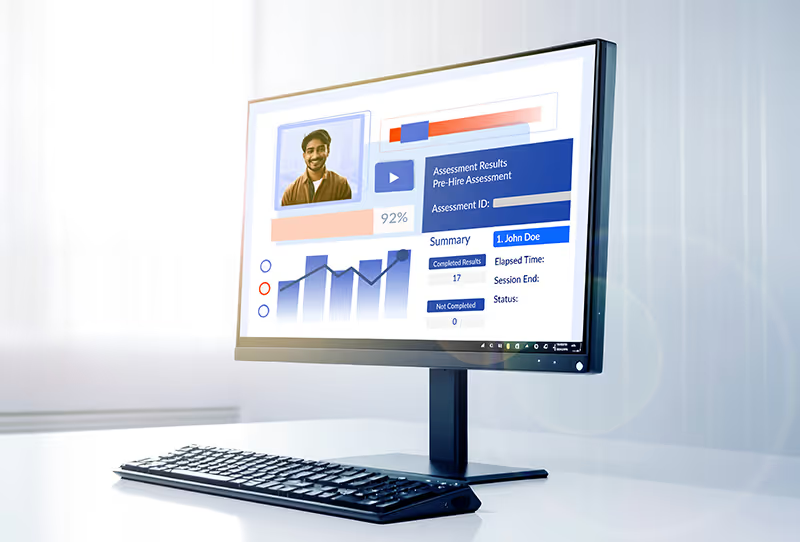
One good way to improve the quality of your hires, reduce time-to-hire, recruitment costs, and turnover? Using technology and automation. This is especially useful in high-volume recruiting and as the total number of resumes submitted to roles steadily increases. On top of an ATS, implementing a pre-employment skills testing platform, in the right place in the hiring process, can help you screen out unqualified candidates to reduce the workload on your recruiters and replace wasted efforts in the interview process.
Here are some additional tips to maximize recruitment ROI:
Improve candidate quality early
Ensuring only high-quality candidates make it through at the beginning of your hiring process. That means only posting to job boards that your ideal candidates frequent, ensuring your job descriptions are specific about skills required, and using skills assessments, if applicable, early in the hiring process to determine candidate fit.
This is especially important the more candidates use ChatGPT to create custom-fit resumes and cover letters.
Reduce time-to-hire
Every day an essential role goes unfilled, your company cries another tear formed from molecules of lost productivity. You can speed things up by automating resume screening or scheduling, sending out assessments efficiently, using structured interviews to quickly compare candidates, and keeping your ATS organized and up-to-date.
Cut low-value spending
Audit where your recruitment dollars go. Are you paying to appear on job boards that only yield low-quality applicants?
Try tracking cost-per-hire by source and double down on the highest-performing channels. You might not post blue-collar job openings on LinkedIn, for example. But you might post them on Indeed.
Additionally, you can audit your tech stack. Are certain tools overlapping for specific functions? Would you save time by using platforms that integrate directly into your ATS? Consider consolidating platforms and switching to vendors that bundle more features (like testing and video interviews).
Increase retention of new hires
Even an amazing hire will cost you if they leave too soon. You can boost retention by improving onboarding, ensuring cultural fit through values-based hiring, and providing clear career paths and feedback early.
Align hiring with business goals
Don’t hire reactively. Rather, forecast talent needs based on growth or product timelines. When you know what roles you’ll need to hire for far down the line, you can prioritize longer hiring processes for roles that generate the most revenue, and you can additionally plan your hiring process in advance for high-volume roles.
Track metrics consistently
You can’t maximize ROI if you’re not measuring it. Make sure you’re measuring key metrics, including cost-per-hire, time-to-fill, quality-of-hire, turnover rates, and employee lifetime value.
It might take time to capture the data you need in recruiting and analyze it effectively, but it’s worth it. Ensure any job board you post to provides robust reporting — and that goes for every tool in your HR tech stack, too.
How the eSkill ROI calculator works
We’ve finally made it full circle — to the eSkill ROI calculator.
The eSkill ROI calculator works by taking quite a few numbers into consideration, so you can get the most accurate prediction of your ROI to share with your HR team and your company leaders.
These include: How many people work in your organization? How many hours of your HR team’s time go into each candidate that applies to your company? How much is your HR team getting paid per hour? How many applicants are you getting per job role?
Are you planning on using pre-hire tests as a screening tool, or simply to gauge the abilities of your applicants to get a more rounded view of their potential?
And what’s your cost of a bad hire? How much did it cost to hire them, onboard them, and pay them salary before they turned over?
Then we use our formula to take all that together and produce your ROI saving estimate, which can be many times over what you’re currently averaging for recruiting ROI.
Why pre-employment testing?
Pre-employment testing is proven to maximize recruitment ROI and help you make confident, capable hires. Not only does it speed up the hiring process, but candidates hired using pre-employment testing are more likely to stay at their jobs longer.
Hear directly from one of our many customers to learn exactly how valuable eSkill pre-hire assessments are to their organization.
And if you haven’t already, we invite you to use the ROI calculator to figure out how much you can save with eSkill.
Talk to sales to learn more about how the eSkill platform can help you hire.